
Quick Summary: Crying is a natural, healthy human response that serves important emotional and physical functions. Research shows that while crying may initially feel uncomfortable, it helps regulate emotions, signals a need for support, and can improve mood after the tears subside. Cultural stigma aside, allowing yourself to cry is not only okay—it’s an essential part of emotional well-being.
Here’s something most people won’t admit: they worry about crying. Not just crying in public—though that’s part of it—but crying at all. Is it weak? Does it mean something’s wrong with you? Should you fight it back?
The short answer? No, no, and definitely no.
Crying is one of the most misunderstood human behaviors. Despite being universal—every culture, every age group, every gender cries—it still carries baggage. Some people were told as children that crying meant weakness. Others learned to suppress tears to avoid judgment.
But here’s what the research actually shows: crying isn’t just okay. It’s essential. Emotional tears serve functions that go beyond simply expressing sadness, and understanding why humans cry can fundamentally change how we view this natural response.
The Science Behind Why Humans Cry
Humans produce three distinct types of tears, each serving a specific purpose. The first two—basal tears and reflex tears—are purely functional. Basal tears keep eyes lubricated continuously, while reflex tears flush out irritants like smoke, dust, or that rogue eyelash.
Then there are emotional tears. These are uniquely human.
According to Harvard Health, emotional tears contain a different chemical composition than other tear types. While basal and reflex tears are 98% water, emotional tears flush stress hormones and other toxins from the body. This isn’t just poetic language—it’s measurable physiology.
The National Institute of Mental Health notes that emotional regulation difficulties appear across various conditions, from everyday stress to more serious concerns like borderline personality disorder. Crying represents one of the body’s built-in mechanisms for managing overwhelming feelings.
But that doesn’t mean every crying episode feels helpful in the moment.
Does Crying Actually Make You Feel Better?
Here’s where things get interesting. The relationship between crying and mood isn’t as straightforward as “cry it out and feel better.”
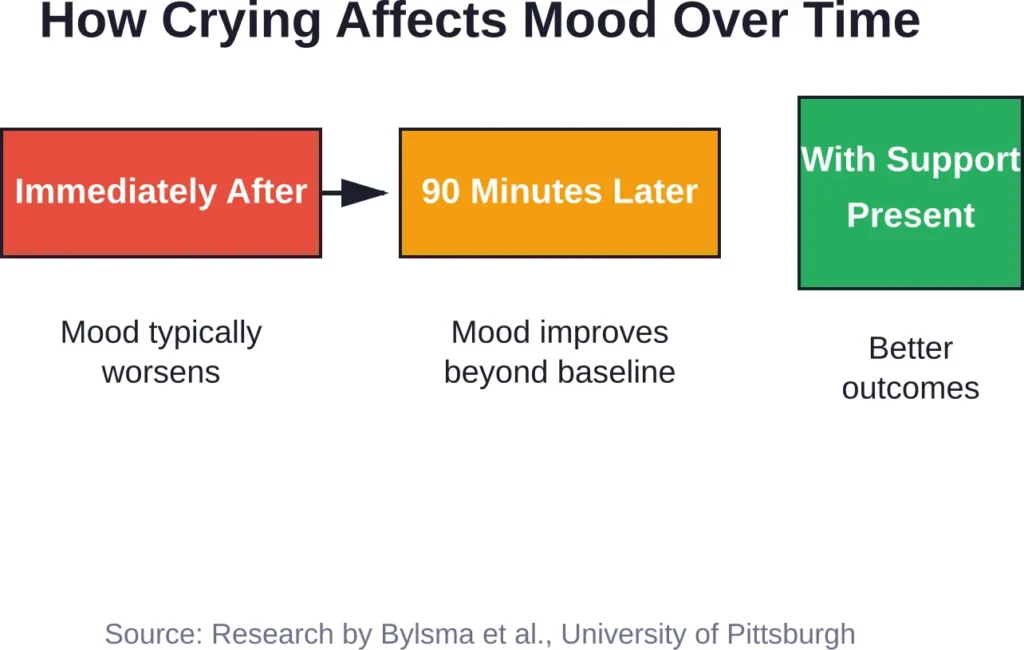
Research from the University of Pittsburgh and other institutions found something surprising: crying often makes people feel worse immediately afterward. One key study tracked participants’ moods and found that right after crying, most people reported feeling more negative.
But wait 90 minutes.
That same research discovered that 90 minutes after crying, participants felt better than they did before they started crying. The tears had done their job—they just needed time to work.
The data gets more nuanced when you look at everyday life versus controlled studies. In research across 35 countries, most men and women reported feeling better after crying episodes. However, in everyday diary studies, a smaller percentage of crying episodes were associated with beneficial mood effects—approximately 30% in one analysis.
So what explains the difference?
Context matters enormously. Crying alone versus crying with supportive people present produces different outcomes. Crying when you feel safe enough to express emotion differs from crying when you’re simultaneously trying to suppress it. And crying that leads to problem-solving or support differs from crying that simply happens and ends.
Why Some People Think Crying Isn’t Okay
If crying is natural and beneficial, why do so many people feel ashamed of their tears?
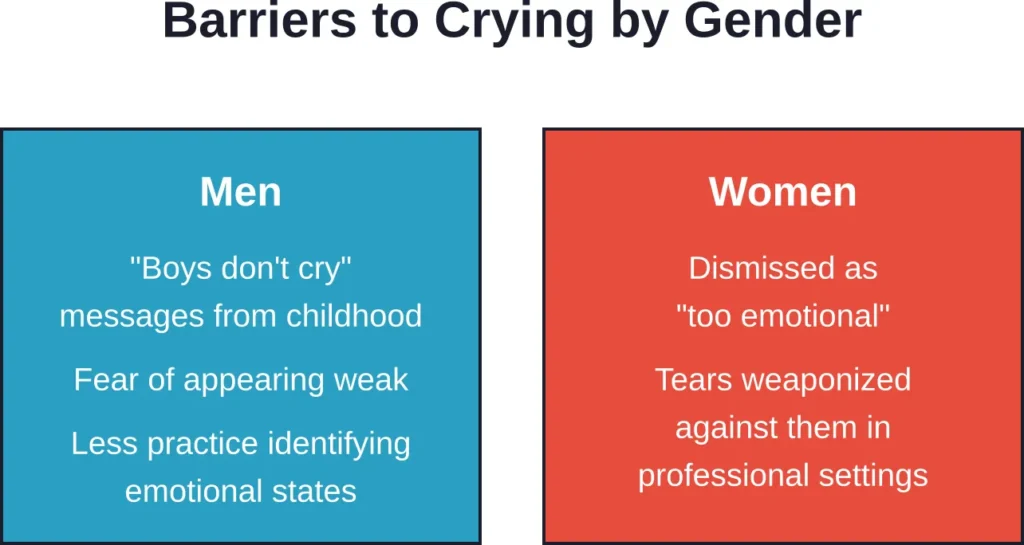
Cultural conditioning plays a massive role. Many societies—particularly Western ones—have historically valued emotional restraint, especially for men. Boys often hear messages like “big boys don’t cry” or “man up.” Girls may be labeled as “too emotional” or “dramatic” when they cry.
These messages don’t just disappear in adulthood. They become internalized beliefs that shape how people respond to their own emotional experiences.
Some research suggests that people who actively try to suppress crying did so because they didn’t want to cause distress in others or increase their own negative feelings. The impulse to protect others from discomfort—or to protect oneself from vulnerability—overrides the body’s natural coping mechanism.
But there’s another factor at play: social context. People cry more freely in some settings than others, and that’s not necessarily about shame. It’s about safety.
According to the National Institute of Mental Health, when people experience stress—whether from performance pressure, traumatic events, or major life changes—the body activates its stress response system. Crying can be part of that response, signaling that the nervous system is overwhelmed and needs support.
The problem isn’t crying itself. The problem is environments where expressing that signal feels dangerous or inappropriate.
The Physical and Emotional Functions of Crying
So what exactly does crying do?
From a physiological standpoint, crying activates the parasympathetic nervous system—the part of the nervous system responsible for rest and recovery. After an initial activation period, heart rate typically slows, breathing deepens, and the body shifts toward a calmer state.
The chemical composition of emotional tears also matters. As Harvard Health notes, these tears carry stress hormones and toxins out of the body. While more research is needed to fully understand this mechanism, the current evidence suggests crying literally removes stress-related chemicals from the system.
From an emotional standpoint, crying serves multiple purposes:
- It provides a pressure-release valve when emotions build beyond manageable levels
- It communicates distress to others, potentially activating social support
- It forces a pause in whatever activity is happening, creating space for processing
- It validates internal experience—the tears confirm that yes, this matters
Research published through the National Library of Medicine explored whether crying functions as self-soothing behavior. The findings suggest it’s more complex than a simple yes or no. Crying can be self-soothing, but it depends on multiple factors: the reason for crying, the social context, whether the person feels safe, and what happens after the tears stop.
This explains why some crying episodes feel cathartic while others feel frustrating or shameful.
When Crying Signals Something More Serious
While crying is normal and healthy, patterns of excessive crying can sometimes indicate underlying concerns that deserve attention.
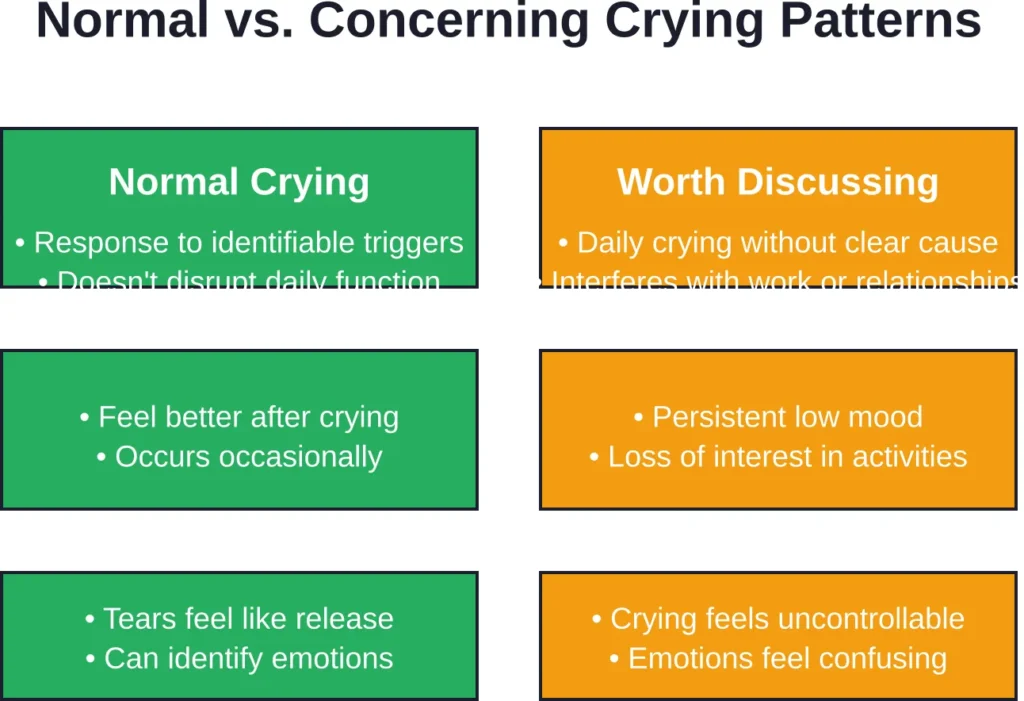
The National Institute of Mental Health notes that children and adults alike can experience anxiety, depression, or other conditions that affect emotional regulation. If someone finds themselves crying daily without clear triggers, or if crying episodes interfere with daily functioning, that’s worth discussing with a healthcare provider.
Seasonal Affective Disorder, for instance, can cause mood changes including increased tearfulness when daylight hours decrease. Borderline personality disorder involves difficulty regulating emotions, which can manifest as frequent, intense crying episodes. Stress that goes unmanaged over time can lead to emotional exhaustion where tears come more easily.
The question isn’t “Is crying okay?” but rather “Is the underlying cause of frequent crying being addressed?”
Here’s a simple framework: occasional crying in response to sad events, stress, joy, or overwhelm is completely normal. Frequent crying that disrupts life or occurs without identifiable cause deserves professional evaluation—not because crying itself is the problem, but because it may point to something treatable.
How to Support Someone Who’s Crying
Watching someone cry can feel uncomfortable. Many people’s first instinct is to stop the tears—to say “don’t cry” or “it’s okay” or immediately try to fix whatever’s wrong.
But here’s what research on emotional processing suggests: those responses, while well-intentioned, often make people feel worse. Telling someone not to cry implies their tears are inappropriate or unwelcome. Rushing to fix things can communicate that their emotions are too much to handle.
Better approaches include:
- Simply being present without judgment
- Offering tissues and physical comfort if the person is receptive
- Saying something like “I’m here” or “Take the time you need”
- Avoiding the urge to explain away their feelings
- Asking “What do you need right now?” rather than assuming
According to child development specialists, this principle applies equally to children. When a child cries, the goal isn’t to stop the tears as quickly as possible. It’s to help them feel safe enough to experience and process the emotion.
The World Health Organization’s guidance on mental health support emphasizes that validating emotions—including tears—represents a fundamental component of psychological first aid. People need to know their responses are understandable and that they’re not alone.
Different Contexts for Crying
Not all crying happens for the same reason, and recognizing different contexts helps normalize the full range of emotional tears.
Crying from Sadness or Grief
This is what most people think of first: tears in response to loss, disappointment, or painful situations. These tears often come with a need to process difficult realities and may benefit most from supportive presence rather than problem-solving.
Crying from Frustration or Anger
Some people cry when they’re furious. This can feel particularly frustrating because the tears get misinterpreted as sadness when they actually signal rage or powerlessness. These tears often accompany situations where someone feels unheard or unable to effect change.
Crying from Joy or Awe
Weddings, graduations, reunions, breathtaking natural beauty—all can trigger tears. These aren’t sad tears but overwhelm tears, when positive emotion exceeds containment capacity. They’re just as valid as any other type.
Crying from Physical Pain
The body doesn’t always distinguish between physical and emotional overwhelm. Severe pain can trigger tears even without emotional distress, and that’s a normal nervous system response.
Crying from Stress or Exhaustion
Sometimes tears come not from a single event but from accumulated pressure. These are the tears that seem to come out of nowhere, often over something minor, because they’re actually about everything else underneath.
| Crying Context | Common Triggers | What It Signals |
|---|---|---|
| Sadness/Grief | Loss, disappointment, rejection | Need to process difficult emotions |
| Frustration/Anger | Feeling unheard, powerlessness | Blocked goals or expression |
| Joy/Awe | Weddings, beauty, reunions | Positive emotional overwhelm |
| Physical Pain | Injury, illness, exhaustion | Nervous system activation |
| Accumulated Stress | “Small” final straw | System overload |
Practical Ways to Allow Yourself to Cry
If someone has spent years suppressing tears, allowing them doesn’t always come naturally. Here are practical approaches:
Create safe spaces. Identify times and places where crying feels lower-risk. This might be at home alone, during therapy sessions, or with specific trusted people.
Notice the urge to suppress. Many people automatically tighten their throat, hold their breath, or distract themselves when tears threaten. Simply noticing this pattern creates the possibility of choosing differently.
Reframe what crying means. Instead of viewing tears as weakness or loss of control, recognize them as the body’s stress-management system doing its job.
Use deliberate triggers if needed. Some people find it helpful to watch sad movies or listen to emotional music when they sense unexpressed emotion that needs release.
Talk back to the critical voice. When thoughts like “this is stupid” or “I shouldn’t be crying” arise, practice responding with “crying is normal” or “my emotions are valid.”
The World Health Organization’s stress management resources emphasize that emotional expression—including crying—represents a healthy coping strategy when paired with other supports like social connection, physical activity, and adequate rest.
The Gender Dimension of Crying
Research consistently shows that women cry more frequently than men in most cultures, but the reasons are complex and not purely biological.
Testosterone appears to inhibit tears to some degree, while prolactin—higher in women—may facilitate crying. But social conditioning likely plays the larger role. Boys and men face stronger cultural prohibition against crying, learning early that tears equal femininity or weakness.
This doesn’t mean men don’t need to cry. It means they’ve often had less practice allowing it and face more judgment when they do.
The data from the 35-country study mentioned earlier showed that both men and women report feeling better after crying—gender doesn’t change the emotional benefit. What changes is how comfortable each gender feels accessing that release.
Breaking down these gender-based crying stigmas benefits everyone. Men deserve the same emotional expression tools women have more ready access to, and women deserve to cry without being dismissed as “too emotional.”
What Crying Doesn’t Mean
Let’s clear up some common misconceptions:
Crying doesn’t mean you’re broken. It means your nervous system is functioning normally. People who never cry aren’t “stronger”—they may simply have different emotional expression patterns or more practice suppressing.
Crying doesn’t mean you can’t handle things. Often it’s precisely the opposite: crying is how people handle things. It’s an active coping mechanism, not a failure to cope.
Crying doesn’t mean the situation is catastrophic. Tears reflect internal experience, not external reality. Someone might cry over a small disappointment because it touched a deeper vulnerability, and that’s valid.
Crying doesn’t obligate others to fix things. Sometimes people just need to feel their feelings, not have them explained away or solved.
Crying doesn’t mean you’re manipulating anyone. While tears do communicate distress and can elicit support, that’s not manipulation—it’s normal social signaling. Real manipulation involves intentional use of tears to control others, which is different from authentic emotional expression.
When to Seek Additional Support
While crying itself is healthy, some patterns warrant professional attention:
- Crying so frequently it interferes with work, relationships, or daily activities
- Inability to stop crying once started, lasting hours
- Crying accompanied by thoughts of self-harm or hopelessness
- Complete inability to cry even in situations where tears would be expected
- Crying that feels disconnected from any identifiable emotion
- Sudden changes in crying patterns without clear cause
These patterns may indicate depression, anxiety, trauma responses, or other treatable conditions. The National Institute of Mental Health emphasizes that effective treatments exist for mental health concerns—seeking help is a sign of self-awareness, not weakness.
Therapy can provide a structured safe space to explore emotions, including why crying might feel difficult or overwhelming. Mental health professionals can also help distinguish between normal emotional expression and symptoms requiring intervention.
Frequently Asked Questions
Occasional daily crying in response to identifiable stressors can be normal, especially during difficult life periods like grief or major transitions. However, if daily crying persists for weeks without clear cause or interferes with functioning, it’s worth discussing with a healthcare provider as it may indicate depression or another treatable condition.
Crying from anger is a common response to frustration, powerlessness, or feeling unheard. Tears can emerge when emotional intensity exceeds expression capacity, regardless of whether that emotion is sadness or rage. Some people’s nervous systems respond to any emotional overwhelm with tears, and that’s a normal variation in how people express feelings.
No. Crying is a natural physiological response to emotional stimuli. Research shows crying serves important functions including stress hormone regulation and social signaling. The perception of crying as weakness is cultural conditioning, not scientific fact. Allowing emotional expression actually demonstrates emotional intelligence and self-awareness.
There’s no “normal” duration—crying episodes vary widely depending on the trigger, context, and individual. Some people cry for a few minutes; others need longer. Most crying naturally subsides within 15-30 minutes as the parasympathetic nervous system activates. If someone finds themselves crying for hours without relief, or cannot stop once started, that may warrant professional evaluation.
This depends on workplace culture and individual comfort levels. While crying is natural, many professional environments haven’t normalized emotional expression. If tears emerge at work, taking a brief break to a private space can allow time for processing. However, occasionally crying at work doesn’t make someone unprofessional—it makes them human. Workplaces that punish normal emotional responses often have broader cultural issues.
Reasons vary widely. Some people naturally express emotions through other channels rather than tears. Others have learned through conditioning to suppress crying. Certain medical conditions or medications can reduce tear production. Difficulty crying doesn’t necessarily indicate a problem unless the person feels emotionally numb or disconnected from their feelings.
Research suggests crying can facilitate stress relief, though the mechanism is complex. Emotional tears contain stress hormones, and crying activates the parasympathetic nervous system’s calming response. Studies show that while crying may initially feel uncomfortable, most people report improved mood 90 minutes afterward, particularly when crying occurs in a supportive context.
Moving Forward: Embracing Tears as Part of Being Human
So, is it okay to cry? Absolutely.
Crying represents one of the body’s most sophisticated coping mechanisms—a built-in system for processing overwhelming emotion, signaling distress, and returning to baseline after stress. The research is clear: emotional tears serve real functions, from flushing stress hormones to activating recovery responses.
The discomfort around crying isn’t about the tears themselves. It’s about cultural messages that wrongly frame natural emotional expression as weakness or instability.
Challenging those messages—both internally and in how society treats people who cry—creates space for healthier emotional processing. This benefits everyone: people who cry easily and need less judgment, people who struggle to cry and need more permission, and everyone in between.
Next time tears threaten to spill, try this: instead of immediately fighting them back, pause. Ask what the tears might be trying to communicate. Consider whether this might be one of those moments where allowing the release serves better than suppressing it.
It won’t always be convenient. It won’t always feel comfortable. But increasingly, the evidence suggests it’s not just okay—it’s valuable.
If you’re struggling with overwhelming emotions, persistent low mood, or difficulty managing stress, reach out to a mental health professional. Organizations like the National Institute of Mental Health (nimh.nih.gov) offer resources for finding support.