

Quick Summary: Doing push-ups every day is generally safe for most people if proper form is maintained and adequate recovery is allowed. The CDC recommends muscle-strengthening activities at least 2 days per week, but daily push-ups can work if volume and intensity are managed appropriately. Key considerations include avoiding overtraining, incorporating rest periods or light days, and balancing pushing movements with pulling exercises to prevent muscle imbalances.
Push-ups remain one of the most accessible and effective bodyweight exercises. They require no equipment, can be performed anywhere, and work multiple muscle groups simultaneously. But the question many fitness enthusiasts ask is straightforward: is it actually OK to do push-ups every day?
The short answer? It depends on your fitness level, recovery capacity, and how you structure your training.
Let’s break down what the research and expert recommendations tell us about daily push-up practice.
What Makes Push-Ups So Effective
Push-ups work the triceps, pectoral muscles, and shoulders as primary movers. When performed with proper form, they also engage the lower back and core muscles, creating a compound movement that builds upper body strength and contributes to core stability.
This exercise strengthens multiple muscles simultaneously, making it highly efficient. Real talk: that efficiency is exactly why people want to do them daily.
The benefits extend beyond muscle building. Research suggests that bodyweight exercises like push-ups may improve cardiovascular health when performed at higher repetitions, enhance sports performance through functional strength development, and support bone health through regular loading of the skeletal system.
What Official Exercise Guidelines Actually Say
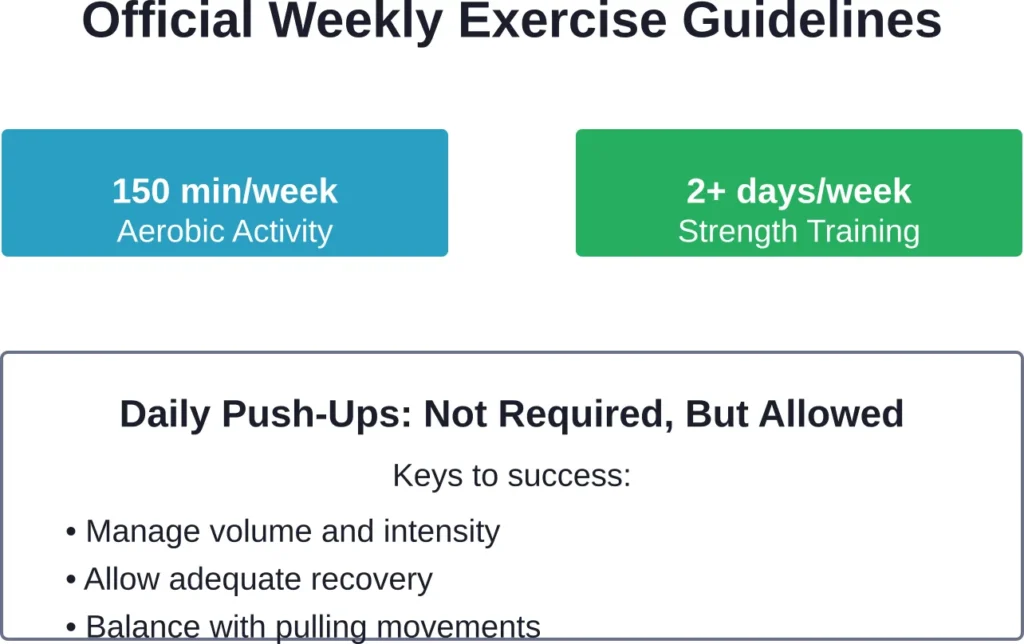
Here’s what the science-backed recommendations look like. According to the CDC, adults need at least 150 minutes of moderate-intensity aerobic activity per week and muscle-strengthening activities on 2 or more days per week that work all major muscle groups.
Notice something? The official guidance doesn’t specify daily strength training as a requirement. The recommendation is 2+ days per week.
That said, daily practice isn’t prohibited either. The ACSM’s updated 2026 guidelines emphasize that consistency matters more than complicated programs, and multiple training approaches can generate positive results.
The Real Risks of Daily Push-Up Training
Overtraining is the primary concern when performing the same movement pattern daily. Research on overtraining syndrome shows that elite runners experience non-functional over-reaching at a lifetime prevalence of approximately 60%, compared with 33% in non-elite female runners.
Among adolescent swimmers, 35% experienced overtraining at least once. While these statistics focus on endurance athletes, the underlying principle applies: inadequate recovery between training sessions can lead to performance decline, fatigue, and increased injury risk.
Muscle imbalances represent another significant concern. Push-ups primarily train pushing movements while neglecting pulling muscles like the lats and rhomboids. This imbalance can contribute to postural issues and shoulder problems over time.
The general recommendation for strength training suggests allowing at least 48 hours for muscle recovery to maximize strength gains. Daily high-intensity push-up sessions don’t provide that recovery window.
How to Make Daily Push-Ups Safe and Effective
If daily practice appeals to you, structure matters enormously.
Consider volume management. Rather than pushing to failure every day, distribute your total weekly volume across seven days with varying intensity. Some days might involve 3 sets to near-failure, while others feature just 1-2 easy sets for movement quality and practice.
Tempo control offers another approach. Slowing down the eccentric (lowering) phase and pausing at the bottom creates training stimulus without requiring maximum reps or added resistance.
Variation prevents repetitive stress. Rotate between standard push-ups, diamond push-ups for triceps emphasis, wide-grip variations for chest focus, and decline push-ups for upper chest development. Different hand positions and angles distribute stress across different muscle fibers and joint angles.
| Training Approach | Daily Volume | Recovery Strategy | Best For |
|---|---|---|---|
| High-frequency, low-volume | 3-5 sets of 5-10 reps | Submaximal effort, varied tempo | Skill practice, movement quality |
| Moderate frequency | 3-4 days heavy, 2-3 days light | Programmed light days | Balanced strength gains |
| Standard protocol | 2-3 days per week | 48+ hours between sessions | Maximum strength development |
Balance your training by incorporating pulling movements. For every pushing exercise session, include an equivalent volume of rows, pull-ups, or band pull-aparts. This maintains shoulder health and prevents the rounded-forward posture that excessive pushing can create.
Progressive Strategies That Actually Work
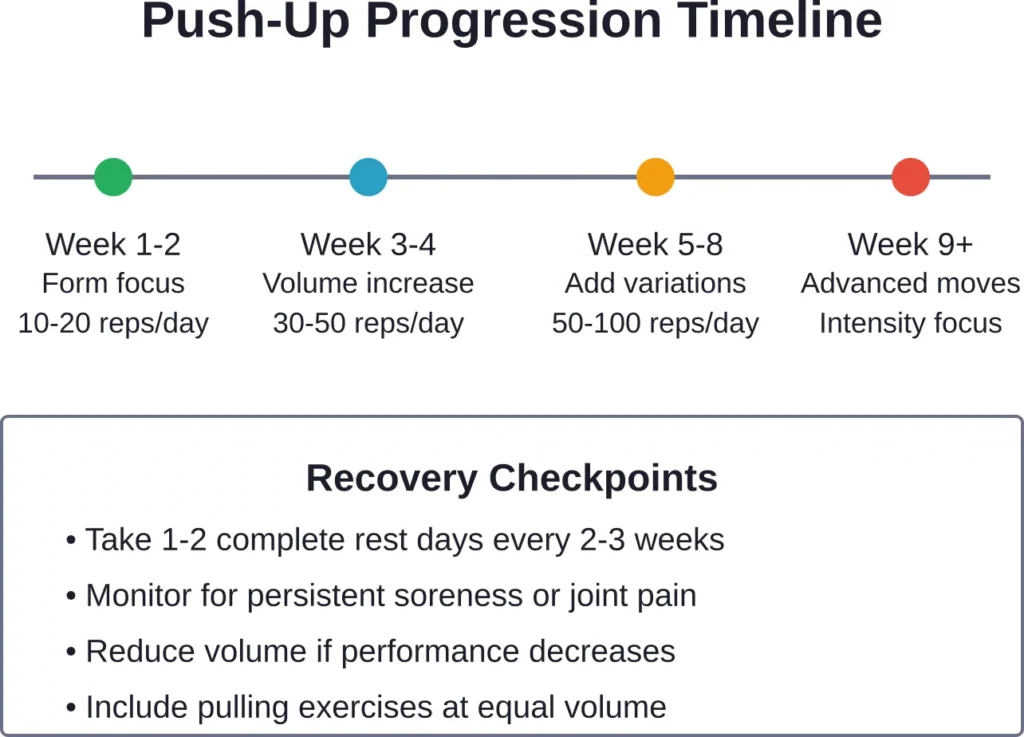
Starting a daily push-up routine requires honest assessment of your current capacity. Beginners might start with wall push-ups or incline variations, performing 2-3 sets daily without approaching failure.
Intermediate practitioners can handle standard push-ups with moderate volume. A sustainable approach might involve 50-100 total reps distributed across the day, never pushing beyond 80% of maximum effort on most days.
Advanced individuals can explore weighted push-ups, explosive variations, or challenging positions like pseudo-planche push-ups. However, these demanding variations typically require more recovery and may not suit daily performance.
Warning Signs You’re Overdoing It
Listen to your body. Persistent shoulder pain, elbow discomfort, or wrist strain indicates that form has broken down or volume exceeds recovery capacity.
Performance decline serves as another red flag. If your rep count consistently drops or form deteriorates, you’re likely experiencing accumulated fatigue. Research on overtraining syndrome documents a case where an athlete training 20–25 hours per week experienced symptoms like heart palpitations, extreme fatigue, and muscle cramping—signs they’d pushed well beyond their recovery capacity.
In documented overtraining cases, recovery protocols have included prescribed rest periods with heart rate management during recovery. While daily push-ups pose much lower risk than endurance overtraining, the principle remains: more isn’t always better.
Building a Balanced Upper Body Routine
Push-ups work brilliantly as part of a comprehensive program. Pair them with horizontal rows or inverted rows to balance pushing and pulling strength. Add overhead pressing for complete shoulder development and vertical pulling movements like pull-ups or lat pulldowns.
A simple weekly structure might look like this: Monday and Thursday feature heavier push-up variations (3-4 sets near failure), Tuesday and Friday include lighter sets for movement practice (2-3 easy sets), and Wednesday, Saturday, and Sunday rotate between pulling work, lower body training, and complete rest.
| Day | Push-Up Work | Complementary Training |
|---|---|---|
| Monday | Heavy: 3-4 sets to near-failure | Horizontal rows, core work |
| Tuesday | Light: 2 sets, focus on tempo | Lower body, mobility |
| Wednesday | Rest or 1 easy set | Pull-ups, shoulder health |
| Thursday | Moderate: 3 sets with variations | Rows, rotator cuff exercises |
| Friday | Light: 2 sets, explosive or slow | Lower body, conditioning |
Frequently Asked Questions
There’s no universal number. Beginners might start with 10-20 total reps, intermediate practitioners can handle 50-100, and advanced individuals may perform 100+ reps. The key is managing intensity—daily practice works best when most sessions stay submaximal, avoiding failure on every set.
Daily push-ups can build muscle, particularly for beginners. However, muscle growth requires progressive overload and adequate recovery. For maximum hypertrophy, research suggests aiming for higher weekly volume (~10 sets per muscle group). Daily practice can hit this volume if sessions remain moderate in intensity.
Daily push-ups increase injury risk if form degrades, volume exceeds recovery capacity, or muscle imbalances develop. Shoulder and elbow issues are most common. Proper form, adequate rest days or light days, and balanced training with pulling movements significantly reduce injury risk.
Timing matters less than consistency. Some people prefer morning push-ups to establish a routine and activate muscles early. Others find evening sessions fit better with their schedule. Choose a time you can maintain consistently. Performance research shows adaptation occurs regardless of training time when consistency is maintained.
Start with incline push-ups using a bench, table, or wall. As strength improves, gradually lower the incline angle. Knee push-ups also work, though incline variations better maintain the full-body tension that makes push-ups so effective. Progress slowly and prioritize form over rep count.
Beginners typically notice strength improvements within 2-3 weeks. Visible muscle development takes 6-8 weeks of consistent training with adequate nutrition. Performance gains appear first, followed by muscular endurance, then visible hypertrophy. Results accelerate when push-ups are part of a comprehensive training program.
Complete rest days aren’t mandatory if volume and intensity are managed properly. However, taking 1-2 full rest days every 2-3 weeks supports long-term sustainability and reduces accumulated fatigue. Alternatively, program light days at 30-50% of normal volume to maintain practice while allowing recovery.
The Bottom Line on Daily Push-Ups
So, is it OK to do push-ups every day? Yes, for most people, with proper planning.
Daily practice works when volume and intensity are managed appropriately, form remains strict, and pushing movements are balanced with pulling exercises. The CDC’s muscle-strengthening recommendation of 2+ days per week represents the minimum for health benefits, not a maximum frequency.
What matters most isn’t whether you train daily or three times weekly—it’s consistency, progressive challenge, adequate recovery, and balanced programming. Daily push-ups can absolutely support fitness goals when these principles guide your approach.
Start conservatively, monitor your body’s response, and adjust based on performance and recovery. Build the habit first, then optimize the details. Your body will tell you what it can handle.