
Quick Summary: Letting children play video games is okay when done with balance and parental guidance. Research shows gaming can offer cognitive benefits and social connections, though moderation matters. The key is setting reasonable time limits, choosing age-appropriate content, ensuring physical activity balances screen time, and staying involved in what your child plays.
The glow of a screen. The rapid-fire clicking of controllers. The occasional shout of triumph or frustration echoing from the living room.
Sound familiar?
For parents today, video games represent one of those modern parenting dilemmas that previous generations never faced. Your child wants to play—their friends are all gaming—but you’re wondering if you’re setting them up for problems down the road.
Here’s the thing though: the science on gaming has evolved considerably. And much of what we feared about video games doesn’t match what researchers have actually found.
What the Research Actually Says About Kids and Gaming
Let’s start with the elephant in the room: do video games harm children’s development?
A recent study published in the Journal of Media Psychology examined fifth graders and found no meaningful links between video game playing—even for extended hours—and diminished cognitive ability. That challenges the long-held worry that gaming somehow stunts learning.
CU Boulder scientists discovered that playing video games comes with small but significant cognitive benefits. The brain doesn’t rot from gaming. It trains.
Research examining video game impacts on cognition found that gaming can enhance certain mental skills including spatial reasoning, problem-solving, and attention allocation among regular players.
But wait—what about addiction and excessive use?
The World Health Organization data shows that 12% of adolescents are at risk of problematic gaming, with boys showing higher rates at 16% compared to 7% for girls.
Real talk: most kids who play video games do so without developing harmful patterns. The risk exists, but it’s not the default outcome.
How Much Gaming Is Too Much?
Numbers matter when setting boundaries. Here’s what current data tells us about actual gaming habits:
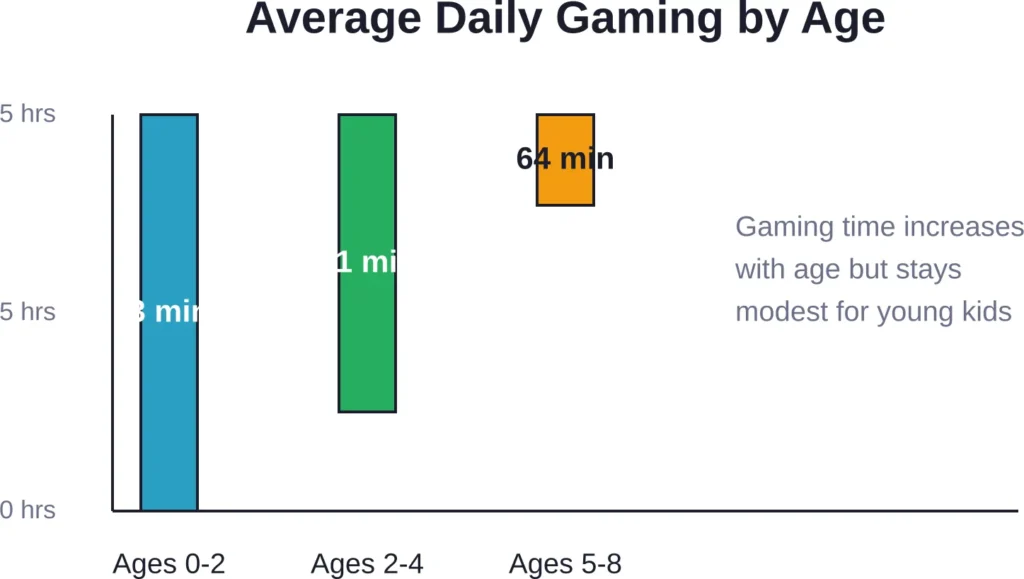
For young children ages 0-2, according to recent data, children ages 0-2 spend an average of 3 minutes per day playing video games (console or smartphone/tablet games).
Children ages 2-4 average 2 hours and 8 minutes per day of total media (gaming is a subset of this), while children ages 5-8 engage with 3 hours and 38 minutes of total media daily, with gaming representing approximately one hour of that. By early school age, gaming becomes a regular part of media consumption.
Overall media use for ages 2-4 averages 2 hours and 8 minutes daily, increasing to 3 hours and 38 minutes for ages 5-8. Gaming represents about 26% of media time for this age group, while TV and video viewing account for 60%.
Among adolescents, 34% play digital games daily. Of those who game, 22% play for at least 4 hours on days when they’re gaming.
A study by Liu et al., encompassing urban and rural populations in China, revealed that 96.1% of children had encountered video games by the age of six. Within this cohort, 36.3% of children engaged with games at higher frequencies.
So where’s the line?
There’s no magic number that works universally. What matters more is whether gaming interferes with sleep, physical activity, schoolwork, family time, and face-to-face social connections.
The Surprising Benefits of Video Games
Before the doom and gloom takes over, consider what gaming actually offers children.
Cognitive Skill Development
Games demand quick decision-making, pattern recognition, and strategic planning. Action games particularly enhance visual attention and spatial cognition.
Puzzle-based games build problem-solving skills. Strategy games develop planning and resource management abilities.
Social Connection
Modern gaming is rarely solitary. Kids connect with friends through multiplayer experiences, building teamwork and communication skills.
Research published in Behavioral Sciences examining the relationship between video game engagement and social development found that executive function plays a mediating role. Games that challenge working memory and cognitive flexibility can support social skill development.
Community discussions highlight how gaming helps children maintain friendships, especially when in-person meetups aren’t possible. During pandemic lockdowns, gaming became a vital social lifeline for many kids.
Stress Relief and Emotional Regulation
Games provide an outlet for stress and a sense of accomplishment through achievable goals. They offer a controlled environment where kids can experience challenges and overcome them.
That said, the type of game matters enormously.
Choosing Age-Appropriate Games
Not all games are created equal. Content varies wildly from educational puzzle games to intensely violent shooters.
Rating systems exist for a reason. The Entertainment Software Rating Board (ESRB) provides age and content ratings that offer genuine guidance:
| Rating | Age Group | Content |
|---|---|---|
| EC (Early Childhood) | Ages 3+ | No inappropriate content |
| E (Everyone) | Ages 6+ | Minimal cartoon violence |
| E10+ (Everyone 10+) | Ages 10+ | More cartoon or fantasy violence, mild language |
| T (Teen) | Ages 13+ | Violence, suggestive themes, crude humor, simulated gambling |
| M (Mature) | Ages 17+ | Intense violence, blood, sexual content, strong language |
Pay attention to these ratings. A 7-year-old shouldn’t be playing M-rated games designed for near-adults.
But here’s where it gets tricky: peer pressure. What happens when your child’s friend plays games you’ve deemed inappropriate?
Stand firm on your family values while avoiding judgment of other households. Explain your reasoning to your child in age-appropriate terms. Offer alternatives when they’re at your home.
The goal isn’t to shelter children from all media exposure, but to ensure what they’re consuming matches their developmental stage.
Setting Healthy Gaming Boundaries
Okay, so gaming isn’t inherently evil. How do parents actually manage it day-to-day?
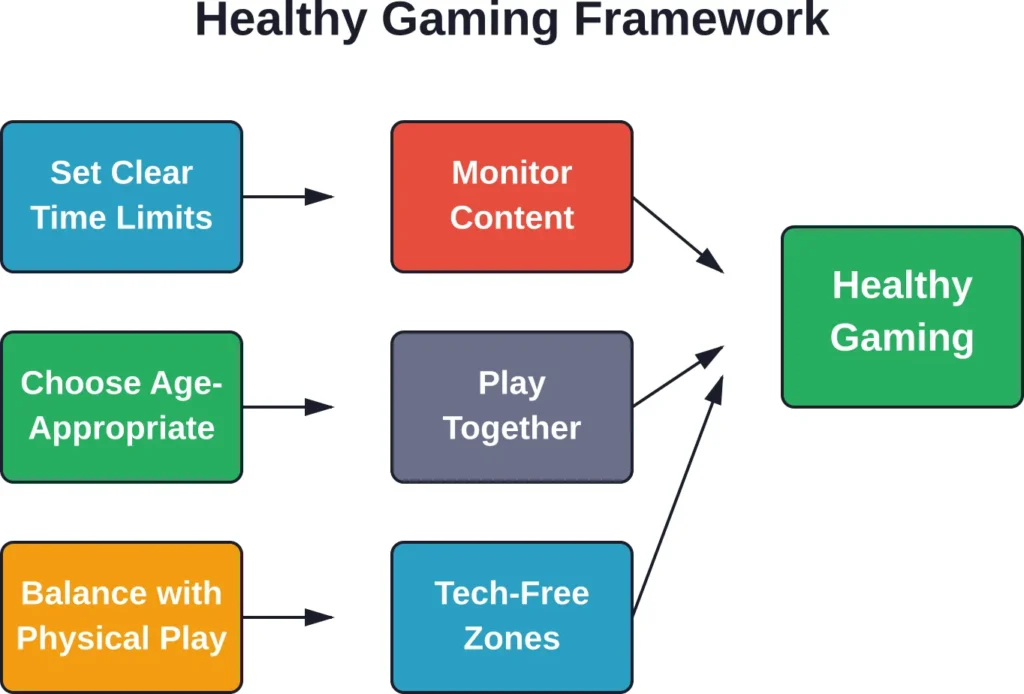
Establish Clear Time Limits
Decide what works for your family and stick to it. Some households do 30 minutes on weekdays and an hour on weekends. Others allow more flexibility.
Whatever limit you set, enforce it consistently. Inconsistency breeds conflict and negotiation battles.
That said, some leniency makes sense. If your child is in the middle of a game at the time limit, allowing 5-10 extra minutes to reach a stopping point shows respect for their engagement.
Prioritize Other Activities First
Gaming should come after homework, chores, physical activity, and family responsibilities. It’s a privilege earned, not a right.
This creates natural motivation. Kids learn that completing their responsibilities leads to desired rewards.
Create Tech-Free Zones and Times
No screens during meals. No gaming in bedrooms. No devices an hour before bed.
These boundaries protect sleep quality, family connection, and prevent gaming from becoming an all-consuming focus.
Game With Your Child
This might be the most important tip. Play the games your kids love.
You’ll understand what captivates them, monitor content firsthand, and create shared experiences. Gaming together opens conversations about in-game decisions, online interactions, and digital citizenship.
It’s harder to demonize something you actually understand.
Warning Signs of Problematic Gaming
While most children game without issues, parents should watch for red flags that indicate gaming has crossed into problematic territory.
The World Health Organization formally recognized gaming disorder in the ICD-11, defined by impaired control over gaming, increasing priority given to gaming over other activities, and continuation despite negative consequences.
Specific warning signs include:
- Preoccupation with gaming even when not playing
- Withdrawal symptoms like irritability or anxiety when gaming isn’t possible
- Tolerance—needing increasing amounts of time to feel satisfied
- Failed attempts to reduce or control gaming
- Loss of interest in previous hobbies and activities
- Continued excessive gaming despite awareness of problems
- Lying about gaming time
- Using gaming to escape negative moods
- Jeopardizing relationships or school performance
If several of these persist for 12 months or more, professional evaluation makes sense.
WHO data from the Health Behaviour in School-aged Children study revealed that problematic social media use among adolescents increased from 7% in 2018 to 11% in 2022, with 12% of adolescents at risk of problematic gaming. Boys face higher risk at 16% versus 7% for girls.
Early intervention matters. Gaming disorder responds to treatment including cognitive behavioral therapy and family therapy approaches.
Balancing Gaming with Physical Activity
One legitimate concern about gaming is sedentary behavior. Kids glued to screens aren’t running, jumping, or building physical fitness.
The solution isn’t eliminating gaming—it’s ensuring adequate physical activity happens daily.
Make outdoor time non-negotiable. Before gaming privileges kick in, children need to move their bodies. This could mean organized sports, playground time, family walks, or backyard play.
Some families use gaming as motivation: one hour of outdoor activity earns one hour of screen time. Others separate the two entirely, scheduling both as distinct parts of the daily routine.
Active video games that involve movement (dance games, sports simulations with motion controls) offer a middle ground, though they shouldn’t fully replace traditional physical play.
The Social Aspect: Online Interactions
Modern gaming includes chat functions, multiplayer lobbies, and online communities. This introduces safety considerations beyond the games themselves.
Children encounter strangers online. They may face bullying, inappropriate language, or exposure to mature content through other players.
Protective measures include:
- Using parental controls to limit or monitor online communication
- Keeping gaming devices in common areas where parents can observe
- Teaching children never to share personal information online
- Discussing what to do if someone makes them uncomfortable
- Reviewing friends lists and contacts periodically
- Understanding reporting and blocking functions
Research examining social development found that video games can support peer connections when used appropriately. The mediating role of executive function means games that challenge cognitive skills may actually enhance social abilities.
Gaming with known friends offers social benefits. Gaming with anonymous strangers requires caution and supervision.
Making the Decision for Your Family
So, is it okay to let your child play video games?
Yes—with intentional boundaries and ongoing involvement.
Gaming isn’t inherently harmful. The research doesn’t support panic. Studies show cognitive benefits, social connection opportunities, and stress relief when approached responsibly.
But gaming also carries risks when it becomes excessive, displaces essential activities, or exposes children to inappropriate content.
The parent’s role is guide, not gatekeeper. Rather than banning games entirely or allowing unlimited access, find the middle ground that works for your child’s age, temperament, and circumstances.
Consider these factors:
| Factor | Green Light | Caution Needed |
|---|---|---|
| Time spent gaming | Less than 2 hours daily | More than 3 hours daily |
| Other activities | Maintains hobbies, sports, friendships | Lost interest in previous activities |
| School performance | Completing work, maintaining grades | Declining grades, incomplete assignments |
| Physical health | Active daily, sleeping well | Sedentary, poor sleep patterns |
| Emotional state | Generally happy, responds to limits | Irritable when not gaming, defiant about limits |
| Social connections | Friends online and offline | Only online friendships, isolation |
Every child is different. Some handle gaming maturely at young ages. Others need stricter limits even as teens.
Stay flexible and responsive to your individual child rather than rigidly following any one-size-fits-all approach.
Practical Tips for Implementing Gaming Rules
Theory is one thing. Implementation is where parents struggle.
Start with family discussion. Explain the reasoning behind limits. When children understand why rules exist, compliance improves.
Use timers and alarms. Let the timer be the enforcer rather than constant nagging. When it goes off, gaming stops—no negotiation.
Create transition rituals. Give warnings at 10 minutes and 5 minutes before gaming ends. This helps children mentally prepare to stop.
Offer clear consequences for rule violations. If gaming extends past limits, the next day’s gaming is forfeited. Consistency matters more than severity.
Acknowledge that pulling away from an engaging game is genuinely difficult. Validate the frustration while maintaining boundaries.
Look for gaming camps or programs that channel interest productively. Some children passionate about games might enjoy learning game design or coding.
Model healthy tech habits yourself. Children notice when parents set screen limits for kids but scroll endlessly on their own devices.
Educational and Developmental Gaming Options
Not all gaming time is equal. Some games genuinely build skills.
Educational games teach mathematics, reading, science, and history through interactive experiences. When learning feels like play, retention improves.
Creative games like sandbox builders encourage imagination, planning, and artistic expression. Children design elaborate structures, solve engineering challenges, and experiment with cause-and-effect.
Cooperative games emphasize teamwork over competition. Players work together toward common goals, building collaboration skills.
Research indicates games designed with educational outcomes in mind can be as effective as traditional instruction for certain skills, particularly when they provide immediate feedback and adaptive difficulty.
Seek out quality over quantity. An hour playing a thoughtfully designed game offers more value than three hours in a mindless click-fest.
Frequently Asked Questions
No universal age applies to all children and all games. Many experts suggest waiting until at least age 2-3 for any screen time beyond video chatting. For actual gaming, ages 5-6 with carefully selected educational or simple games represents a reasonable starting point. The focus should be on content appropriateness and ensuring gaming doesn’t displace critical developmental activities like physical play, reading, and face-to-face interaction.
For children ages 2-5, limit screen time to 1 hour per day of high-quality programming, with gaming as just one component. For older children, 1-2 hours daily represents a reasonable guideline, though this should be earned after completing homework, chores, and physical activity. Weekend limits can be slightly more flexible. The key is ensuring gaming doesn’t interfere with sleep, schoolwork, physical health, or family time.
Research shows certain games can enhance cognitive skills including spatial reasoning, problem-solving, attention control, and quick decision-making. Studies have found no meaningful link between moderate gaming and diminished cognitive ability. Games that challenge working memory and executive function may support development. However, benefits depend on game type, duration, and whether gaming balances with other developmental activities. Passive or repetitive games offer fewer cognitive benefits than strategic or puzzle-based options.
Watch for warning signs including preoccupation with gaming, withdrawal symptoms when not playing, failed attempts to reduce gaming, loss of interest in other activities, declining school performance, and lying about time spent gaming. If these persist for several months, consult a pediatrician or mental health professional. Treatment approaches include cognitive behavioral therapy, family therapy, and structured reduction programs. Early intervention improves outcomes. Avoid complete cold-turkey removal without professional guidance, as this can worsen anxiety and defiance.
Multiplayer games carry both benefits and risks. They enable social connection and teamwork but also expose children to strangers, potential bullying, and inappropriate content. Safety measures include using parental controls to limit chat functions, keeping gaming devices in common areas, teaching children never to share personal information, reviewing friend lists regularly, and gaming alongside your child to monitor interactions. Age-appropriate games with strong moderation and reporting systems offer better protection than unmoderated platforms.
Content appropriateness depends on age and individual maturity. Young children should avoid violent content entirely. For adolescents, research hasn’t established clear causal links between gaming violence and real-world aggression in neurotypical children, though violent content may increase short-term aggressive thoughts. Consider your family values, your child’s temperament, and age ratings. If you do allow age-appropriate games with violence, discuss them actively—talk about the difference between game scenarios and reality, consequences of violence, and conflict resolution. Involvement and conversation matter more than blanket bans or unrestricted access.
Start by ensuring gaming is earned through completing other activities rather than the default option. Expose children to diverse experiences—sports, arts, nature activities, building projects, cooking, music. Find what genuinely interests them rather than forcing activities. Make non-gaming activities social by involving friends or doing them together as a family. Limit overall screen access so boredom drives creativity and exploration. Consider whether excessive gaming fills a void (loneliness, stress, boredom) and address underlying causes. Gradually reducing gaming while expanding other options works better than sudden dramatic restrictions.
Final Thoughts: Finding Your Family’s Balance
Video games are here to stay. They’re woven into modern childhood in ways previous generations never experienced.
Fighting against this reality or pretending games don’t exist won’t serve children well. Neither will unlimited access without boundaries.
The path forward involves informed, intentional parenting. Understanding what games offer, what risks they carry, and how to maximize benefits while minimizing harms.
Your child can play video games and still thrive—still excel in school, maintain friendships, stay physically active, and develop into a well-rounded person.
It requires your involvement. Know what they’re playing. Set clear expectations. Enforce boundaries consistently. Model healthy habits. Stay curious about their interests rather than dismissive.
Gaming isn’t the enemy. Passive, uninvolved parenting around gaming is the problem.
So yes, it’s okay to let your child play video games. Just do it thoughtfully, with limits, and with your eyes wide open.
Start today: have a conversation with your child about gaming. Ask what they love about their favorite game. Play it together for 20 minutes. Then set one clear boundary you’ll implement this week.
Small steps toward intentional gaming create big results over time.