

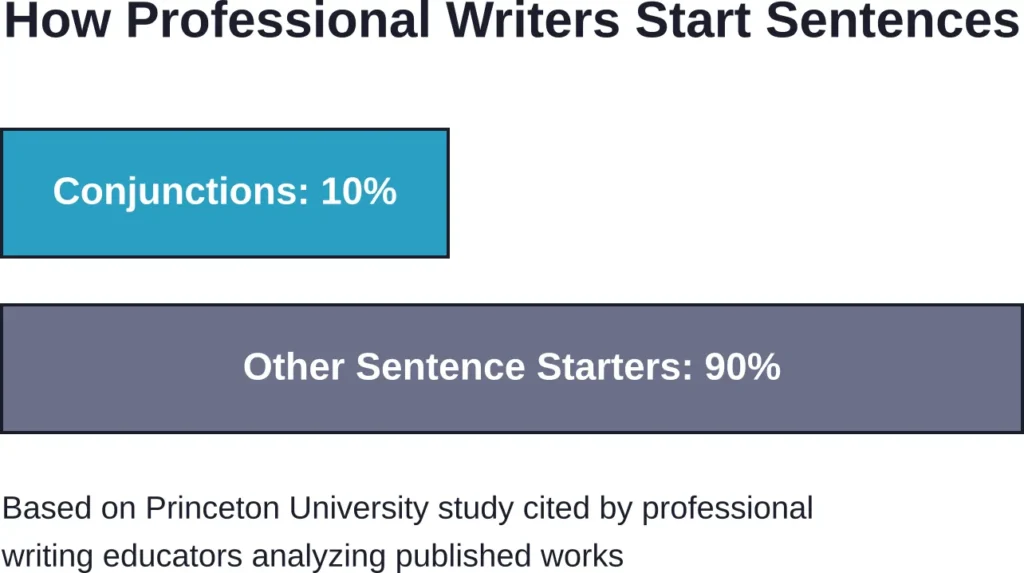
Quick Summary: Yes, it’s perfectly acceptable to start a sentence with ‘but’ in modern English writing. This supposed rule is actually a grammar myth that has been debunked by linguists, style guides, and professional writers. Professional writers start approximately 10% of their sentences with conjunctions like ‘but’ and ‘and,’ and doing so can create effective transitions and natural-sounding prose.
The chalk screeches across the blackboard. Your teacher’s voice rings out: “Never start a sentence with ‘but’ or ‘and.’”
Sound familiar? Generations of students have heard this command echoed through classrooms. But here’s the thing—it’s not actually a rule.
Despite what many learned in school, starting a sentence with ‘but’ is grammatically correct, widely accepted, and used by professional writers everywhere. This persistent myth has no basis in actual English grammar rules, yet it continues to haunt writers who second-guess every sentence that begins with a conjunction.
So where did this supposed rule come from? Why does it feel wrong to so many people? And when should writers actually use ‘but’ at the beginning of a sentence?
The Grammar Myth That Won’t Die
The prohibition against starting sentences with coordinating conjunctions like ‘but,’ ‘and,’ ‘so,’ or ‘yet’ is one of the most persistent grammar myths in English. Real talk: it’s right up there with never ending a sentence with a preposition.
According to BriefCatch, writers may feel they “would rather get a root canal than split an infinitive” or start sentences with conjunctions. Yet no reputable grammar authority actually supports this rule.
Writer Jean Klein offered a standing challenge during her teaching years: $100 cash to any student who could find the “Don’t start a sentence with but” rule in a grammar book from a reputable publisher. The librarians reported a run on grammar books for days afterward. Nobody ever claimed that money.
Where Did This Myth Come From?
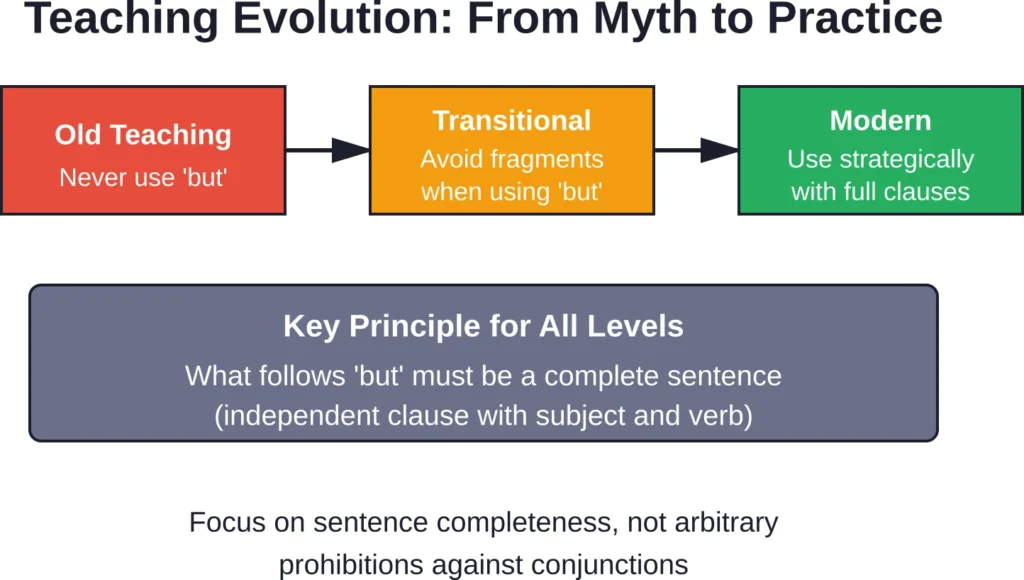
The origin of this supposed rule likely stems from elementary education. Teachers may have introduced this guideline to help young students avoid sentence fragments and run-on sentences—common issues when children are learning to write.
Starting a sentence with ‘but’ requires understanding independent clauses. What follows ‘but’ must be a complete sentence, not a fragment. For beginners, that’s tricky.
But somewhere along the way, this teaching tool hardened into a perceived absolute rule. Students carried it into adulthood, and the myth perpetuated itself across generations.
What Professional Writers Actually Do
Here’s where theory meets practice. According to research cited by professional writing educators, a Princeton University study found that professional writers start approximately 10% of their sentences with ‘but’ and ‘and.’
Approximately ten percent. That’s roughly one in every ten sentences.
Open any well-regarded book, magazine, or newspaper, and sentences beginning with ‘but’ appear regularly. They’re not mistakes—they’re deliberate stylistic choices that create rhythm, emphasize contrasts, and improve readability.
Examples from Classic Literature
Still need convincing? Consider the opening of Genesis 1 from the Bible, which uses coordinating conjunctions to begin multiple sentences throughout the creation narrative.
Or look at respected style guides themselves. Fowler’s Modern English Usage discusses starting sentences with conjunctions as acceptable (see page 191 for the discussion about starting sentences with but).
The Elements of Style, another cornerstone grammar reference, doesn’t prohibit the practice either. If these authorities allowed it, why would modern writers avoid it?
Understanding Coordinating Conjunctions
To fully grasp why starting sentences with ‘but’ works, understanding coordinating conjunctions helps. These words connect elements of equal grammatical rank—whether those elements are words, phrases, or independent clauses.
English has seven coordinating conjunctions, easily remembered by the acronym FANBOYS:
- For
- And
- Nor
- But
- Or
- Yet
- So
These conjunctions traditionally connect two independent clauses within a single sentence: “I wanted to go, but it was raining.” The comma plus conjunction creates a compound sentence.
But that same conjunction can also begin a new sentence: “I wanted to go. But it was raining.” The meaning remains essentially the same. The difference lies in emphasis and rhythm.
The Grammar Is Solid
When ‘but’ starts a sentence, it functions as a coordinating conjunction that connects the new sentence to the previous one. The connection is logical and rhetorical rather than grammatical.
The sentence after ‘but’ must be an independent clause—a complete sentence with a subject and verb that expresses a complete thought. This requirement ensures the structure remains grammatically sound.
Fragment: “But when the rain stopped.”
Complete sentence: “But the rain never stopped.”
That distinction matters. The myth conflates two separate issues: using conjunctions to start sentences (perfectly fine) versus writing sentence fragments (grammatically incorrect).
When to Start a Sentence with But
Knowing that starting sentences with ‘but’ is acceptable doesn’t mean doing it constantly. Like any writing technique, it works best when used deliberately and appropriately.
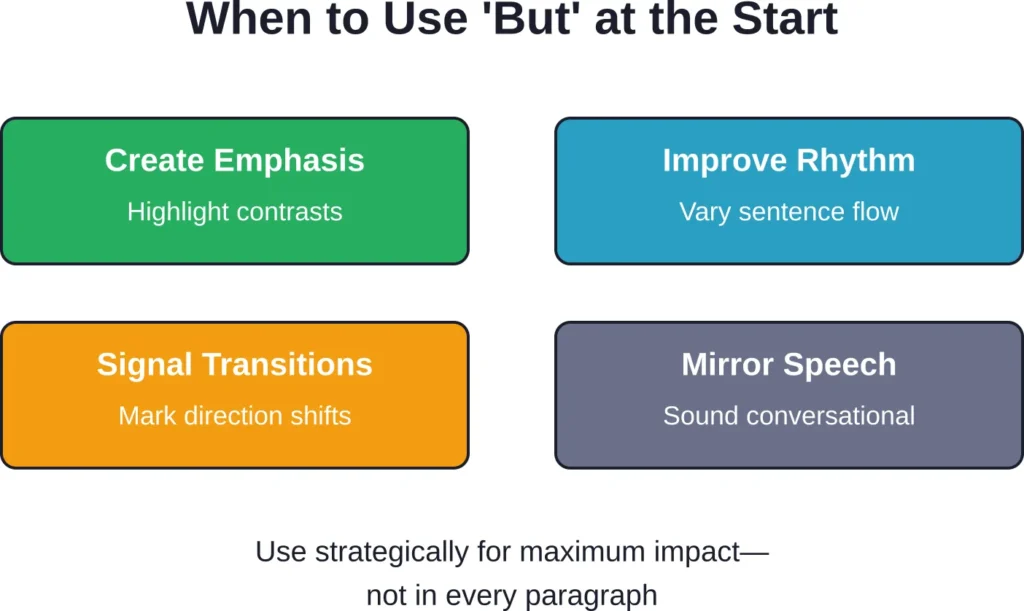
To Create Emphasis
Starting a sentence with ‘but’ places emphasis on the contrast or contradiction that follows. It creates a stronger break than a comma would within a compound sentence.
Compare these versions:
“The project seemed straightforward, but the implementation revealed unexpected complexities.”
“The project seemed straightforward. But the implementation revealed unexpected complexities.”
The second version gives the contradiction more weight. The period creates a pause, and ‘but’ signals to readers that what follows challenges what came before.
To Improve Rhythm and Flow
Varying sentence length and structure keeps writing engaging. When multiple short, declarative sentences pile up, the rhythm becomes choppy. A sentence beginning with ‘but’ can smooth that transition.
It also mirrors natural speech patterns. People regularly begin spoken sentences with ‘but,’ ‘and,’ and ‘so.’ Using this pattern in writing creates a conversational tone that feels more accessible.
To Signal a Transition
In longer pieces, ‘but’ at the beginning of a sentence signals a shift in direction. It tells readers that the discussion is pivoting to address an opposing viewpoint, complication, or exception.
This function proves especially useful in argumentative or analytical writing, where presenting multiple perspectives is essential.
Context Matters: Formal vs. Informal Writing
While starting sentences with ‘but’ is grammatically acceptable across all contexts, some writing situations call for more conservative choices.
Academic and Formal Writing
Academic writing traditionally favors more formal transitions. Instead of beginning with ‘but,’ academic writers often use transitional phrases like ‘however,’ ‘nevertheless,’ ‘on the other hand,’ or ‘conversely.’
These alternatives aren’t grammatically superior—they’re stylistically different. The choice depends on the conventions of the field, the preferences of the publication, and the desired tone.
That said, many contemporary academic writers do start sentences with ‘but.’ The practice has become increasingly accepted even in scholarly contexts, particularly in fields that value clear, direct communication.
Business and Professional Writing
Business writing increasingly prioritizes clarity and readability over rigid formality. Starting sentences with ‘but’ aligns with this modern approach, particularly in emails, reports, and internal communications.
For external communications—especially those directed at conservative audiences or traditional industries—some writers still prefer more formal transitions. Reading the room helps.
Creative and Journalistic Writing
In creative writing and journalism, starting sentences with ‘but’ is standard practice. These forms prize natural voice, varied rhythm, and engaging prose—all areas where sentence-initial ‘but’ excels.
Feature articles, opinion pieces, and narrative nonfiction regularly employ this technique. It’s not remotely controversial in these contexts.
Common Concerns Addressed
Even when writers understand that starting sentences with ‘but’ is acceptable, concerns linger. Addressing these directly helps clear up remaining confusion.
“Won’t It Make My Writing Seem Informal?”
Not necessarily. The overall tone of writing comes from word choice, sentence complexity, subject matter, and dozens of other factors. A single sentence beginning with ‘but’ doesn’t suddenly make formal writing informal.
Consider this formal example: “The data suggests a significant correlation between variables. But further research is required to establish causation.”
The sentence beginning with ‘but’ doesn’t undermine the formal tone. It simply provides a clear, direct transition.
“What If My Teacher or Editor Marks It Wrong?”
This happens. Some educators and editors still enforce the old rule, despite its lack of grammatical foundation.
In academic settings where grades matter, following the instructor’s preferences—even when those preferences contradict modern usage—makes practical sense. Once outside that specific context, writers can return to standard contemporary practice.
For professional editing situations, discussing the issue directly often helps. Most professional editors recognize that starting sentences with conjunctions is acceptable. If one doesn’t, that conversation reveals whether stylistic flexibility exists in the working relationship.
“How Often Should I Do This?”
Moderation matters. Professional writers start about 10% of sentences with conjunctions, but that’s an observed average, not a target. The right frequency depends on content, audience, and style.
Overusing any sentence structure creates monotony. Starting too many consecutive sentences with ‘but’ becomes repetitive. Varied sentence openings keep prose dynamic.
Style Guides Weigh In
What do major style guides actually say about this practice? The answer might surprise those still clinging to the old prohibition.
| Style Guide | Position on Starting Sentences with ‘But’ | |
|---|---|---|
| Fowler’s Modern English Usage | Explicitly permits and discusses appropriate use | |
| The Elements of Style | No prohibition; examples throughout the text | |
| Chicago Manual of Style | Accepts the practice as standard usage | |
| AP Stylebook | No rule against it; commonly used in journalism | |
| MLA Handbook | No prohibition; focuses on avoiding fragments |
No major style guide prohibits starting sentences with coordinating conjunctions. The focus instead falls on ensuring that what follows the conjunction is a complete sentence, not a fragment.
Teaching the Next Generation
Given that this myth persists primarily through education, how should grammar be taught to avoid perpetuating misinformation?
Teachers working with young students might still introduce simplified guidelines: “Make sure each sentence has a subject and verb” or “Avoid starting too many sentences the same way.” These principles help without creating false rules.
As students mature, explicitly addressing the myth helps. Explaining that coordinating conjunctions can begin sentences—when followed by independent clauses—empowers writers to make informed choices rather than following arbitrary prohibitions.
Examining professional writing provides concrete examples. When students see respected authors, journalists, and academics starting sentences with ‘but,’ the permission becomes real rather than theoretical.
Other Grammar Myths Worth Questioning
Once one grammar myth crumbles, others deserve scrutiny. The prohibition against starting sentences with ‘but’ belongs to a family of false rules that many learned in school.
According to BriefCatch, common grammar myths include:
- Never split infinitives
- Never end a sentence with a preposition
- Never start a sentence with ‘because’
- Always write out numbers under ten
Each of these “rules” has exceptions, context-dependencies, or no real grammatical foundation. Understanding which rules are actual grammar principles versus stylistic preferences or outdated conventions helps writers make informed choices.
Grammar serves communication. When a supposed rule interferes with clarity, readability, or natural expression without offering grammatical benefit, questioning that rule makes sense.
Practical Examples in Action
Seeing ‘but’ used effectively at sentence starts helps internalize when and how to use this technique.
Example 1 – Creating Contrast:
“The marketing campaign generated significant buzz on social media. But actual sales figures remained disappointing.”
Example 2 – Emphasizing a Problem:
“The proposed solution appears cost-effective and easy to implement. But it fails to address the underlying infrastructure issues.”
Example 3 – Adding a Qualification:
“Research shows strong correlation between exercise and mood improvement. But individual results vary based on numerous factors.”
Example 4 – Shifting Perspective:
“Proponents argue the policy will stimulate economic growth. But critics point to potential environmental consequences.”
In each case, starting the sentence with ‘but’ creates a stronger break than a comma would within a compound sentence. The emphasis shifts, highlighting the contrast or complication being introduced.
FAQs
Yes, starting a sentence with ‘but’ is grammatically correct. No authoritative grammar guide prohibits this practice. The sentence following ‘but’ must be an independent clause with a subject and verb, but the construction itself is standard English that professional writers use regularly.
Teachers likely introduced this guideline to help young students avoid sentence fragments. When learning to write, children often create incomplete sentences starting with conjunctions. The simplified rule “don’t start with but” prevented this issue. However, this teaching tool was misunderstood as an absolute grammar rule rather than a beginner’s guideline.
Yes, professional writers frequently start sentences with ‘but’ and other coordinating conjunctions. According to a Princeton University study, professional writers begin approximately 10% of their sentences with coordinating conjunctions like ‘but’ and ‘and.’ This practice appears regularly in published books, academic papers, and journalism.
Generally speaking, starting sentences with ‘but’ is acceptable in academic writing, though conventions vary by field and publication. Contemporary academic writing increasingly favors clear, direct communication, which includes sentence-initial coordinating conjunctions. However, some instructors or style guides prefer transitional phrases like ‘however’ or ‘nevertheless’ for formal tone.
When ‘but’ appears in the middle of a sentence with a comma, it creates a compound sentence with less emphasis on the contrast. When ‘but’ starts a new sentence, it creates a stronger break and places more emphasis on what follows. The meaning remains similar, but the rhythm and emphasis change.
Moderation matters when starting sentences with any conjunction. While professional writers average around 10% of sentences beginning with conjunctions, this isn’t a target—just an observation. Use sentence-initial ‘but’ when it serves a purpose: creating emphasis, improving rhythm, or signaling transitions. Avoid overuse, which becomes repetitive.
If an instructor, style guide, or editor specifically prohibits starting sentences with coordinating conjunctions, following that guideline makes practical sense in that context. Additionally, starting too many consecutive sentences with ‘but’ creates monotony. Finally, ensure what follows ‘but’ is always a complete sentence, never a fragment.
Conclusion
The supposed rule against starting sentences with ‘but’ is a grammar myth without foundation in actual English grammar. Professional writers, respected authors, and authoritative style guides all accept and use this construction regularly.
Starting sentences with ‘but’ serves legitimate stylistic purposes: creating emphasis, improving rhythm, signaling transitions, and mirroring natural speech patterns. When the sentence following ‘but’ is a complete independent clause, the construction is grammatically sound.
Writers who have avoided this practice based on outdated teaching can confidently use it where appropriate. Context matters—understanding audience expectations and specific style requirements helps. But the grammatical permission is clear.
Now it’s time to apply this knowledge. Look at writing with fresh eyes. Notice how published authors structure sentences. Experiment with starting sentences with ‘but’ where doing so strengthens the prose. Trust the grammar, not the myth.