
Quick Summary: Taking creatine at night is perfectly safe and won’t disrupt sleep since it’s not a stimulant. Research shows timing matters less than consistent daily intake, though some studies suggest taking creatine close to workouts may offer slight absorption advantages. Whether morning or evening, the key is maintaining regular supplementation to keep muscle creatine stores saturated.
Creatine has earned its reputation as the gold standard supplement for strength, power, and muscle growth. But when it comes to timing, confusion runs rampant.
Should creatine be reserved for pre-workout shakes? Will taking it before bed sabotage sleep quality? The internet is full of conflicting advice, and cutting through the noise requires looking at what research actually demonstrates.
Here’s the thing though—most of the anxiety around nighttime creatine dosing stems from misconceptions about how the supplement works. Unlike stimulants that spike energy and alertness, creatine operates on an entirely different mechanism.
What Creatine Actually Does in Your Body
Before diving into timing strategies, understanding creatine’s role clarifies why nighttime dosing isn’t the problem many assume it to be.
Creatine is a nitrogenous organic acid naturally occurring in muscle cells. Roughly 95% of the body’s creatine stores reside in skeletal muscle tissue, with the remainder distributed in the brain and other organs.
The compound serves as a rapid energy reserve during high-intensity exercise. When muscles contract explosively—think sprinting, lifting heavy weights, or jumping—they burn through adenosine triphosphate (ATP) stores quickly. Creatine phosphate steps in to regenerate ATP, allowing sustained power output.
Supplementation increases these muscle creatine stores by 10-40%, depending on individual baseline levels. This enhancement translates to improved strength, endurance, power, and increased muscle mass over time.
But here’s what creatine doesn’t do: it doesn’t stimulate the central nervous system. It won’t jack up heart rate, trigger alertness, or interfere with the biological mechanisms governing sleep.
The Short Answer: Nighttime Creatine Is Completely Safe
Real talk: there’s no physiological reason to avoid taking creatine before bed.
Since creatine isn’t a stimulant, it won’t cause insomnia or disrupt sleep architecture. Community discussions consistently report positive experiences with nighttime dosing, and many users find it convenient to stack creatine with evening meals or pre-bed protein shakes.
The concern about sleep disruption likely stems from confusing creatine with pre-workout formulas—many of which contain caffeine, beta-alanine, and other stimulants that absolutely should be avoided before bed.
So if nighttime fits better with individual schedules and supplement routines, there’s zero harm in taking creatine in the evening hours.
Does Timing Actually Matter for Creatine Effectiveness?
Now, this is where it gets interesting. While nighttime creatine is safe, does timing influence results?
The research offers nuanced findings. Generally speaking, consistent daily intake matters more than precise timing. Creatine works by saturating muscle stores over time—a process that takes several days to weeks. Once saturation is achieved, maintaining those levels through regular supplementation drives the performance benefits.
That said, some evidence suggests taking creatine close to exercise sessions may offer marginal advantages.
Workout Day Timing Considerations
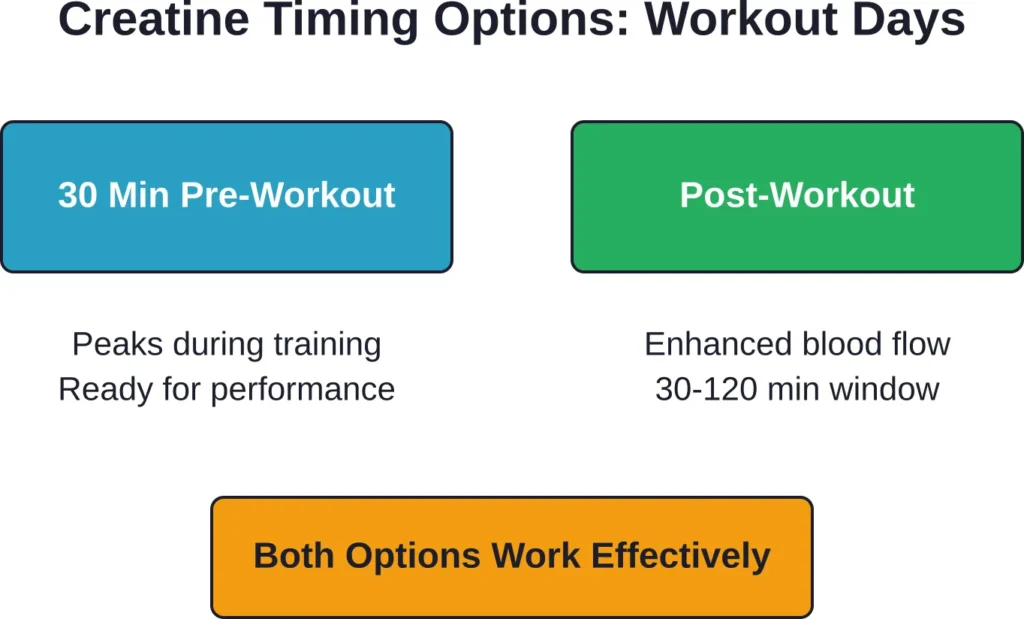
Studies have examined creatine absorption patterns around training sessions. Peak blood creatine levels may occur within a few hours of ingestion, with effects lasting up to 4 hours.
Additionally, blood flow increases significantly during and after exercise—a phenomenon called exercise hyperaemia. This enhanced circulation to activated muscles may improve creatine uptake. Depending on workout intensity, elevated blood flow can persist 30 to 120 minutes post-exercise.
Based on these physiological factors, taking creatine 30 minutes before workouts or immediately afterward as part of post-workout nutrition appears logical for workout days.
Rest Day Strategy
What about non-training days? The goal shifts from optimizing acute absorption to maintaining saturated muscle creatine stores.
On rest days, timing becomes even less critical. Taking creatine with meals—whether breakfast, lunch, or dinner—works perfectly fine. Some prefer consistency by taking it at the same time daily regardless of training schedule.
And yes, that includes nighttime dosing. If evening meals or bedtime routines offer the most convenient reminder to stay consistent, that’s when creatine should be taken.
Factors That Actually Influence Creatine Absorption
While timing receives outsized attention, other variables matter more for creatine effectiveness.
Consistency Trumps Everything
The single most important factor is daily intake. Missing doses means muscle creatine stores gradually decline, diminishing the performance benefits that took weeks to build.
Whether taken morning, afternoon, or night matters far less than simply taking it every day without fail.
Dosage Protocols
Standard creatine supplementation follows one of two approaches:
- Loading phase: 20-25 grams daily (split into 4-5 doses) for 5-7 days, followed by 3-5 grams daily maintenance
- Standard dosing: 3-5 grams daily from day one, reaching saturation in 3-4 weeks
Both methods achieve the same endpoint—saturated muscle stores—with loading simply accelerating the timeline.
Food Pairing
Creatine absorption may improve when paired with carbohydrates or carbohydrate-protein combinations. The insulin response triggered by these nutrients potentially enhances creatine transport into muscle cells.
This doesn’t mean creatine requires food, but taking it alongside meals or post-workout shakes that already contain carbs and protein makes practical sense.
| Factor | Impact on Results | Recommendation |
|---|---|---|
| Daily Consistency | High – Maintains saturation | Take every day without missing |
| Precise Timing | Low – Marginal differences | Choose convenient, sustainable time |
| Dosage Amount | High – Determines saturation | 3-5g daily or loading protocol |
| Food Pairing | Moderate – May improve uptake | Take with meals when possible |
Debunking Common Nighttime Creatine Myths
Let’s address the most persistent misconceptions head-on.
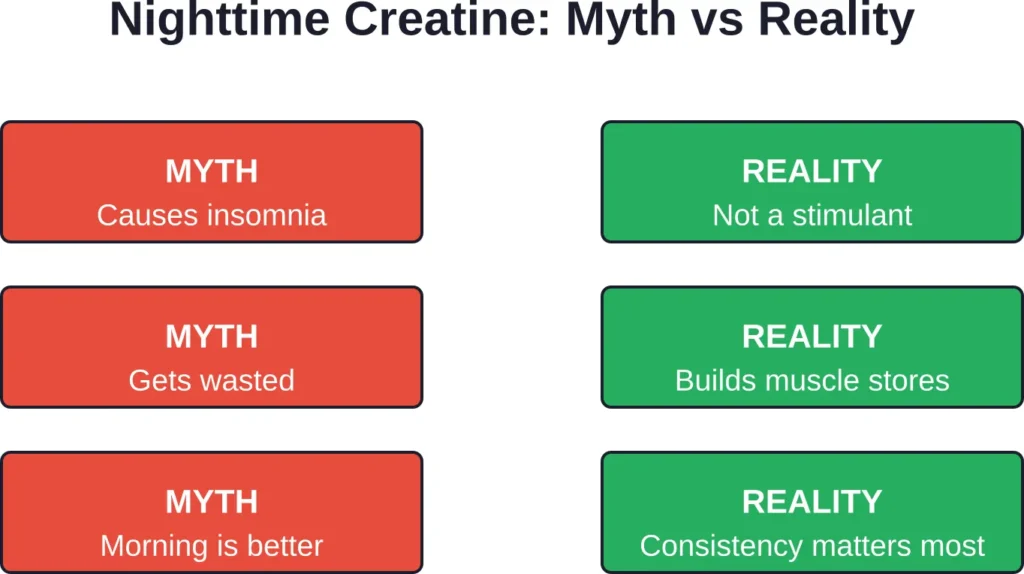
Myth: Creatine Causes Insomnia
No credible evidence supports this claim. Creatine doesn’t interact with neurotransmitter systems involved in sleep regulation. It doesn’t increase cortisol, stimulate adrenaline release, or affect melatonin production.
Confusion likely arises from conflating creatine with stimulant-laden pre-workout supplements. If a product contains caffeine, taurine, or other energizing compounds alongside creatine, those ingredients—not the creatine—disrupt sleep.
Myth: Nighttime Dosing Wastes Creatine
Some claim creatine taken before bed gets “wasted” since muscles aren’t being worked. This misunderstands the mechanism entirely.
Creatine supplementation builds and maintains a reservoir in muscle tissue over days and weeks. The compound taken tonight contributes to tomorrow’s stores, which support next week’s training sessions. There’s no “wasted” dose when following consistent supplementation.
Myth: Morning Is Always Superior
While morning dosing works great for many people, declaring it universally superior lacks scientific backing. The body doesn’t preferentially absorb or utilize creatine based on circadian rhythms.
The “best” time is whenever adherence is highest. For shift workers, night owls, or those who train in evenings, nighttime dosing often proves more sustainable than forcing an inconvenient morning routine.
Practical Nighttime Creatine Strategies
For those who decide nighttime dosing fits their lifestyle best, here are effective implementation approaches.
Pair With Evening Meals
Taking creatine alongside dinner provides the carbohydrate and protein pairing that may enhance absorption. It also creates a consistent routine—finishing dinner becomes the automatic cue to take the supplement.
Add to Bedtime Protein Shakes
Many strength athletes consume slow-digesting protein (like casein) before bed to support overnight muscle recovery. Adding creatine to these shakes creates a convenient stack and ensures neither supplement gets forgotten.
Set a Consistent Evening Reminder
Whether through phone alarms, pill organizers, or habit stacking with existing nighttime routines (brushing teeth, taking other supplements), consistency mechanisms prevent missed doses.
Stay Hydrated
Creatine draws water into muscle cells. While this isn’t problematic, maintaining adequate hydration throughout the day—including evenings—supports optimal function. Just avoid chugging excessive water right before bed to prevent disruptive nighttime bathroom trips.
When Workout Timing Might Influence Your Decision
Individual training schedules sometimes make certain timing strategies more practical than others.
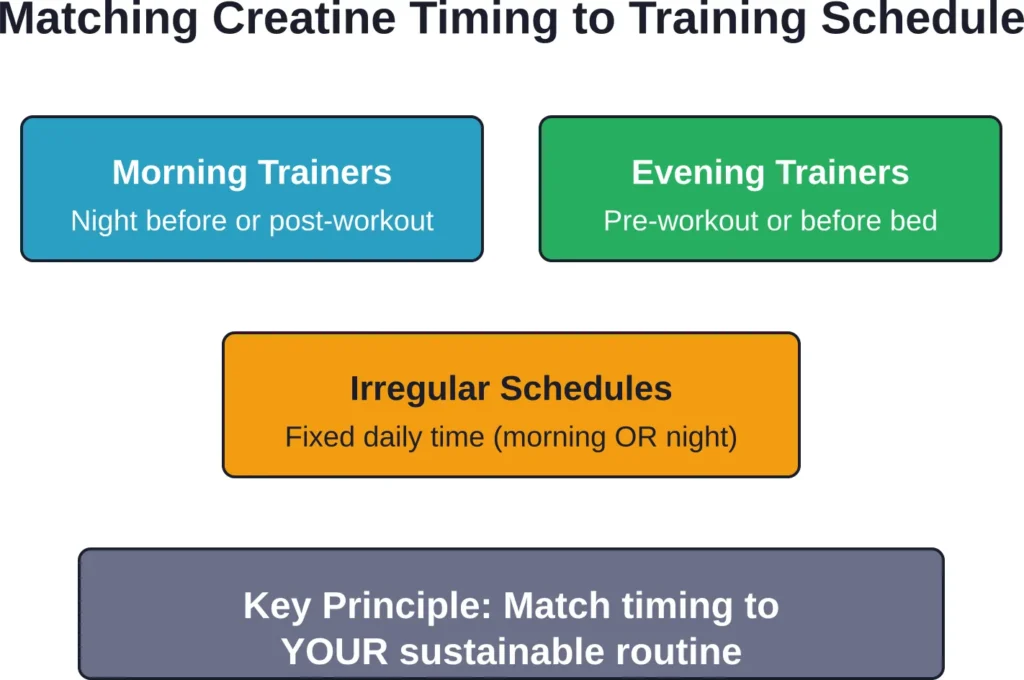
Morning Training Sessions
Athletes who train first thing in the morning might prefer taking creatine the night before, ensuring muscle stores are topped off for the upcoming session. Alternatively, taking it immediately post-workout (still in the morning) works equally well.
Evening Training Sessions
For those hitting the gym after work, taking creatine pre-workout in the evening or post-workout before bed aligns perfectly with the research on exercise-related absorption windows.
Irregular Training Times
When workout schedules vary dramatically day-to-day, picking one consistent time—morning or night—regardless of training ensures supplementation never gets skipped due to schedule confusion.
What the Research Actually Shows
While the bulk of creatine research focuses on efficacy rather than precise timing, a few studies have examined this specific question.
Research has examined morning versus evening creatine intake in athletic populations. Studies generally show minimal performance differences between timing groups, reinforcing that consistency matters more than the clock.
Other research examining workout-proximate timing (before/after exercise versus distant timing) shows modest advantages for peri-workout supplementation—but these effects are small and inconsistent across studies.
The scientific consensus? Creatine works regardless of timing, provided daily intake remains consistent. Any marginal timing advantages are dwarfed by the importance of regular supplementation, adequate dosing, and patience for saturation to occur.
Potential Side Effects (Unrelated to Timing)
Creatine is one of the most extensively studied supplements with an excellent safety profile. However, some users experience minor side effects—none of which are timing-dependent.
Water retention is the most common effect, as creatine increases intramuscular water content. This typically manifests as 1-3 pounds of water weight gain, which isn’t problematic and actually contributes to the fuller muscle appearance many athletes desire.
Gastrointestinal discomfort occasionally occurs, particularly with large doses taken on an empty stomach. This can be minimized by splitting doses, taking creatine with food, or avoiding loading phases in favor of standard daily dosing.
Concerns about kidney damage or dehydration have been thoroughly debunked in healthy individuals using recommended doses. That said, anyone with pre-existing kidney conditions should consult healthcare providers before starting supplementation.
Importantly, none of these potential effects worsen with nighttime dosing compared to daytime use.
Who Should Consider Nighttime Creatine?
Certain situations make evening supplementation particularly practical:
- Individuals who train in the evening and want post-workout dosing
- Those who consistently forget morning supplements
- People taking multiple supplements who prefer spreading them across the day
- Athletes consuming bedtime protein shakes who can stack creatine conveniently
- Anyone whose schedule makes nighttime dosing more sustainable long-term
But wait. None of these are requirements—they’re simply scenarios where nighttime dosing solves practical adherence challenges.
Frequently Asked Questions
No, creatine doesn’t cause insomnia or sleep disruption. Unlike stimulants such as caffeine, creatine doesn’t affect the central nervous system or interfere with sleep-regulating neurotransmitters. Research and user experiences consistently show no negative impact on sleep quality from nighttime creatine dosing.
Neither timing is definitively better. Research shows minimal performance differences between morning and evening creatine intake. The most important factor is consistent daily supplementation regardless of timing. Choose whichever schedule ensures better adherence—that’s the optimal time for individual needs.
Yes, taking creatine on rest days maintains saturated muscle stores built during the loading or standard dosing phases. On non-training days, timing matters even less than workout days. Taking it with any meal—breakfast, lunch, or dinner—works equally well for maintaining creatine levels.
Potentially. Pairing creatine with carbohydrates or carbohydrate-protein meals may enhance uptake due to insulin’s role in nutrient transport. Taking creatine alongside evening meals or bedtime protein shakes provides this potential advantage while creating a consistent supplementation routine.
Creatine increases intramuscular water retention gradually over days to weeks, not overnight. The 1-3 pounds of water weight associated with creatine supplementation accumulates as muscle stores saturate, regardless of what time of day it’s taken. This effect isn’t specific to nighttime dosing.
There’s no specific window to worry about. Since creatine doesn’t stimulate wakefulness, it can be taken immediately before bed without issue. The main consideration is personal comfort—some prefer taking supplements an hour or two before sleep simply to avoid feeling overly full when lying down.
If the pre-workout contains stimulants like caffeine, avoid taking it before bed regardless of creatine content—the stimulants will disrupt sleep. However, stimulant-free pre-workout formulas can be taken in the evening alongside creatine without sleep concerns. Always check ingredient labels for caffeine and other energizing compounds.
The Bottom Line on Nighttime Creatine
Taking creatine at night is not only okay—it’s a perfectly viable strategy that works as effectively as any other timing approach.
The supplement’s non-stimulant nature eliminates sleep concerns. The body’s creatine saturation mechanism operates over days and weeks, making individual dose timing far less critical than marketing claims suggest.
What actually matters? Consistent daily intake at adequate doses (typically 3-5 grams). Whether that happens at 7 AM with breakfast or 10 PM before bed makes virtually no difference to long-term muscle creatine stores or performance outcomes.
For workout days, taking creatine close to training sessions (30 minutes before or immediately after) may offer marginal absorption advantages based on blood flow patterns. But even these potential benefits are small compared to the fundamental requirement of regular supplementation.
The best time to take creatine is whenever it fits sustainably into daily routines. For some, that’s morning coffee. For others, evening meals or bedtime protein shakes provide the most reliable reminder.
Stop overthinking the clock. Focus on consistency, adequate dosing, and patience for saturation to build. Those fundamentals drive results far more than precise timing strategies.
Ready to optimize your creatine supplementation? Pick a time—morning, afternoon, or night—that fits your schedule, set a daily reminder, and maintain consistency. The gains follow from regular use, not perfect timing.