

Quick Summary: AI tools for Facebook ads automate creative generation, audience targeting, bid management, and campaign optimization. Top platforms include Extuitive, Revealbot for rule-based automation, Canva and AdCreative.ai for visual content, Anyword for copywriting, and Madgicx for AI-driven audience insights. Meta’s native AI features inside Ads Manager now handle most optimization tasks, while third-party tools excel at creative production and cross-platform management.
Facebook advertising has become a battlefield where speed, data, and creativity determine winners. The platform processes millions of signals every second, adjusting bids and targeting while advertisers scramble to keep up.
That’s where AI steps in.
Instead of manually tweaking campaigns at midnight or guessing which creative will convert, modern tools automate the grunt work. They test, optimize, and scale while marketing teams focus on strategy. But here’s the thing—not every AI tool delivers on its promises.
Some platforms genuinely improve ROAS. Others just add complexity.
This guide breaks down the tools that actually move the needle for Facebook and Instagram advertising in 2026. From automation platforms that pause underperforming ads to creative generators that produce hundreds of variations, the right stack can transform campaign performance.
Why AI Matters for Facebook Advertising
Meta’s algorithm already uses machine learning to optimize delivery. The platform’s native AI analyzes user behavior, predicts conversions, and adjusts bids in real time. So why add third-party tools?
Real talk: Meta’s AI works great when campaigns have clean data and sufficient volume. But it doesn’t write ad copy, design visuals, or manage rules across dozens of campaigns simultaneously.
Third-party AI tools fill these gaps. They handle tasks like generating dozens of headline variations, creating video ads from product images, building complex automation rules, and providing analytics Meta doesn’t surface natively.
The technology processes creative decisions faster than any human team. Where a copywriter might test five headlines per day, AI tools generate and evaluate hundreds. Where manual bid adjustments happen hourly, automation platforms react in seconds.
What Meta’s Native AI Already Handles
Before adopting external tools, it’s worth understanding what Ads Manager already automates. Meta’s built-in AI manages delivery optimization, selecting which users see ads based on predicted conversion likelihood. It adjusts bids dynamically through Advantage+ campaigns and determines placements across Facebook, Instagram, Messenger, and Audience Network.
Value-based bidding tells Meta which conversions matter most. If a $500 purchase and a $20 purchase both count as one conversion, value-based bidding tells Meta which conversions matter most.
That said, Meta’s native tools don’t create content, write persuasive copy, or build complex multi-condition rules. Those capabilities require dedicated platforms.
Top AI Tools for Facebook Ad Automation
Automation platforms reduce the repetitive decision-making that bogs down campaign management. These tools monitor performance metrics and execute actions based on predefined rules or AI recommendations.
Extuitive
Extuitive is an AI-powered predictive creative validation platform for Facebook and Meta Ads, specifically built for Shopify stores. It generates full ad concepts (headlines, copy, images, videos, reels, hooks, and pricing) and pre-tests them on a network of over 150,000 AI agents modeled after real consumer behavior, predicting CTR, ROAS, and purchase intent before any budget is spent.
The platform connects directly to Shopify, analyzes the product catalog, brand historical data, and market trends, then runs an evolutionary selection process. Weak creatives are eliminated during generation, while top performers receive performance forecasts and audience recommendations. This allows advertisers to launch only high-potential ads and dramatically reduce wasted spend on testing losers.
Extuitive works best as an upstream tool that complements creative generators and campaign optimizers (AdCreative.ai, Madgicx, etc.). It requires minimal setup after store connection, but prediction accuracy improves with more historical brand data. The interface is designed for e-commerce owners and teams who want faster, data-driven launches with lower risk.
Contact Information:
- Website: extuitive.com
- Email: [email protected]
- LinkedIn: www.linkedin.com/company/extuitive
- Twitter: x.com/Extuitive_Inc
- Instagram: www.instagram.com/extuitiveinc
Revealbot

Revealbot provides an automated rule builder that allows managers to automate processes such as pausing and restarting ads, and controlling budget and bidding processes. The rule builder enables AND/OR operators, custom metrics, timeframes, and testing, as well as rank-based comparisons.
The platform connects directly to Meta’s API and executes actions without manual intervention. For example, a rule might pause any ad set with cost-per-acquisition above $50 after 100 impressions, then restart it with a 20% lower bid.
Revealbot works across Facebook and Instagram campaigns, making it useful for teams managing multiple accounts. The interface requires some learning curve—setting up complex rules takes time—but the automation saves hours once configured properly.
Madgicx

Madgicx combines automation with AI-driven audience insights. The platform analyzes campaign data to identify high-performing audience segments, then creates lookalike audiences and exclusion lists automatically.
The tool’s creative intelligence feature scans ad performance and flags which visuals, headlines, and formats drive results. Instead of manually comparing metrics across dozens of ads, Madgicx surfaces patterns and recommends scaling decisions.
It also offers budget optimization across campaigns, shifting spend toward top performers without manual reallocation. The platform integrates with Shopify and other e-commerce systems to track post-click behavior and attribute revenue accurately.
Smartly.io

Smartly.io focuses on enterprise-level automation and creative production. The platform generates dynamic ad variations by combining product feeds with design templates, producing thousands of personalized ads at scale.
Its automation engine handles bid adjustments, budget pacing, and campaign launches across multiple markets simultaneously. Large brands use Smartly.io to manage localized campaigns in dozens of countries without exponentially increasing team workload.
The platform isn’t cheap—pricing reflects its enterprise positioning—but teams managing significant ad spend benefit from the efficiency gains.
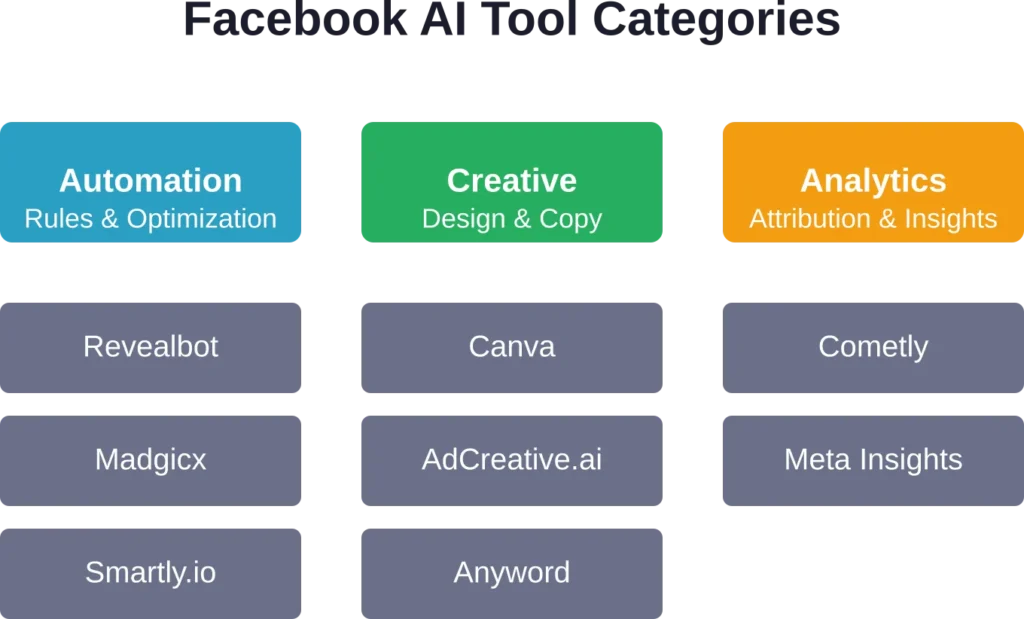
Best AI Creative Generators for Facebook Ads
Creative fatigue kills campaign performance. When the same visuals and messages saturate an audience, engagement drops and costs rise. AI creative tools solve this by producing variations at scale.
Canva
Canva has evolved from a simple design tool into an AI-powered creative platform. Its Magic Design feature generates complete ad layouts from text prompts, while background removal, image enhancement, and template customization happen with single clicks.
For Facebook ads, Canva offers pre-sized templates for every placement—feed, stories, reels, and more. The brand kit functionality ensures consistency across hundreds of ad variations, automatically applying logos, fonts, and color schemes.
The platform doesn’t optimize creative based on performance data, but it accelerates production dramatically. Teams can generate 50 ad variations in the time it would take to manually design five.
AdCreative.ai

AdCreative.ai specializes in generating high-converting ad visuals using machine learning trained on millions of successful ads. Users upload product images or brand assets, select a goal, and the platform produces dozens of design variations optimized for click-through and conversion.
The tool scores each creative based on predicted performance, helping advertisers prioritize which variations to test first. It integrates directly with Meta’s ad platform, allowing one-click export of generated creatives into campaigns.
AdCreative.ai works particularly well for e-commerce brands that need to produce ads at scale for large product catalogs. The AI handles layout, text placement, and color combinations based on what historically drives results.
Anyword

While most creative tools focus on visuals, Anyword tackles copywriting. The platform uses natural language processing to generate ad headlines, primary text, and descriptions optimized for engagement and conversions.
Anyword analyzes existing high-performing ads to identify messaging patterns that resonate with specific audiences. It then produces variations that match those patterns while maintaining brand voice.
The tool integrates with Meta’s API to pull performance data, continuously learning which copy variants drive better results. Over time, it refines recommendations based on actual campaign outcomes rather than generic best practices.
Analytics and Attribution Tools
Meta’s native analytics provide campaign-level data, but they don’t always reveal the full customer journey—especially when users interact across multiple touchpoints before converting.
Cometly

Cometly focuses on accurate attribution, tracking user behavior from first click through final purchase. The platform uses server-side tracking to capture conversion data that browser-based pixels might miss due to privacy restrictions and ad blockers.
It connects advertising data with backend sales systems, attributing revenue to specific campaigns, ad sets, and creatives. This clarity helps teams understand which Facebook ads actually drive profit rather than just clicks or cheap conversions.
Cometly’s reporting reveals patterns like which ads attract high-lifetime-value customers versus one-time buyers, enabling smarter budget allocation.
Pixis
Pixis positions itself as a comprehensive AI ad platform that combines automation, creative intelligence, and predictive analytics. The tool monitors campaign performance across Meta, Google, and other channels, providing unified reporting and cross-platform optimization recommendations.
Its AI models predict future performance based on current trends, alerting teams to potential budget waste or scaling opportunities before they become obvious in standard reports.
Pixis fits brands running complex multi-channel strategies where Facebook ads interact with search, display, and other touchpoints. The platform’s value increases with campaign complexity and ad spend volume.
| Tool | Primary Function | Best For | Meta-Specific Features |
|---|---|---|---|
| Revealbot | Automation | Rule-based campaign management | Custom metrics, AND/OR operators, rank comparisons |
| Madgicx | Automation + Insights | Audience optimization | Creative intelligence, automatic audience exclusions |
| Smartly.io | Enterprise automation | Large-scale dynamic creative | Product feed integration, multi-market campaigns |
| Canva | Creative design | Fast visual production | Pre-sized templates, Magic Design |
| AdCreative.ai | Creative generation | Performance-optimized visuals | Predictive scoring, one-click export |
| Anyword | Copywriting | Message optimization | Performance-based learning, API integration |
| Cometly | Attribution | Accurate revenue tracking | Server-side tracking, LTV analysis |
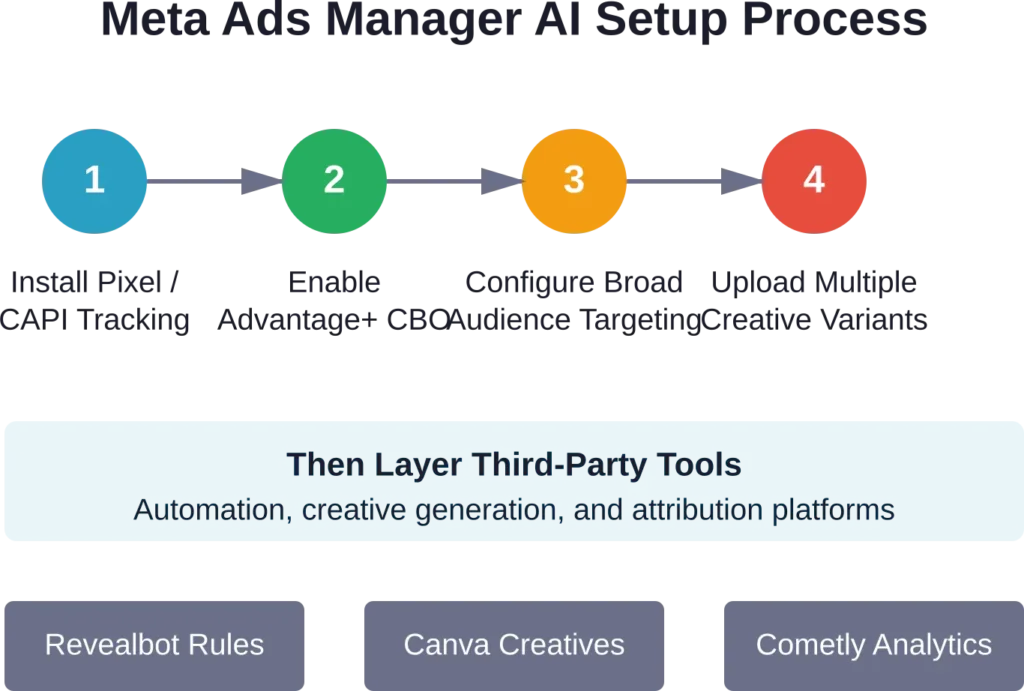
Setting Up AI Automation in Meta Ads Manager
Meta’s native AI features handle much of the heavy lifting when configured correctly. Here’s how to leverage built-in automation before layering on third-party tools.
Step 1: Install Quality Conversion Tracking
Value-based bidding requires accurate conversion data. Install the Meta pixel or Conversions API to track key events—purchases, leads, sign-ups. If selling products at different price points, pass the actual transaction value, not just a generic conversion event.
This allows Meta’s algorithm to optimize for high-value customers rather than treating all conversions equally.
Step 2: Enable Advantage+ Campaign Budget
Advantage+ campaign budget (formerly Campaign Budget Optimization) lets Meta’s AI distribute spend across ad sets dynamically. Instead of manually allocating budgets, the algorithm shifts money toward top performers in real time.
This works best when ad sets target distinct audiences or test different creatives. If ad sets overlap significantly, the algorithm may consolidate spend into one, starving others of data.
Step 3: Use Broad Targeting with Advantage+ Audience
Meta’s machine learning performs better with larger audience pools. Narrow targeting—age 25-34, specific interests, layered behaviors—restricts the algorithm’s ability to find optimal users.
Advantage+ audience allows Meta to expand beyond defined parameters when it identifies high-probability converters outside those constraints. Start broad, let the AI learn, then refine based on data rather than assumptions.
Step 4: Launch Multiple Creatives per Ad Set
Meta’s dynamic creative feature tests combinations of headlines, images, and descriptions automatically. Upload 5-10 images, write 3-5 headlines and primary text variations, and let the algorithm assemble and test combinations.
This accelerates learning and surfaces winning creative elements faster than manual A/B testing.
Best Practices to Maintain Performance
AI tools aren’t set-and-forget solutions. Maintaining performance over weeks and months requires ongoing attention to data quality, creative freshness, and strategic oversight.
Refresh Creative Every 2-4 Weeks
Even AI-optimized ads suffer from creative fatigue. When frequency climbs above 3-4 impressions per user and engagement rates decline, it’s time to introduce new visuals and messaging.
Use creative generation tools to produce variations systematically rather than scrambling when performance drops. Schedule creative reviews bi-weekly and have new assets ready to deploy.
Monitor Data Quality
AI optimization depends on accurate conversion tracking. Browser privacy features, iOS tracking restrictions, and technical errors can degrade data quality, causing algorithms to optimize toward incomplete signals.
Regularly audit conversion events. Compare platform-reported conversions against backend sales data. Implement Conversions API server-side tracking to supplement pixel data and improve accuracy.
Don’t Over-Automate
Automation rules can conflict with Meta’s native optimization, creating feedback loops that destabilize campaigns. If Advantage+ budget is already reallocating spend and a third-party tool is simultaneously adjusting bids based on similar triggers, the two systems can work against each other.
Start with conservative automation—pause obviously failing ads, alert on anomalies—then expand gradually. Test one rule at a time and measure its impact before stacking additional automation.
Segment Audiences for Cleaner Learning
AI performs better when audiences don’t overlap significantly. If three ad sets target slight variations of the same demographic, they’ll compete in auctions and slow learning for all three.
Create distinct audience segments: cold traffic from interest targeting, warm traffic from website visitors, hot traffic from cart abandoners. This gives both Meta’s algorithm and third-party tools cleaner data to optimize against.
Common Pitfalls and How to Avoid Them
Even the best tools produce poor results when used incorrectly. Here are mistakes that derail AI-driven campaigns.
Insufficient Conversion Volume
Machine learning requires data. If a campaign generates fewer than 50 conversions per week per ad set, Meta’s algorithm struggles to optimize effectively. AI tools layered on top face the same constraint.
For low-traffic businesses, optimize toward upper-funnel events first—link clicks, landing page views—then shift to conversion optimization once volume increases. Alternatively, consolidate ad sets to concentrate conversions and accelerate learning.
Ignoring Creative Quality
AI can optimize delivery and generate variations, but it can’t fix fundamentally weak creative. If the underlying message, offer, or visual doesn’t resonate, automation just scales failure faster.
Before investing heavily in AI tools, validate that core creative assets drive results manually. Once proven, AI amplifies success. But it won’t transform poor creative into high performers through optimization alone.
Chasing Vanishing Metrics
Some tools promise improvements on metrics that don’t correlate with business outcomes. High click-through rates mean nothing if those clicks don’t convert. Low cost-per-click is irrelevant if the traffic has no purchase intent.
Align AI tool goals with revenue metrics—cost per acquisition, return on ad spend, customer lifetime value. Optimizing toward proxy metrics often produces superficial gains that don’t translate to profit.
Choosing the Right Tool for Your Needs
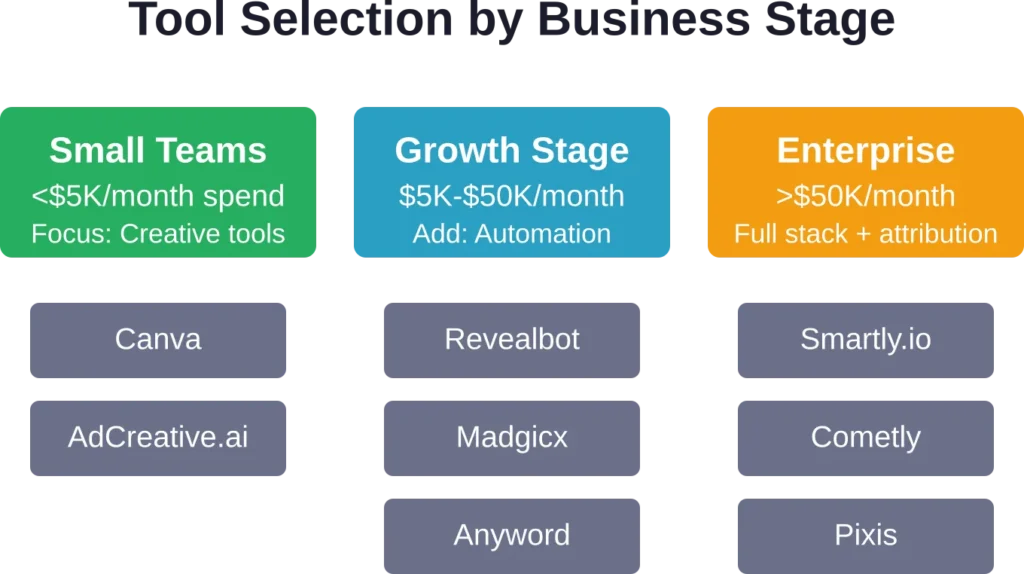
Not every business needs every tool. The optimal stack depends on team size, ad spend, and specific bottlenecks.
Small teams with limited budgets benefit most from creative generation tools like Canva or AdCreative.ai. These eliminate production bottlenecks, allowing one person to manage campaigns that would otherwise require a design team.
Mid-sized advertisers spending $10,000+ monthly on Facebook ads gain value from automation platforms like Revealbot or Madgicx. At this scale, manual campaign management becomes inefficient, and rule-based optimization delivers measurable time savings.
Enterprise brands with complex product catalogs and multi-market campaigns need platforms like Smartly.io that handle dynamic creative and localization at scale. The investment makes sense when coordinating dozens of campaigns across regions and languages.
Attribution tools like Cometly matter most for businesses with longer sales cycles or multi-touchpoint journeys. If most customers interact with ads multiple times before converting, accurate attribution reveals which campaigns truly drive revenue versus which just happen to receive last-click credit.
What Meta Won’t Tell You About AI Tools
Meta benefits when advertisers spend more. The platform’s guidance often steers toward solutions that increase budget rather than efficiency.
Third-party tools can actually reduce total ad spend while maintaining results by cutting waste faster than Meta’s native features. Automation that pauses underperforming ads immediately saves money that would otherwise burn through learning phases.
Meta’s algorithm prioritizes its own objectives—user engagement, time on platform, ad revenue—not necessarily advertiser profit. Tools like Cometly that track actual revenue help identify when Meta’s optimization diverges from business goals.
But here’s the thing—Meta’s API access terms mean third-party tools depend on the platform’s cooperation. When Meta updates policies or restricts data access, external tools can lose functionality overnight. Diversifying across multiple tools reduces this risk but doesn’t eliminate it.
Frequently Asked Questions
Some do, some don’t. Creative generation tools like Canva and AdCreative.ai provide value regardless of budget since they reduce production time and costs. Automation platforms like Revealbot become cost-effective around $5,000 monthly spend when manual management becomes inefficient. Attribution tools matter most for complex customer journeys, which correlate more with business model than budget size.
Not yet. AI handles execution and optimization effectively but struggles with strategic decisions—positioning, offer development, audience research, competitive analysis. The tools amplify skilled marketers rather than replacing them. Small businesses might run campaigns with minimal oversight using AI, but performance typically improves when human strategy guides the automation.
Most automation platforms require 7-14 days to gather sufficient data before making optimization decisions. Creative tools produce immediate output but need the same testing period to identify which AI-generated assets perform best. Attribution tools provide value immediately by clarifying existing performance, though actionable insights accumulate over weeks as customer journey data builds.
AdCreative.ai and Madgicx frequently deliver strong returns for e-commerce since they address specific pain points—producing product-focused creatives at scale and identifying high-value audience segments. Cometly adds value when average order values vary significantly, helping distinguish campaigns that attract high-LTV customers. The optimal choice depends on whether creative production, audience targeting, or attribution represents the biggest bottleneck.
Canva offers a functional free tier with AI features, though advanced capabilities require paid plans. Meta’s native AI features inside Ads Manager cost nothing beyond ad spend and handle optimization effectively when configured properly. Most specialized tools—automation platforms, advanced analytics—require paid subscriptions since they depend on ongoing infrastructure and API costs.
Legitimate tools that use Meta’s official API and follow platform guidelines don’t violate policies. But automated tactics like rapid creative testing or aggressive bid adjustments can trigger ad review issues if they create poor user experiences. Choose established tools with documented Meta partnerships and avoid platforms promising to circumvent platform rules or exploit loopholes.
Run controlled tests. Disable the tool for a segment of campaigns and compare performance against campaigns where it remains active. Track metrics that matter—revenue, profit, customer acquisition cost—not just platform-reported conversions. If removing the tool causes no performance degradation, it’s not adding value. Real impact shows up in bottom-line metrics, not dashboards full of activity.
Making AI Work for Your Facebook Campaigns
The AI tool landscape shifts constantly. Platforms merge, new features launch, pricing changes, and what works today might become obsolete next quarter.
The constant? Advertisers who combine automation with strategic thinking outperform those who rely on either alone.
Start with Meta’s native AI—it’s powerful, free, and improving constantly. Layer third-party tools where specific gaps exist: creative production bottlenecks, complex automation needs, attribution blind spots.
Test incrementally. Don’t overhaul an entire account overnight. Add one tool, measure its impact, refine the implementation, then consider the next addition.
And remember—AI tools optimize what exists. They can’t fix broken offers, invent compelling value propositions, or create demand where none exists. Get the fundamentals right first. Then let automation scale what works.
For teams ready to move beyond manual campaign management, the right AI stack transforms Facebook advertising from a time-intensive grind into a scalable growth channel. Choose tools that solve real problems, measure results honestly, and adjust based on data rather than vendor promises.