
Quick Summary: AI tools for Meta ads optimization now include native Meta Advantage+ systems (Andromeda and GEM), third-party automation platforms (Extuitive, AdEspresso, Revealbot, Madgicx), creative generation tools (AdCreative.ai, Creatify), and AI assistants (Claude, ChatGPT). Testing shows advertisers doubled high-value conversions with AI-driven targeting and reduced landing page view costs by 31% using Meta’s native optimization features.
Meta advertising performance in 2026 hinges on speed, data processing, and creative agility. Manual campaign management no longer scales when competing advertisers deploy AI systems that analyze millions of signals in real time.
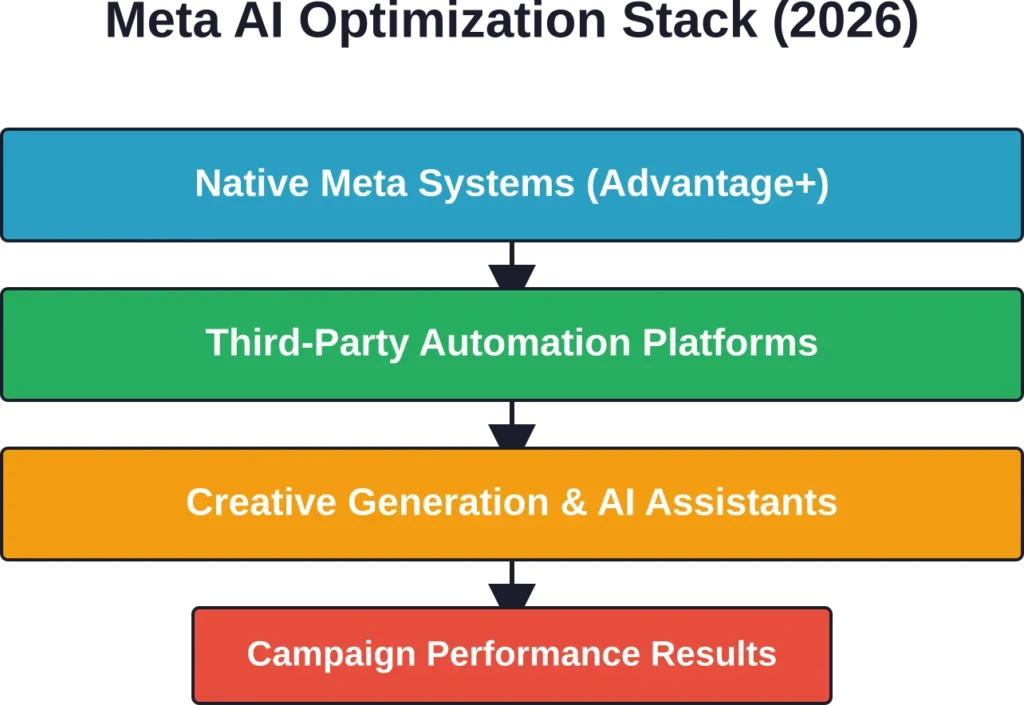
The AI tools landscape splits into three categories: native Meta systems built into Ads Manager, third-party automation platforms that manage campaigns across accounts, and specialized creative generation tools. Each addresses different bottlenecks.
Meta’s own Andromeda and GEM systems now determine how ads are selected, ranked, and sequenced across Facebook and Instagram. According to Search Engine Land reporting from January 2026, these underlying algorithms process user behavior patterns at a scale human campaign managers cannot match.
But Meta’s native tools handle only part of the optimization equation. Third-party platforms fill gaps in multi-account management, granular automation rules, and creative testing workflows.
Understanding Meta’s Native AI Systems (Advantage+)
Meta Advantage+ represents the platform’s branded AI suite built directly into Ads Manager. It’s not a single tool but rather a collection of AI-driven features that automate targeting, placements, creative selection, and budget allocation.
The technology relies on two core systems. Andromeda handles ad selection and ranking—determining which ads to show to which users. GEM (short for Generalized Engagement Model) predicts user engagement likelihood and sequences ads to maximize conversion probability.
Here’s what changed in 2025-2026: Meta shifted from advertisers manually defining narrow audience segments to AI systems discovering high-intent users across broader parameters. Landing page view optimization, introduced in late 2025, reduced cost per view by 31% for brands without direct pixel access, according to Search Engine Land data from September 2025.
Advantage+ Shopping Campaigns
These campaigns automate targeting, creative combinations, and placements for e-commerce advertisers. Instead of building separate ad sets for different audiences, the system tests creative variants across Meta’s full user base and concentrates budget on combinations that convert.
Tests referenced by Search Engine Land showed advertisers doubled high-value conversions compared to business-as-usual manual setups. The catch: reduced granular control. Advertisers can’t see performance breakdowns by age, gender, or specific interest targeting—Meta’s AI decides where budget flows.
Advantage+ Creative
This suite includes automatic image enhancements (brightness, contrast adjustments), music generation for Reels ads, and template-based variations. The tools work inside Ads Manager during campaign creation.
For static image ads, the system suggests cropping alternatives optimized for different placements (Feed, Stories, Reels). For video, it auto-generates captions and tests thumbnail variations.
Advantage+ Placements
Rather than manually selecting where ads appear (Facebook Feed, Instagram Stories, Audience Network), this feature lets Meta’s algorithm allocate budget across all placements based on cost-per-result efficiency.
The benefit: lower cost per conversion when the algorithm finds cheaper inventory on underutilized placements. The downside: less control over brand safety and user experience context.
Third-Party Automation Platforms
While Meta’s native tools handle campaign-level optimization, third-party platforms add cross-account management, advanced rule engines, and integrations that Ads Manager lacks.
Extuitive
Extuitive is an AI-powered predictive platform that forecasts Meta ad creative performance before launch, helping advertisers select winners without burning test budget.
The platform lets users upload or generate creatives (copy, images, videos), then scores them using brand-specific AI models trained on historical campaign data and simulated behavior from ~150,000 real consumers. It predicts key metrics like CTR, ROAS, and conversion probability across Meta placements. Advertisers can rank dozens or hundreds of variations, get High/Medium/Low performance labels, and export only the strongest ones directly into Meta Ads Manager. It also includes AI creative generation and audience insights tailored for Shopify stores.
Key differentiation: True pre-launch prediction instead of post-launch testing. While most tools optimize after ads are already running, Extuitive shifts the entire creative selection process earlier, dramatically cutting wasted spend on weak concepts. Ideal for e-commerce brands and agencies that want data-backed confidence before committing even a dollar of ad budget.
Pricing is based on monthly ad spend level and volume of ads scored. Starter plan starts at $1,000/month (or $10k/year) for brands spending >$10K/month on Meta/TikTok. Higher tiers (Professional $2,500+/month, Enterprise custom) unlock more predictions, seats, and features. Free demo available, no public free trial.
Contact Information:
- Website: extuitive.com
- Email: [email protected]
- LinkedIn: www.linkedin.com/company/extuitive
- Twitter: x.com/Extuitive_Inc
- Instagram: www.instagram.com/extuitiveinc
Revealbot

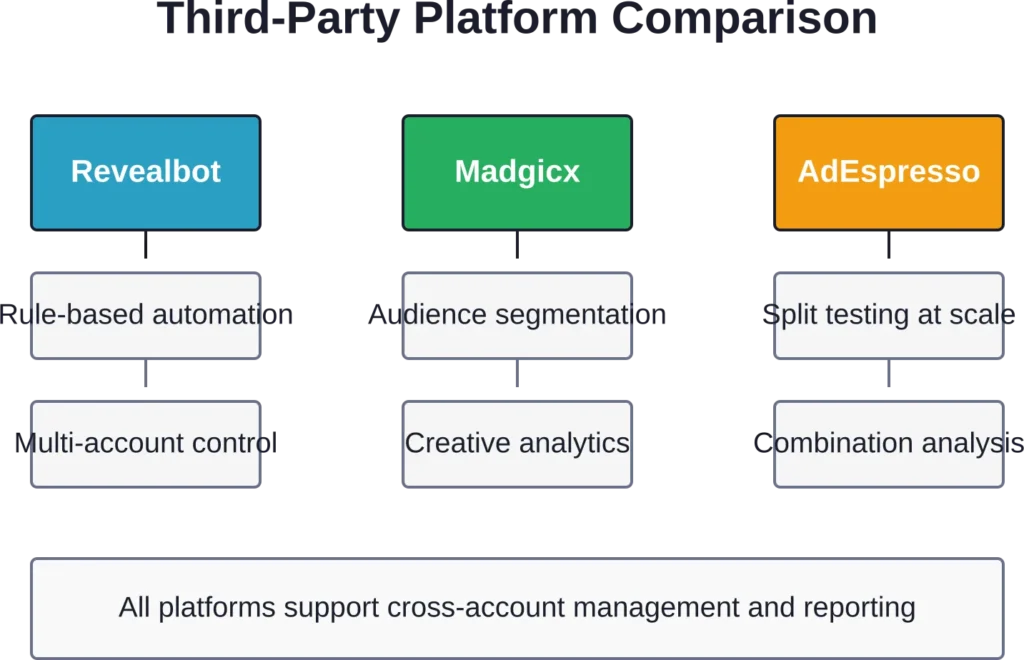
Revealbot specializes in rule-based automation for Meta ads. The platform monitors campaigns 24/7 and executes actions when predefined conditions trigger.
Example rules: pause ad sets when cost per acquisition exceeds $50, increase budget by 20% when ROAS surpasses 3.0, duplicate top-performing ads to new ad sets. The system checks metrics every hour and applies changes automatically.
Key differentiation: granular control. Unlike Meta’s black-box Advantage+ systems, Revealbot lets advertisers define exact thresholds and actions. The tool shines for agencies managing dozens of client accounts from a unified dashboard.
Pricing varies based on ad spend under management—check the official site for current tiers. Free trial available for testing automation workflows before committing.
Madgicx

Madgicx combines automation with AI-driven audience insights and creative analytics. The platform segments Meta audiences into tactical categories (“Engaged window shoppers,” “High-intent browsers”) based on behavior signals, then builds ad sets targeting each segment.
The creative intelligence module scans active ads across connected accounts and identifies performance patterns—which colors, messaging angles, or layouts drive conversions. That analysis feeds a recommendation engine suggesting what to test next.
Budget optimization runs continuously, shifting spend toward ad sets hitting efficiency targets. The system also flags anomalies: sudden CPM spikes, conversion rate drops, or audience saturation signals.
Pricing includes multiple tiers based on monthly ad spend and feature access. Most plans include a trial period.
AdEspresso (by Hootsuite)
AdEspresso simplifies split testing for Meta ads. The platform’s core strength: creating dozens of ad variations from a single campaign setup, then analyzing performance across variables (headlines, images, audiences, placements).
The workflow: upload creative assets, write multiple headline and description variants, define audience segments. AdEspresso generates all combinations and launches them as separate ads within one campaign structure.
Results dashboard highlights winning combinations and flags underperformers. The tool works well for advertisers who want structured testing without manually building hundreds of ad variants in Ads Manager.
Integration with Hootsuite provides unified reporting across paid and organic social. Pricing scales with ad spend—starter plans available for small budgets.
AdAmigo.ai

AdAmigo positions itself as a fully autonomous ad manager—set targets, connect accounts, and let the AI handle daily optimizations. The platform manages campaign creation, budget allocation, audience targeting, and performance monitoring without ongoing manual input.
The system tracks competitor activity and market shifts, surfacing alerts when external factors impact performance. Many users report improved ROAS by letting the platform adjust bids and budgets faster than human managers react to data changes.
Setup completes in approximately five minutes according to the company’s documentation. AdAmigo pricing information should be verified on the official AdAmigo.ai website for current rates.
AI-Powered Creative Generation Tools
Creative production represents a persistent bottleneck for Meta advertisers. Testing at scale requires fresh assets—images, videos, copy variations—delivered faster than traditional design workflows allow.
AdCreative.ai

AdCreative.ai generates ad visuals and copy using machine learning models trained on high-performing ad data. Input a product description and brand guidelines; the system outputs multiple design concepts optimized for Meta’s ad formats.
The platform creates static images, carousel assets, and video ads. Each output includes suggested headlines and primary text variations. The AI considers current Meta best practices: text overlay limits, focal point positioning for mobile viewing, color contrast ratios.
Pricing includes a free tier with limited generations, and paid plans scale by monthly credits. The tool integrates with Ads Manager for direct asset upload.
Creatify

Creatify specializes in video ad generation for Meta Reels and Stories. The workflow: provide a product URL, select voiceover style, choose from AI-generated scripts. The platform assembles video clips, adds text overlays, applies transitions, and renders a finished ad in minutes.
The system sources video clips from stock libraries or generates simple animations. For e-commerce, it can extract product images from websites and animate them with zoom, pan, and rotation effects.
Typical use case: testing 10-15 video ad variants per week to identify winning messaging angles before investing in professional video production. Pricing varies by output volume—check official documentation for current rates.
Foreplay.co

Foreplay functions as a creative intelligence platform rather than a generator. It monitors competitor ads across Meta, cataloging creative approaches, messaging themes, and format trends.
Users search the ad library by industry, brand, or keyword to discover what competitors currently run. The platform tags ads by creative type (user-generated content, testimonial, product demo) and tracks which ads run longest—a proxy for performance.
That competitive intelligence feeds creative strategy: identify gaps in competitor messaging, spot emerging trends early, avoid oversaturated angles. Pricing typically based on subscription tiers with varying access to historical ad data.
AI Assistants for Campaign Strategy
General-purpose AI assistants like Claude, ChatGPT, and Gemini now play supporting roles in Meta campaign planning and optimization analysis.
Claude (Anthropic)

Claude handles long-form analysis—feed it campaign performance data exports, and it identifies patterns, flags anomalies, and suggests optimization hypotheses. According to PPC.io testing documentation, some advertisers interact with Claude 20+ times daily for everything from creative brief generation to performance analysis.
Typical workflow: export campaign data from Ads Manager, paste into Claude with a prompt like “Analyze this for budget allocation opportunities.” The model spots ad sets with rising CPMs, audiences showing fatigue signals, or placements delivering inefficient results.
The tool also drafts ad copy variations, generates audience persona descriptions, and outlines testing roadmaps. Free tier available; paid plans start around $20/month for higher usage limits.
ChatGPT (OpenAI)

ChatGPT serves similar functions with additional plugin integrations. The Advanced Data Analysis feature processes CSV exports directly, generating performance visualizations and statistical summaries without manual spreadsheet work.
For creative tasks, it generates campaign concepts, writes multiple headline variants, and adapts copy for different audience segments. Some advertisers use it to translate ad copy for international campaigns or rewrite messaging at different reading levels.
Pricing includes a free tier with GPT-3.5 and paid ChatGPT Plus subscription for GPT-4 access and priority availability.
Budget Optimization and Bidding Tools
Beyond creative and targeting, AI tools increasingly manage bid strategy and budget allocation decisions that previously required manual adjustment.
Meta’s Advantage Campaign Budget
This native feature distributes campaign budget across ad sets dynamically based on real-time performance. Instead of assigning fixed budgets to each ad set, advertisers set one campaign-level budget and let Meta’s algorithm allocate spending toward the best-performing segments.
The system rebalances budget every few hours as auction dynamics shift. If one ad set’s CPM rises or conversion rate drops, budget automatically flows to better-performing alternatives within the same campaign.
Best practice: combine with Advantage+ audiences for maximum AI control, or use with manual targeting when specific audience constraints matter.
Value-Based Bidding Setup
Meta’s algorithm optimizes for conversion value rather than conversion volume when campaigns use value-based bidding. The system requires quality conversion data—purchase values passed through the pixel or Conversions API.
According to best practices outlined by Pixis.ai in January 2026, maintaining performance requires ongoing attention to data quality. If a $500 purchase and a $20 purchase both count as one conversion without value differentiation, the algorithm cannot optimize for revenue.
Configuration steps: enable value optimization in Ads Manager, ensure purchase events include value parameters, set minimum ROAS targets if needed. The algorithm learns which user behaviors predict high-value conversions and adjusts bidding to prioritize those signals.
Setting Up AI-Driven Meta Campaigns
Effective AI optimization requires proper campaign structure and data foundations. The algorithms perform only as well as the inputs and constraints provided.
Conversion Tracking Configuration
Meta’s AI systems depend on conversion signals. Install the Meta Pixel on website pages where key actions occur (purchase confirmations, lead form submissions, account registrations). Configure the Conversions API as a backup data stream—it bypasses browser tracking limitations and improves signal accuracy.
For mobile apps, integrate the Meta SDK and configure app events. The more conversion data flowing into Meta’s systems, the faster algorithms optimize toward business outcomes rather than proxy metrics like clicks or landing page views.
Creative Asset Requirements
Advantage+ campaigns require multiple creative assets to test combinations. Best practice: provide at least five images or videos, three to five headlines, and three to five primary text variants per campaign.
The algorithm assembles combinations, tests them across placements and audiences, then concentrates delivery on winners. Insufficient creative variety limits the system’s ability to discover high-performing combinations.
Audience Configuration Options
For Advantage+ campaigns, choose between “Advantage+ audience” (full AI control) or “original audiences” (manual targeting with AI expansion). The AI-controlled option delivers better cost efficiency on average but sacrifices transparency—advertisers cannot see demographic breakdowns or exclude specific segments.
Manual targeting with suggestions enabled provides a middle ground: define core audiences (location, age, interests), then let Meta’s algorithm expand reach to similar users showing intent signals.
Budget and Bid Strategy Selection
Use Advantage Campaign Budget for dynamic allocation across ad sets. Set realistic daily or lifetime budgets—too low constrains the learning phase, too high risks overspending before optimization kicks in.
For bidding, “Highest volume” works well during initial testing. Once campaigns generate sufficient conversion data (typically 50+ conversions per week per ad set), switch to “Highest value” or set cost caps to control efficiency while scaling.
Measuring AI Tool Performance
Evaluating whether AI optimization delivers results requires tracking metrics beyond Meta’s reported numbers.
Incrementality Testing
Conversion lift studies measure the true impact of ad spend by comparing exposed and control groups. Meta offers native conversion lift tools within Ads Manager—they split audiences, show ads to one segment, withhold from another, then measure outcome differences.
This reveals incremental conversions (purchases that occurred because of ads) versus organic conversions (would have happened anyway). Many advertisers discover their reported ROAS overstates actual impact when incrementality data surfaces.
Cross-Channel Attribution
Meta’s attribution window (default: 7-day click, 1-day view) captures only conversions occurring within that timeframe. Longer consideration cycles require attribution platforms that track customer journeys across touchpoints.
Tools like Google Analytics 4, Segment, or dedicated attribution platforms (Rockerbox, Northbeam) provide multi-touch attribution models showing how Meta ads interact with other channels before conversion.
Creative Fatigue Monitoring
AI systems optimize toward current performance but don’t predict creative fatigue—the gradual decline in engagement as audiences see the same ads repeatedly. Track frequency metrics (average impressions per user) and watch for rising CPMs or declining CTR as signals to refresh creative.
Most third-party platforms include fatigue alerts. Revealbot, for example, can pause ad sets automatically when frequency exceeds thresholds or engagement rates drop below benchmarks.
Common AI Optimization Challenges
AI tools introduce new failure modes that manual campaign management avoids.
Learning Phase Instability
Meta’s algorithm enters a “learning phase” when campaigns launch or after significant edits. During this period (typically until 50 conversions accumulate), performance fluctuates and cost efficiency suffers.
Frequent campaign changes restart learning. That means well-intentioned optimizations—pausing underperforming ads, adjusting budgets, tweaking targeting—can actually harm performance by preventing algorithms from stabilizing.
Best practice: let campaigns run for at least four to seven days before making changes, unless performance is catastrophically bad.
Data Quality Issues
AI systems optimize toward the conversion events tracked. If tracking breaks—pixel stops firing, Conversions API misconfigured, events duplicated—the algorithm optimizes toward corrupted data and performance collapses.
Regular audits matter. Use Meta’s Events Manager to verify event counts match expected volumes, check for sudden drops or spikes indicating tracking problems, and test conversions manually to confirm events fire correctly.
Over-Optimization Risk
Algorithms optimize for reported metrics, which don’t always align with business value. A campaign optimizing for purchases might drive low-quality customers with high return rates. A lead generation campaign might deliver form submissions from unqualified prospects.
As Search Engine Land reported in April 2026, platforms often shape performance to look better than reality—default attribution settings, view-through conversions, and broad match expansions can inflate reported results while actual business outcomes stagnate.
Mitigation: track business metrics outside Meta’s platform (revenue, customer lifetime value, qualified lead rates) and reconcile them with reported ad performance regularly.
| Challenge | Symptom | Mitigation Strategy |
|---|---|---|
| Learning phase instability | Erratic CPMs, fluctuating conversion rates during first week | Avoid campaign edits for 4-7 days after launch; consolidate ad sets to accumulate conversions faster |
| Data quality degradation | Sudden performance drops, event counts mismatched to sales | Weekly Events Manager audits; test conversion flows manually; enable Conversions API redundancy |
| Over-optimization to proxies | Reported ROAS looks great but revenue flat or declining | Track business KPIs outside Meta; run incrementality tests quarterly; audit conversion quality |
| Creative fatigue | Rising frequency, declining CTR, increasing CPMs on stable campaigns | Refresh creative every 2-4 weeks; monitor frequency metrics; use fatigue alerts in third-party tools |
Integration and Workflow Automation
AI tools deliver maximum value when integrated into broader marketing workflows rather than used in isolation.
Zapier for Cross-Platform Automation
Zapier connects Meta Ads Manager with thousands of other tools through pre-built integrations. Example workflows: new lead forms in Meta trigger CRM record creation, completed purchases fire Slack notifications, budget thresholds trigger email alerts to account managers.
These automations eliminate manual data transfer and ensure timely responses to campaign events. Pricing includes a free tier for basic automations; paid plans start from $19.99/month for higher task volumes.
Data Warehouse Integration
For large advertisers, streaming Meta campaign data into data warehouses (BigQuery, Snowflake, Redshift) enables custom analysis and machine learning models beyond what native tools provide.
Tools like Fivetran, Stitch, or Airbyte automate data pipeline creation—Meta data syncs daily or hourly into the warehouse, joins with CRM data, product catalogs, and other sources, then feeds business intelligence dashboards or custom ML models predicting customer lifetime value.
Creative Asset Management
Platforms like Bynder or Brandfolder centralize creative assets and integrate with ad platforms for streamlined asset deployment. Designers upload new creatives to the DAM system; ad managers access them directly within campaign creation workflows without downloading and re-uploading files.
This prevents version control issues and ensures brand guidelines apply consistently across campaigns and team members.
Pricing Considerations Across Tools
AI tool costs vary widely based on functionality, ad spend under management, and usage volume. Here’s what the pricing landscape looks like in 2026:
| Tool Category | Typical Pricing Model | Entry-Level Cost |
|---|---|---|
| Native Meta Advantage+ | Included free in Ads Manager | $0 (part of ad platform) |
| Third-party automation (Revealbot, Madgicx) | Monthly subscription tiered by ad spend | Check official sites; varies by spend volume |
| Creative generation (AdCreative.ai, Creatify) | Credit-based or monthly tiers | Free tiers available; paid from $29-$99/month per SERP data |
| AI assistants (Claude, ChatGPT) | Monthly subscription for premium features | Free tiers; paid around $20/month |
| Workflow automation (Zapier) | Task-based monthly pricing | Free tier; paid from $20/month |
Most platforms offer free trials—testing multiple tools in parallel before committing prevents expensive mismatches between tool capabilities and actual needs.
For budget-conscious advertisers, starting with Meta’s free native Advantage+ tools plus a free AI assistant (Claude or ChatGPT free tier) provides significant optimization capability before investing in paid platforms.
Future Developments in Meta AI Advertising
Meta continues expanding AI capabilities across its advertising stack. Based on Search Engine Land reporting from 2025-2026, several trends are accelerating:
Reels ads now include trending content features that align brand campaigns with cultural moments. Early tests showed a 20% boost in unaided awareness according to September 2025 data. Threads integration provides new inventory as that platform scales, with AI-driven placement optimization determining when Threads ads outperform Instagram or Facebook alternatives.
Generative AI creative tools are expanding beyond templates. Meta’s testing systems that generate full video ads from text prompts, produce voiceovers in multiple languages, and adapt creative styles to match audience preferences automatically.
Privacy changes continue reshaping how algorithms work. As third-party tracking declines, Meta’s AI systems rely more heavily on on-platform signals (engagement patterns, content consumption, in-app actions) rather than external website behavior. This shifts optimization toward upper-funnel engagement metrics and conversion modeling rather than direct attribution.
Frequently Asked Questions
Meta Advantage+ operates inside Ads Manager and optimizes campaigns using Meta’s proprietary algorithms and data. Third-party tools like Revealbot or Madgicx add cross-account management, custom automation rules, creative analytics, and integrations that Ads Manager lacks. Advantage+ costs nothing but offers less granular control; third-party tools charge subscription fees but provide more customization and transparency.
No. AI handles optimization at scale but still requires human oversight for strategy, creative direction, data quality audits, and business goal alignment. Algorithms optimize toward tracked metrics, which don’t always match actual business value. Successful campaigns combine AI automation for tactical execution with human judgment for strategic decisions and quality control.
Meta’s learning phase typically requires 50 conversions per ad set before performance stabilizes. For campaigns generating 10-15 conversions daily, that means three to five days. Lower conversion volume extends learning to one to two weeks. During this period, cost efficiency fluctuates. Avoid making campaign changes during learning—edits reset the optimization process.
Yes, but with limitations. Meta’s native Advantage+ tools work at any budget level and cost nothing extra. Third-party platforms often include minimum ad spend requirements or charge fees that consume a larger percentage of small budgets. For budgets under $1,000/month, start with native Meta tools plus free AI assistants (Claude, ChatGPT) before investing in paid automation platforms.
Track business outcomes outside Meta’s reporting: actual revenue, customer acquisition cost calculated from accounting data, qualified lead rates, customer lifetime value. Compare these against Meta’s reported metrics (ROAS, CPA, conversion counts). Run incrementality tests using Meta’s conversion lift tools to measure true ad impact versus organic conversions. If reported performance looks strong but business metrics stagnate, your optimization may be targeting the wrong signals.
AdEspresso excels at generating and testing hundreds of ad combinations from a single campaign setup. It creates all permutations of headlines, images, audiences, and placements, then reports which combinations perform best. For video ad generation specifically, Creatify produces multiple variants quickly from templates. For competitive intelligence informing creative strategy, Foreplay.co catalogs competitor ads and identifies trending approaches.
Advantage+ audiences (full AI control) typically deliver lower cost per conversion by finding high-intent users across Meta’s entire user base. But they sacrifice transparency—no demographic breakdowns or exclusion controls. Use them when pure efficiency matters most. Manual targeting with Meta’s suggestion features provides middle ground: define core audiences, then let AI expand reach to similar users. Use manual when brand safety, audience exclusions, or demographic constraints matter more than maximum efficiency.
Conclusion
AI tools for Meta ads optimization now span native platform features, third-party automation platforms, creative generation systems, and general-purpose AI assistants. Each addresses different workflow bottlenecks: native Advantage+ handles targeting and placement optimization at no extra cost, third-party platforms add cross-account management and granular rule engines, creative tools accelerate asset production, and AI assistants support strategy and analysis.
Testing shows properly configured AI systems doubled high-value conversions and reduced specific cost metrics by 31% compared to manual management. But success requires quality data inputs, patient learning phases, and ongoing human oversight to ensure algorithms optimize toward actual business value rather than platform-reported proxies.
Start with Meta’s free native tools combined with an AI assistant, then layer in specialized platforms as campaign complexity and budgets scale. Regularly audit tracking accuracy, run incrementality tests, and track business KPIs outside Meta’s reporting to verify optimization delivers real results.
The competitive advantage in 2026 Meta advertising belongs to teams that combine AI automation speed with human strategic judgment—not those who hand complete control to algorithms without verification.