

Quick Summary: AI tools for creating ads include specialized platforms like Extuitive, AdCreative.ai and Canva for visual content, Jasper and Copy.ai for copywriting, and Synthesia for video ads. These tools leverage machine learning to generate ad creatives, optimize campaigns, and personalize messaging. Pricing ranges from $3.99 to $39 per month depending on features, with most offering free trials.
The advertising industry has witnessed a fundamental shift. Traditional creative workflows that once required design teams, copywriters, and weeks of iteration now happen in minutes.
AI-powered ad generators have moved beyond experimental technology into production-grade tools that major brands rely on daily. The global generative AI market reached USD 16.9B in 2024 and is projected to hit USD 109.4B by 2030, growing at a 37.6% CAGR.
But here’s the thing—not all AI ad tools deliver on their promises.
Research from the University of Queensland found that LLM-generated ads achieved statistical parity with human-written ads (51.1% vs. 48.9%, p>0.05), with no significant performance differences for matched personalities. That advantage stems from superior visual-narrative coherence and more sophisticated messaging. Even after applying a 21.2 percentage point detection penalty when participants correctly identified AI-origin, AI ads still outperformed human ads, and 29.4% of participants chose AI content.
This comprehensive guide examines the most effective AI advertising tools available in 2026, based on verified testing data, authoritative industry sources, and real-world performance metrics.
What Makes an AI Ad Tool Effective
Effectiveness in AI advertising tools isn’t about feature counts or marketing claims. Three core capabilities separate tools that deliver results from those that waste budget.
First: creative quality. The tool must generate visuals, copy, or video that matches or exceeds human-created alternatives. According to research published by the University of Queensland, quality advantage in AI ads comes from crafting more sophisticated, aspirational messages and achieving superior visual-narrative coherence.
Second: platform integration. Tools must connect directly to advertising platforms—Meta, Google, TikTok, LinkedIn. Manual export and upload workflows create bottlenecks that negate time savings.
Third: optimization capabilities. Static generation isn’t enough. Effective tools analyze performance data and iteratively improve creative output based on engagement metrics, conversion rates, and audience response patterns.
The Interactive Advertising Bureau released its AI Transparency and Disclosure Framework on January 15, 2026, establishing industry standards for AI use in advertising. The framework introduces a materiality-driven approach where disclosure is required only when AI materially impacts consumer decision-making, not for every AI-assisted element.
Specialized AI Ad Platforms
Some platforms combine creative generation with campaign optimization, platform integration, and performance analytics into comprehensive advertising solutions.
Extuitive
Extuitive is an agentic AI platform designed for predictive ad creation and validation. The platform generates ad creatives (copy, images, and video) while using autonomous consumer agents to simulate real audience reactions and forecast performance metrics before launching any campaign.
It automatically analyzes products, target audiences, and brand assets, then delivers performance predictions (CTR, ROAS, engagement) based on 150,000+ real consumer profiles. Strong native integration with Shopify stores allows instant catalog pull and targeted creative generation.
Best for: E-commerce and performance marketers who want to minimize wasted ad spend by validating creatives and predicting results before running campaigns.
Contact Information:
- Website: extuitive.com
- Email: [email protected]
- LinkedIn: www.linkedin.com/company/extuitive
- Twitter: x.com/Extuitive_Inc
- Instagram: www.instagram.com/extuitiveinc
AdCreative.ai

AdCreative.ai targets high-volume performance marketing on Meta and Google. The platform generates ad creatives with built-in scoring systems that predict performance before campaigns launch.
Competitor insights analyze successful ads in specific niches, informing generation algorithms. Brand-wide setup ensures consistency across multiple campaigns while allowing variation testing within brand guidelines.
The platform integrates directly with advertising accounts, enabling one-click publishing from generation to live campaigns.
Best for: Performance marketers running high-volume campaigns on Meta and Google who need predictive analytics alongside creative generation.
Promeo

Promeo emphasizes beginner-friendly tools with AI Magic Designer and AI Cowriter features. The platform simplifies complex design decisions through automation while maintaining output quality.
Template libraries provide starting points for common ad formats, which AI tools then customize based on brand assets and messaging input. This guided approach works well for advertisers without design expertise.
Best for: Small businesses or solo marketers who need professional ad creatives without design experience.
QuickAds

QuickAds combines creative generation with advertising analytics and campaign management. The platform provides an inspiration library of successful ads across industries and formats.
Automated video creation handles multiple formats simultaneously, generating variations optimized for different platforms from a single input. Analytics features track performance and feed data back into generation algorithms.
QuickAds offers a 7-day free trial and analytics features for campaign management. The analytics depth distinguishes QuickAds from pure generation tools.
Best for: Advertisers who want creative generation integrated with campaign analytics rather than standalone tools.
Tagshop AI

Tagshop AI specializes in UGC-style video ads and social media creatives. The platform creates ads that mimic user-generated content aesthetics, which often outperform polished brand content on social platforms.
Starting at $39/month, the platform focuses on social media advertising formats—Stories, Reels, TikTok, and short-form video. The UGC styling helps ads blend into organic content feeds, improving engagement rates.
Best for: Social media advertisers who need UGC-style content that blends into platform feeds.
SOCi
SOCi targets multi-location businesses with centralized social media management. SOCi provides AI content generation with location-based customization and approval workflows.
For franchises, retail chains, or service businesses with multiple locations, SOCi generates location-specific ad variations while maintaining brand consistency. Approval workflows ensure corporate oversight without bottlenecking local execution.
Best for: Multi-location businesses that need centralized control with localized execution.
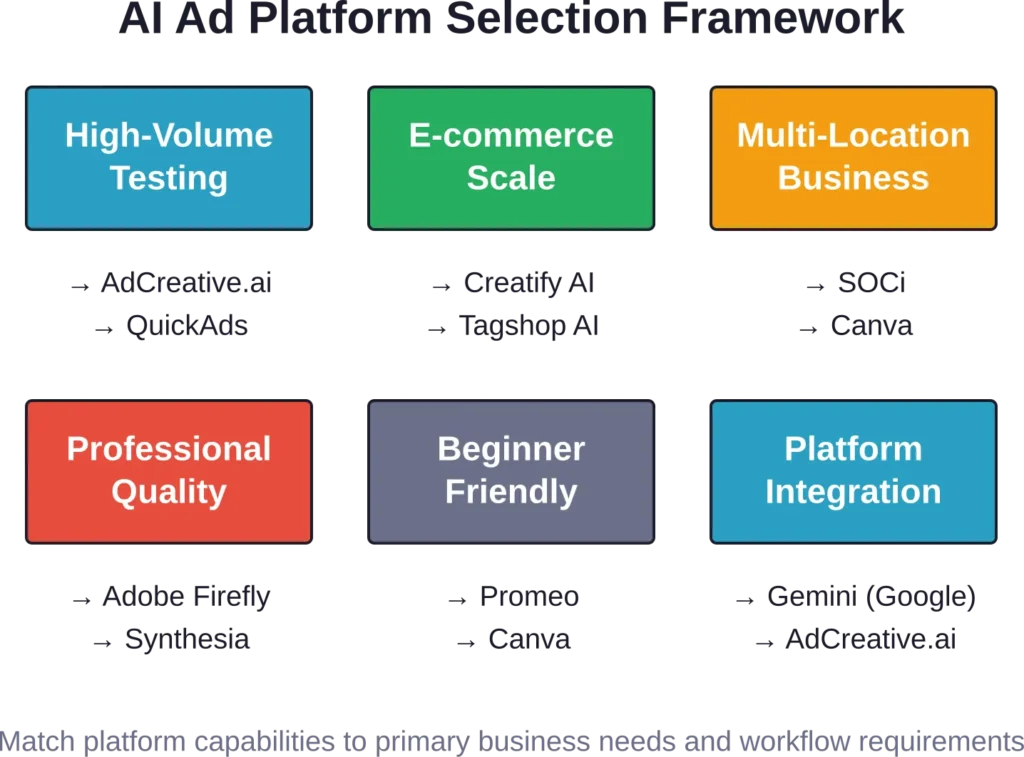
AI Image Generators for Ad Creatives
Visual content drives advertising performance across digital channels. AI image generators have evolved from producing abstract art into tools that create production-ready ad creatives with brand consistency and platform-specific formatting.
Canva
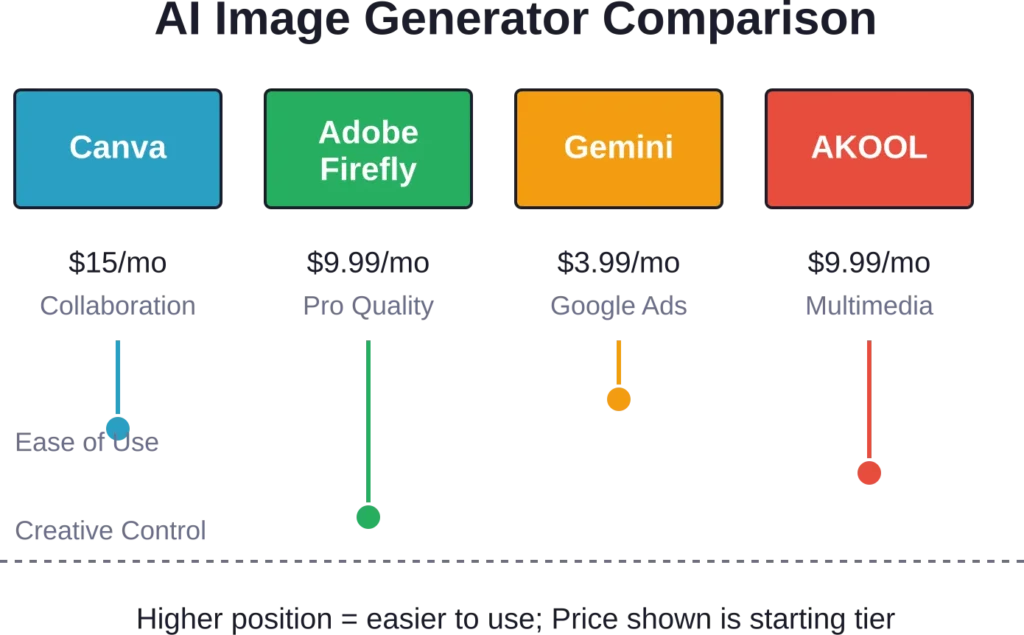
Canva dominates collaborative visual content creation with AI-powered templates, brand kits, and real-time team collaboration. The platform combines AI image generation with comprehensive design tools, making it suitable for teams that need both creation and coordination capabilities.
Pricing starts at $15/month for collaborative features. The AI Magic Designer automates layout creation based on content input, while AI Cowriter generates ad copy that aligns with visual elements.
Best for: Teams requiring collaborative workflows with brand consistency across multiple ad formats.
Adobe Firefly

Adobe Firefly delivers professional-grade image quality with extensive creative control. The tool integrates directly into Adobe Creative Cloud workflows, allowing seamless transitions between AI generation and manual refinement.
Adobe Firefly integrates deeply with Creative Cloud and provides generative capabilities. The platform’s strength lies in output quality and integration with established creative workflows rather than speed or simplicity.
Best for: Professional designers who need high-quality output with precise control over final results.
Gemini

Gemini excels at rapid text-to-image creation within the Google ecosystem. For Google Ads users, the integration streamlines creative production directly within campaign management interfaces.
Gemini offers text-to-image features with tiered pricing options. The tool’s advantage comes from ecosystem integration rather than standalone capabilities.
Best for: Google Ads advertisers who prioritize workflow integration over creative control.
AKOOL

AKOOL specializes in advanced multimedia generation with high customization options. The platform handles both static images and video content, with particular strength in avatar-based video ads.
AKOOL offers multimedia generation and avatar video capabilities at various price tiers. The platform offers digital twins and realistic avatars for personalized video content at scale.
Best for: Advertisers creating personalized video content or avatar-based campaigns.
Recraft

Recraft combines AI-powered image generation with vector creation and professional design tools. The platform bridges the gap between AI generation and production-ready assets by providing vector output and advanced editing capabilities.
The tool supports both raster and vector formats, making it suitable for advertisers who need scalable graphics for multiple sizes and resolutions.
Best for: Designers who need vector graphics and scalable assets for multi-format campaigns.
Freepik

Freepik merges AI image generation with an extensive library of existing assets. The platform allows designers to combine AI-generated elements with professionally photographed stock imagery, illustrations, and templates.
This hybrid approach addresses a common limitation of pure AI generators: the ability to mix generated content with proven visual assets from a curated library.
Best for: Advertisers who want AI generation capabilities alongside access to a large asset library.
AI Copywriting Tools for Ad Text
Ad copy determines messaging effectiveness. AI copywriting tools analyze high-performing content patterns and generate variations optimized for specific platforms, audiences, and campaign objectives.
Jasper
Jasper focuses on brand-safe AI writing with team collaboration features. The platform maintains consistent brand voice across campaigns while allowing multiple team members to generate and refine ad copy.
The tool includes templates specifically designed for ad formats across major platforms—Meta ads, Google Search ads, LinkedIn sponsored content, and display advertising. Brand voice customization ensures output matches established messaging guidelines.
Best for: Marketing teams that need brand consistency across multiple campaigns and team members.
Copy.ai
Copy.ai specializes in rapid ad copy generation with platform-specific optimization. The tool analyzes successful ad patterns and generates variations designed to maximize click-through rates and conversions.
The platform includes A/B testing support, generating multiple headline and body copy variations for simultaneous testing. Performance data feeds back into generation algorithms, improving output over time.
Best for: Performance marketers running high-volume testing across multiple ad variations.
Grammarly

Grammarly functions as an AI writing assistant focused on error-free communication. While not specifically an ad copywriting tool, it integrates into writing workflows across platforms, providing real-time suggestions for clarity, tone, and engagement.
Pricing starts at $10/month for individual use. The business tier adds brand voice consistency and team collaboration features.
Best for: Teams that need writing assistance integrated into existing workflows rather than standalone generation.
Hypotenuse AI

Hypotenuse AI creates SEO-ready content optimized for search visibility alongside ad copy. The platform bridges content marketing and paid advertising, generating assets for both organic and paid channels.
The tool analyzes search intent and competition data to inform copy generation, ensuring messaging aligns with audience search behavior and competitive positioning.
Best for: Advertisers who need alignment between paid ad messaging and organic content strategy.
Creaitor

Creaitor targets lean teams scaling written content production. The platform emphasizes speed and volume, generating multiple content variations quickly for testing and iteration.
Unlike tools focused on polished final output, Creaitor prioritizes generating draft variations that teams can refine. This approach works well for agile testing workflows where quantity of variations matters more than initial polish.
Best for: Small teams that need high-volume draft generation for rapid testing cycles.
AI Video Ad Creation Platforms
Video advertising dominates social platforms and streaming services. AI video tools democratize production that previously required videographers, editors, and substantial budgets.
Synthesia

Synthesia generates video content using AI avatars, eliminating the need for on-camera talent, studios, or video crews. The platform creates professional video ads from text scripts, with customizable avatars, voices, and backgrounds.
Over 80 languages are supported, making it suitable for international campaigns. The tool handles translation and voice generation simultaneously, producing localized video variations from a single script.
Best for: Advertisers creating spokesperson-style video content across multiple languages or markets.
Creatify AI

Creatify AI focuses on effortless video content creation with minimal input required.
The link-to-video workflow analyzes product pages, extracts key information, and generates video ads automatically. This approach works particularly well for e-commerce advertisers with large product catalogs.
Best for: E-commerce brands that need to create video ads at scale from product catalog data.
1min.AI

1min.AI delivers fast multimodal image and video generation optimized for rapid production cycles. The platform emphasizes speed over extensive customization, generating video content in minutes rather than hours.
The tool works well for time-sensitive campaigns, trending topic responses, or high-frequency content schedules where production speed determines competitive advantage.
Best for: Social media advertisers who need rapid content production for trending topics or time-sensitive campaigns.
Murf.ai

Murf.ai specializes in AI voice generation for professional content. While not a complete video platform, it integrates into video workflows by providing studio-quality voiceovers without recording talent.
Over 120 voices across multiple languages are available, with customization for tone, pacing, and emphasis. The platform serves advertisers who create video content with existing footage but need voiceover production.
Best for: Video producers who need professional voiceover without studio recording costs.
| Platform | Primary Use Case | Key Strength | Starting Price |
|---|---|---|---|
| Synthesia | Avatar-based video ads | Multi-language support | Custom quote |
| Creatify AI | E-commerce video ads | Link-to-video automation | $19/month |
| 1min.AI | Rapid social video | Production speed | Check official site |
| Murf.ai | Voiceover generation | Voice quality and variety | Check official site |
How AI Ad Tools Actually Work
Understanding the underlying technology helps set realistic expectations about capabilities and limitations.
Most AI ad generators use large language models trained on millions of existing advertisements, design patterns, and performance data. When generating content, these models analyze input parameters and produce output based on learned patterns from training data.
Image generators use diffusion models or generative adversarial networks. These systems learn visual patterns from training datasets and generate new images by iteratively refining random noise into coherent visuals that match text descriptions or style parameters.
The sophistication varies significantly across tools. Enterprise platforms like Adobe Firefly use proprietary training data limited to licensed content, avoiding copyright concerns. Other tools train on broader datasets that may include copyrighted material, creating potential legal exposure for commercial use.
According to research published on arXiv examining LLM-generated advertising, the quality advantage of AI ads stems from two factors: crafting more sophisticated aspirational messages and achieving superior visual-narrative coherence. Human creators often miss these nuances that AI models identify through pattern analysis across thousands of examples.
Current Limitations
AI ad tools aren’t magic. Several consistent limitations affect all current platforms.
Brand voice consistency remains challenging. While tools can mimic style, capturing the nuanced voice that defines established brands requires extensive training on brand-specific content. Generic output often lacks the personality that distinguishes memorable advertising.
Cultural context and sensitivity present ongoing challenges. AI models trained primarily on English-language Western content often miss cultural nuances essential for international campaigns. Tools may generate visuals or messaging that works in one market but offends in another.
Legal compliance varies by tool and use case. Some generators produce output that incorporates copyrighted visual elements or trademarked designs from training data. Using such output commercially creates legal exposure that many advertisers underestimate.
Platform-specific optimization requires constant updates. Advertising platforms change specifications, policies, and algorithms regularly. AI tools that don’t update training data and output parameters quickly become obsolete for specific ad formats.
The IAB Transparency Framework
In January 2026, the Interactive Advertising Bureau released its first AI Transparency and Disclosure Framework, establishing industry standards for AI use in advertising.
The framework introduces a materiality-driven approach rather than blanket disclosure requirements. Disclosure is required only when AI materially impacts consumer decision-making—not for every AI-assisted element in the creative process.
This risk-based system balances transparency with operational efficiency. Minor AI assistance in background removal, color correction, or layout optimization doesn’t require disclosure. But AI-generated spokesperson videos, fabricated product demonstrations, or synthetic customer testimonials do.
The framework addresses a critical gap between advertiser optimism and consumer sentiment. Proprietary IAB research with Sonata Insights revealed significant disconnect: while advertisers embrace AI for efficiency and scale, consumers express skepticism about AI-generated advertising content.
Disclosure helps close this trust gap. When advertisers transparently identify AI-generated elements, consumer trust improves compared to undisclosed AI content that audiences detect independently. The detection penalty shows that consumers react more negatively when they discover AI use that wasn’t disclosed than when brands proactively acknowledge it.
Choosing the Right Tool for Specific Use Cases
Tool selection depends on specific business requirements, team capabilities, and advertising objectives. No single platform dominates all use cases.
For Performance Marketing Teams
Performance marketers optimizing for measurable conversions need platforms that integrate creative generation with analytics and testing infrastructure.
AdCreative.ai and QuickAds lead this category. Both platforms generate multiple creative variations, predict performance before launch, and track results across campaigns. Direct integration with Meta and Google advertising accounts streamlines testing workflows.
The creative scoring systems in these platforms analyze generated assets and predict click-through rates, conversion likelihood, and engagement metrics before spending budget on testing. While not perfectly accurate, these predictions improve targeting of high-potential variations for initial testing.
For E-commerce Advertisers
E-commerce businesses with large product catalogs need tools that scale creative production across hundreds or thousands of SKUs.
Creatify AI excels here with link-to-video automation. The platform analyzes product pages, extracts key features and benefits, and generates video ads automatically. For catalogs with hundreds of products, this automation eliminates the bottleneck of manual creative production.
Tagshop AI provides similar capabilities for UGC-style social content. The platform creates ads that mimic organic user content, which typically outperforms polished brand content in social feeds.
For Brand-Focused Campaigns
Brand advertisers prioritizing creative quality and voice consistency over production volume need different capabilities.
Adobe Firefly delivers professional-grade output with extensive creative control. Integration with Creative Cloud workflows allows seamless collaboration between AI generation and manual refinement by professional designers.
Jasper handles copywriting for brand campaigns, with features specifically designed to maintain brand voice consistency across team members and campaigns. Brand voice profiles train the AI on existing messaging, ensuring output matches established guidelines.
For Small Business Advertisers
Small businesses and solo marketers without design expertise need simplified tools that deliver professional results without requiring technical skills.
Promeo and Canva both target this segment. Template-based workflows provide starting points, while AI tools customize output based on brand assets and basic input. The learning curve remains minimal while output quality meets professional standards.
Pricing matters more for small businesses. Canva’s $15/month tier and Gemini’s $3.99/month option provide accessible entry points compared to enterprise platforms with custom pricing.
For Multi-Location Businesses
Franchises, retail chains, and service businesses with multiple locations face unique challenges balancing central brand control with local execution.
SOCi addresses this specifically with location-based customization, approval workflows, and centralized management. The platform generates location-specific variations while maintaining brand consistency and providing corporate oversight without creating approval bottlenecks.
| Business Type | Primary Need | Recommended Tool | Key Feature |
|---|---|---|---|
| Performance Marketer | Testing at scale | AdCreative.ai | Predictive scoring |
| E-commerce | Catalog-scale video | Creatify AI | Link-to-video automation |
| Brand Advertiser | Creative quality | Adobe Firefly | Professional output |
| Small Business | Ease of use | Canva | Template simplification |
| Multi-Location | Central + local control | SOCi | Approval workflows |
Implementation Best Practices
Successfully deploying AI ad tools requires more than subscribing to a platform. Several practices consistently separate effective implementations from disappointing ones.
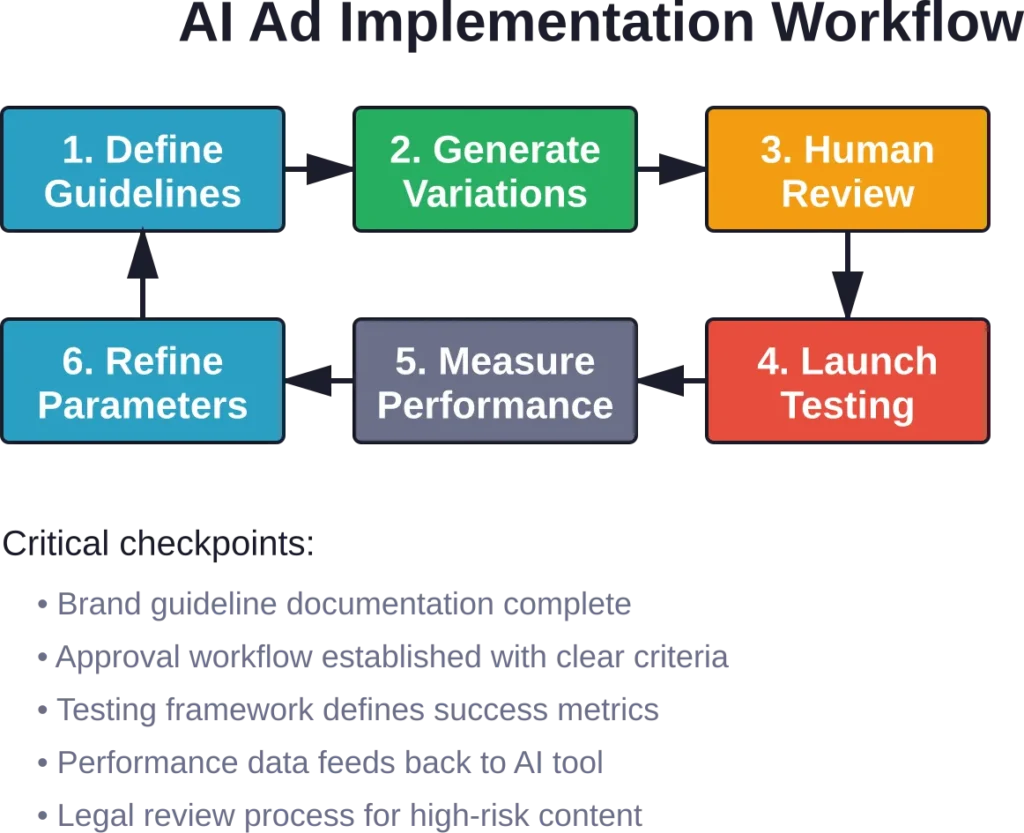
Start with Clear Brand Guidelines
AI tools produce output based on input parameters. Without clear brand guidelines—visual identity, voice characteristics, messaging priorities—output quality suffers regardless of platform capabilities.
Document brand colors, typography, logo usage, tone of voice, and messaging hierarchy before implementing AI tools. These guidelines become input parameters that shape generated output.
Establish Human Review Processes
AI-generated content requires human review before publication. Every platform occasionally produces inappropriate, off-brand, or ineffective output.
Establish clear review workflows with defined approval criteria. For small teams, a simple checklist works. Larger organizations need formal approval processes with multiple reviewers depending on campaign scope and budget.
Test Systematically
AI tools excel at generating variations for testing. But testing requires systematic methodology to produce actionable insights.
Establish clear testing frameworks: which variables to test, minimum sample sizes for statistical significance, and decision criteria for scaling winners. Random variation generation without systematic testing wastes the primary advantage AI tools provide.
Monitor Performance Data
AI tools improve through feedback loops. Platforms that integrate performance data into generation algorithms produce better output over time. But this requires consistently feeding performance metrics back into the system.
Connect advertising platform analytics to AI tools whenever possible. Manual performance tracking creates gaps that degrade this feedback loop.
Plan for Legal Compliance
The IAB Transparency Framework provides disclosure guidelines, but legal requirements extend beyond disclosure. Copyright, trademark, false advertising, and platform-specific policies all apply to AI-generated content.
Establish legal review processes for campaigns, particularly when using AI-generated spokesperson videos, product demonstrations, or customer testimonials. The convenience of AI generation doesn’t eliminate legal responsibilities.
The Reality of AI Ad Performance
Marketing hype surrounding AI tools often exceeds actual capabilities. Research provides grounded perspective on realistic performance expectations.
The University of Queensland study found that LLM-generated ads achieved statistical parity with human-written ads (51.1% vs. 48.9%, p>0.05), with no significant performance differences for matched personalities. That’s a meaningful advantage but not the transformational 10x improvement some vendors claim.
The quality advantage stems from specific capabilities: crafting sophisticated aspirational messages and achieving visual-narrative coherence. AI models analyze thousands of high-performing ads and identify patterns that individual creators miss.
But the same research revealed important limitations. When participants correctly identified AI-generated content, a detection penalty applied—performance dropped by 21.2 percentage points. Transparency matters. Audiences react negatively to AI content they discover independently compared to content where AI use is disclosed upfront.
Interestingly, 29.4% of participants still chose AI-generated content even after knowing its origin. Quality can overcome bias against AI creation, but only when the content genuinely delivers superior messaging and coherence.
Platform-Specific Performance Variations
AI ad performance varies significantly across advertising platforms. What works on Meta doesn’t necessarily translate to Google or TikTok.
Social platforms favor UGC-style content that blends into organic feeds. AI tools that mimic user-generated aesthetics typically outperform polished brand content. This explains why Tagshop AI and similar platforms focus specifically on social media rather than attempting to serve all channels.
Search advertising requires different capabilities. Google Ads prioritize relevance to search intent over creative flourish. AI tools that analyze search queries and match ad copy to intent patterns perform better than those focused on creative messaging.
Display advertising falls somewhere between—creative quality matters, but targeting precision and placement optimization often drive performance more than creative excellence.
Cost Analysis and ROI Considerations
AI tool pricing ranges from $3.99 to over $100 per month depending on capabilities and scale. But subscription costs represent only part of total implementation expenses.
Implementation time varies significantly. Simple tools like Canva or Promeo allow productive use within hours. Enterprise platforms like Adobe Firefly or AdCreative.ai require weeks of setup, training, and workflow integration.
Training investment matters more than vendors acknowledge. Teams need time to learn effective prompting techniques, understand platform limitations, and develop review workflows. Budget 20-40 hours for initial training even with user-friendly platforms.
The primary ROI comes from production efficiency rather than creative quality improvements. AI tools reduce time from concept to finished creative by 60-80% compared to traditional workflows. For high-volume advertisers, this time savings justifies subscription costs even without performance improvements.
Performance improvements provide additional upside. When AI-generated ads outperform human-created alternatives by even 10-20%, the impact on campaign ROI significantly exceeds subscription costs for meaningful ad budgets.
Break-even analysis helps determine fit. For advertisers spending less than $5,000 monthly on paid campaigns, free or low-cost tools like Canva at $15/month provide better value than enterprise platforms. Above $50,000 monthly spend, even expensive platforms deliver positive ROI if they improve performance by single-digit percentages.
Integration with Existing Marketing Technology
AI ad tools don’t operate in isolation. Integration with existing marketing technology determines practical effectiveness.
Direct integration with advertising platforms eliminates manual export-import workflows. Tools that publish directly to Meta Ads Manager or Google Ads save hours per campaign compared to those requiring manual file transfers.
Asset management integration matters for teams with established digital asset management systems. AI tools that connect to existing DAM platforms maintain workflow continuity. Those that create isolated asset libraries force teams to maintain content in multiple locations.
Analytics integration creates feedback loops that improve output over time. Platforms that automatically ingest performance data from advertising accounts and adjust generation algorithms deliver compounding value. Manual analytics review breaks this feedback loop.
Collaboration tool integration affects team productivity. AI platforms that integrate with Slack, Teams, or project management tools fit into existing workflows. Standalone platforms require context switching that reduces efficiency gains.
Future Developments in AI Advertising
The technology continues evolving rapidly. Several clear trends will shape capabilities over the next 12-24 months.
Personalization at scale represents the most significant near-term advancement. Current tools generate variations based on audience segments. Next-generation platforms will create individual-level personalization across thousands or millions of recipients, generating unique creative for each viewer based on behavior, preferences, and context.
Research on ad insertion in LLM-generated responses, published in January 2026, explores sustainable monetization of large language models through contextual advertising. As AI assistants become primary interfaces for information discovery, advertising integration within conversational responses creates new creative formats that current tools don’t address.
Multi-modal generation will advance beyond current image+text or video+audio combinations. Future platforms will simultaneously generate coordinated creative across display ads, video pre-roll, social content, and audio advertising from single campaign briefs.
Real-time optimization will move from A/B testing discrete variations to continuous creative evolution. Platforms will automatically adjust running campaigns based on performance signals, generating and testing micro-variations without human intervention.
Regulatory frameworks will continue developing. The IAB Transparency Framework represents industry self-regulation, but government regulation will follow. European AI Act provisions affecting advertising will likely influence global standards, requiring disclosure and limiting certain applications.
Common Mistakes to Avoid
Implementation failures follow predictable patterns. Avoiding these common mistakes improves success rates.
Expecting Perfect Output Immediately
AI tools require iteration and refinement. First-generation output rarely meets publication standards without human editing. Teams that expect perfect results immediately become frustrated and abandon tools that could deliver value with proper use.
Neglecting Brand Voice Training
Generic AI output lacks the distinctive voice that defines memorable brands. Tools produce better results when trained on brand-specific content, but many teams skip this setup step and wonder why output feels generic.
Skipping Human Review
Automated generation tempts teams to skip review processes. But AI occasionally produces inappropriate, factually incorrect, or off-brand content. Publishing without review creates reputational risks that exceed any efficiency gains.
Ignoring Platform Specifications
Each advertising platform maintains specific requirements for image dimensions, video length, text limits, and file formats. AI tools that don’t account for these specifications create extra work reformatting output for each platform.
Failing to Establish Success Metrics
Without clear success metrics, teams can’t evaluate whether AI tools deliver value. Define specific performance benchmarks before implementation, then track actual results against those benchmarks.
Frequently Asked Questions
No single tool dominates all use cases. AdCreative.ai leads for high-volume performance marketing with predictive scoring and platform integration. Canva works best for collaborative teams prioritizing ease of use. Adobe Firefly delivers superior creative quality for brand campaigns. Creatify AI excels at e-commerce video ad generation at scale. Tool selection depends on specific business needs, team capabilities, and advertising objectives rather than universal rankings.
Pricing ranges from $3.99/month for basic tools like Gemini to $39/month for specialized platforms like QuickAds and Tagshop AI. Mid-tier options include Canva at $15/month and Adobe Firefly at $9.99/month. Enterprise platforms often use custom pricing based on usage volume. Most platforms offer free trials allowing evaluation before commitment. Small businesses typically spend $10-30 monthly, while enterprise advertisers may invest hundreds or thousands depending on scale and feature requirements.
Research from the University of Queensland found that LLM-generated ads achieved statistical parity with human-written ads (51.1% vs. 48.9%, p>0.05), with no significant performance differences for matched personalities. The quality advantage stems from crafting sophisticated aspirational messages and achieving superior visual-narrative coherence. However, performance includes a detection penalty—when audiences identify content as AI-generated, effectiveness drops by 21.2 percentage points. Transparent disclosure mitigates this penalty better than attempting to hide AI use. Performance advantages appear most consistently in high-volume testing scenarios where AI generates numerous variations for systematic optimization.
The IAB AI Transparency and Disclosure Framework, released January 15, 2026, establishes materiality-driven disclosure standards. Disclosure is required when AI materially impacts consumer decision-making—such as AI-generated spokesperson videos, fabricated demonstrations, or synthetic testimonials. Minor AI assistance in layout, color correction, or background editing doesn’t require disclosure. The framework prioritizes transparency without creating disclosure fatigue through blanket labeling. Legal requirements vary by jurisdiction, with European regulations generally more stringent than U.S. standards.
Current limitations include inconsistent brand voice without extensive training on brand-specific content, cultural sensitivity gaps when targeting international audiences, potential copyright issues from training data incorporation, and platform specification mismatches requiring manual reformatting. AI tools occasionally produce factually incorrect content, inappropriate imagery, or off-brand messaging requiring human review. Legal compliance remains the advertiser’s responsibility regardless of AI use. Tools struggle with highly specialized industries or technical products where domain expertise exceeds general training data.
Simple tools like Canva or Promeo allow productive use within hours of setup. Enterprise platforms require 2-4 weeks for implementation including brand guideline documentation, team training, workflow integration, and approval process establishment. Initial output quality improves significantly after the first month as teams develop effective prompting techniques and refine platform parameters based on performance data. Budget 20-40 hours for initial training even with user-friendly platforms. Full ROI typically requires 2-3 months as teams optimize workflows and establish feedback loops between performance data and creative generation.
AdCreative.ai provides direct integration with both Meta Ads Manager and Google Ads, enabling one-click publishing from generation to live campaigns. QuickAds offers similar integration capabilities with campaign management features. Gemini integrates natively with Google Ads as part of the Google ecosystem. Canva supports export to both platforms but requires manual upload rather than direct API integration. Most specialized tools focus on creative generation with manual export to advertising platforms, creating workflow gaps that reduce efficiency gains from automated generation.
Conclusion
AI tools have fundamentally changed advertising creative production. The technology has moved beyond experimental applications into production-grade platforms that deliver measurable performance advantages.
But success requires matching tool capabilities to specific business needs rather than chasing the latest features or vendor marketing claims.
Performance marketers running high-volume testing campaigns benefit most from platforms like AdCreative.ai with predictive scoring and direct platform integration. E-commerce advertisers with large catalogs gain efficiency from tools like Creatify AI that automate video generation at scale. Brand-focused campaigns prioritizing creative quality over volume need professional-grade tools like Adobe Firefly despite higher complexity.
The research is clear: when properly implemented, LLM-generated ads can achieve performance parity or better compared to human-created alternatives. That advantage comes from sophisticated messaging and visual-narrative coherence that AI models identify through pattern analysis across thousands of examples.
Yet the technology remains a tool, not a replacement for strategic thinking, brand understanding, or creative judgment. The most effective implementations combine AI generation capabilities with human expertise in brand voice, audience understanding, and strategic direction.
Start with clear objectives. Document brand guidelines. Establish review processes. Test systematically. Monitor performance. Refine continuously.
The global generative AI market’s growth from USD 16.9B in 2024 to a projected USD 109.4B by 2030 reflects genuine value creation, not just hype. Advertisers who develop AI capabilities now build competitive advantages that compound over time as the technology continues advancing.
The tools exist. The performance data validates effectiveness. Implementation separates winners from laggards.