
Quick Summary: Cutting a cat’s whiskers disrupts their spatial awareness, navigation, and sensory perception, potentially causing disorientation, anxiety, and difficulty judging distances. While whiskers will eventually grow back, trimming them is never recommended and can leave cats feeling vulnerable and confused in their environment.
Whiskers aren’t just long hairs. They’re highly specialized sensory organs that cats rely on to navigate their world, hunt, and stay safe.
If you’ve accidentally trimmed your cat’s whiskers—or are wondering whether it matters—the short answer is yes, it absolutely does. But let’s break down exactly what happens and why these seemingly simple hairs are so crucial.
What Are Cat Whiskers, Really?
Cat whiskers, scientifically called vibrissae, are tactile hairs deeply embedded in a cat’s skin. Each whisker follicle is packed with nerve endings and blood vessels, making them extraordinarily sensitive to even the slightest touch or vibration.
These specialized hairs are typically found on a cat’s muzzle (the mystacial whiskers), above the eyes, on the chin, and even on the back of the front legs. The mystacial whiskers are the most prominent, extending roughly to the width of the cat’s body.
Unlike regular fur, whiskers connect directly to the muscular and nervous systems. When a whisker detects movement or brushes against an object, it sends immediate sensory information to the cat’s brain.
Why Whiskers Are So Important for Cats
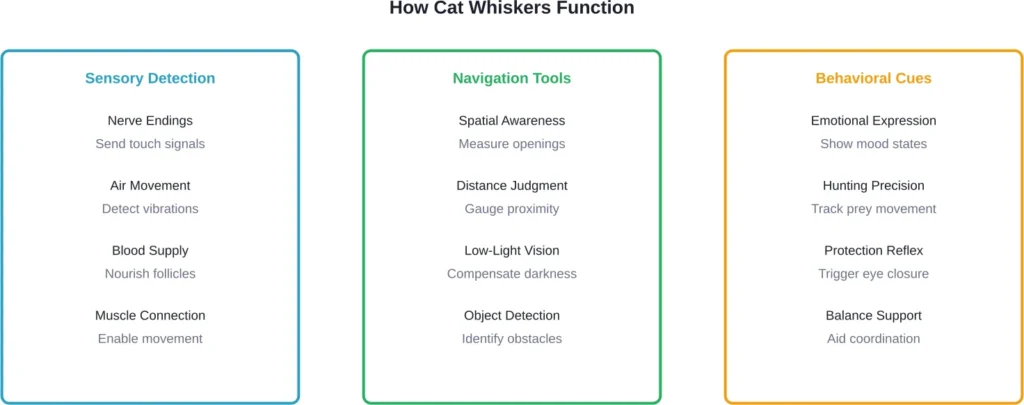
Whiskers serve multiple critical functions that regular fur simply can’t replicate.
Spatial Awareness and Navigation
A cat’s whiskers are approximately as wide as their body. This allows them to determine whether they can fit through tight spaces without getting stuck. When a cat approaches a narrow opening, their whiskers brush the sides, giving instant feedback about clearance.
In low-light conditions or complete darkness, this becomes even more essential. Cats may have excellent night vision, but whiskers provide tactile information that vision alone can’t offer.
Hunting and Prey Detection
Whiskers detect air currents and subtle vibrations. When hunting, cats use this ability to track moving prey even in the dark or when their view is obstructed. The whiskers pick up on the movement of a mouse or insect, helping the cat strike with precision.
Protection and Reflexes
When something touches a cat’s whiskers near their eyes, it triggers an automatic blink reflex. This protects their eyes from debris, branches, or other hazards. Without functional whiskers, this protective mechanism is compromised.
What Happens If You Cut a Cat’s Whiskers
Now here’s what actually occurs when whiskers get trimmed or cut.
Immediate Disorientation and Confusion
Cats lose a major sensory input system instantly. Many cats become noticeably confused or hesitant in their movements. They may misjudge distances, bump into objects, or struggle to navigate spaces they previously moved through easily.
Community discussions frequently describe cats appearing “off-balance” or unusually cautious after whisker trimming. This isn’t surprising—it’s like suddenly losing peripheral vision.
Difficulty Judging Spaces
Without whiskers to measure openings, cats may attempt to squeeze through gaps that are too narrow, potentially getting stuck. Alternatively, they might avoid spaces they could easily fit through because they lack the sensory confirmation of adequate clearance.
Increased Anxiety and Stress
Losing whiskers can make cats feel vulnerable. They depend on these sensory tools for confidence in their environment. Some cats become more withdrawn, anxious, or clingy after whisker damage.
Impaired Hunting and Play
Cats with trimmed whiskers often show reduced interest or ability in hunting-related activities. Their precision suffers, and they may miss targets or seem less engaged during play.
| Effect | Severity | Duration |
|---|---|---|
| Spatial disorientation | Moderate to High | Until regrowth (weeks to months) |
| Difficulty navigating tight spaces | High | Until regrowth |
| Reduced hunting accuracy | Moderate | Until partial regrowth |
| Anxiety or behavioral changes | Variable | Until regrowth |
| Bumping into objects | Moderate | First few weeks |
Does Cutting Whiskers Hurt Cats?
Here’s a common question: does trimming whiskers cause physical pain?
The whisker shaft itself has minimal innervation compared to the follicle, so cutting the hair doesn’t hurt in the same way trimming your own hair doesn’t hurt. However, if the cut is too close to the skin or the follicle is pulled or damaged, that absolutely can cause pain.
But the real issue isn’t physical pain during cutting—it’s the sensory deprivation and disorientation that follows. The discomfort cats experience is primarily psychological and functional, not from the act of cutting itself.
Do Cat Whiskers Grow Back?
Yes, whiskers do grow back, but it takes time.
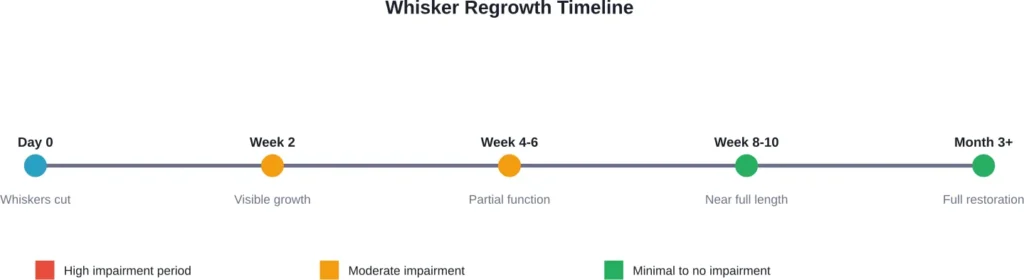
Whiskers typically regrow over a period of weeks to months for full length restoration. Partial functionality may gradually return as whiskers reach intermediate length.
Whiskers naturally shed and regrow throughout a cat’s life, just like regular hair, but on a much slower cycle. If whiskers are cut rather than naturally shed, the regrowth timeline remains the same—the follicle wasn’t damaged, so it continues its normal cycle.
What to Do If Your Cat’s Whiskers Get Trimmed
Accidents happen. Maybe a well-meaning groomer trimmed them, or a child didn’t know better. Here’s what to do.
Keep Your Cat Indoors
If your cat normally goes outside, keep them inside until whiskers regrow. Without functional whiskers, outdoor navigation becomes significantly more dangerous.
Simplify Their Environment
Remove obstacles or rearrange furniture to create wider, clearer pathways. This reduces the chance of your cat bumping into things or getting stuck.
Monitor for Stress
Watch for signs of anxiety like hiding, reduced appetite, or excessive vocalization. Provide extra comfort, familiar spaces, and maintain routine to minimize stress.
Avoid Trimming Again
Communicate clearly with groomers that whiskers should never be trimmed. If grooming at home, be extremely careful around the whisker areas.
Consult a Veterinarian if Needed
If your cat shows severe disorientation, stops eating, or appears to be in pain, contact your vet. While whisker trimming itself isn’t a medical emergency, underlying issues or extreme behavioral changes warrant professional attention.
Should You Ever Trim Cat Whiskers?
The answer is straightforward: no, never intentionally trim cat whiskers.
There’s no legitimate grooming or health reason to cut them. Whiskers are essential sensory tools, not cosmetic features. Even if whiskers look long, uneven, or aesthetically displeasing, they serve critical functions that far outweigh any appearance concerns.
Veterinarians and animal welfare organizations universally advise against whisker trimming. The ASPCA and similar organizations emphasize that whiskers should be left alone during grooming.
Frequently Asked Questions
Yes, whiskers will grow back. Whiskers typically regrow over a period of weeks to months. The follicle remains intact, so the natural growth cycle continues, with partial functionality gradually returning as whiskers reach intermediate length.
Cats can survive without whiskers, but their quality of life decreases significantly. They experience disorientation, reduced spatial awareness, and difficulty navigating, especially in low light or tight spaces. It’s not life-threatening but substantially impairs their natural abilities.
Most cats have mystacial whiskers on each side of the muzzle, typically arranged in multiple rows. However, the exact number can vary slightly between individual cats. Whiskers also appear above the eyes, on the chin, and on the front legs.
Natural whisker shedding is normal and happens periodically throughout a cat’s life. Since only one or two whiskers shed at a time and regrow on their natural cycle, cats don’t experience the disorientation that comes from multiple whiskers being cut simultaneously.
Even trimming the tips reduces whisker functionality. The full length is necessary for accurate spatial measurement and sensory detection. Any shortening compromises their effectiveness, so whiskers should never be trimmed, even partially.
Some cat breeds, particularly rex varieties, naturally have curly or kinked whiskers. While these may be less effective than straight whiskers, cats born with them adapt accordingly. Cutting straight whiskers to match curly ones, however, would create the same problems as any whisker trimming.
Yes, indoor cats rely on whiskers just as much for navigation, spatial awareness, and sensory information. They use whiskers to move through furniture, gauge openings, and interact with their environment, regardless of whether that environment is indoors or outdoors.
The Bottom Line on Cutting Cat Whiskers
Whiskers aren’t optional accessories—they’re essential sensory organs that cats depend on for navigation, hunting, protection, and confidence in their environment.
Cutting them causes disorientation, anxiety, and functional impairment that lasts until regrowth completes. While the act of cutting doesn’t cause pain, the resulting sensory deprivation absolutely affects your cat’s well-being.
If whiskers have been accidentally trimmed, keep your cat safe indoors, simplify their environment, and give them time to regrow. And going forward, make whisker protection a non-negotiable part of grooming—whether you’re doing it yourself or working with a professional.
Your cat’s whiskers deserve respect and protection. They’ve earned them through millions of years of evolution.