

Quick Summary: Swallowing a single magnet typically passes through the digestive system without harm, but ingesting multiple magnets is a medical emergency. When two or more magnets are swallowed, they can attract each other through bowel walls, causing tissue death, perforations, and obstructions that often require emergency surgery within hours.
Magnets are everywhere. From children’s toys to desk gadgets, these small powerful objects pose a serious health risk when swallowed.
But here’s what makes this different from swallowing other foreign objects: the unique danger of multiple magnets attracting each other inside your body.
Between 2003 and 2006, CPSC staff identified one death and 19 other cases of injuries requiring gastrointestinal surgery from magnet ingestion, with patients ranging from 10 months to 11 years, 6 months old. The real problem? Rare earth magnets—also called neodymium magnets—are significantly more powerful than traditional refrigerator magnets.
The Single Magnet vs. Multiple Magnet Distinction
Not all magnet ingestions are created equal.
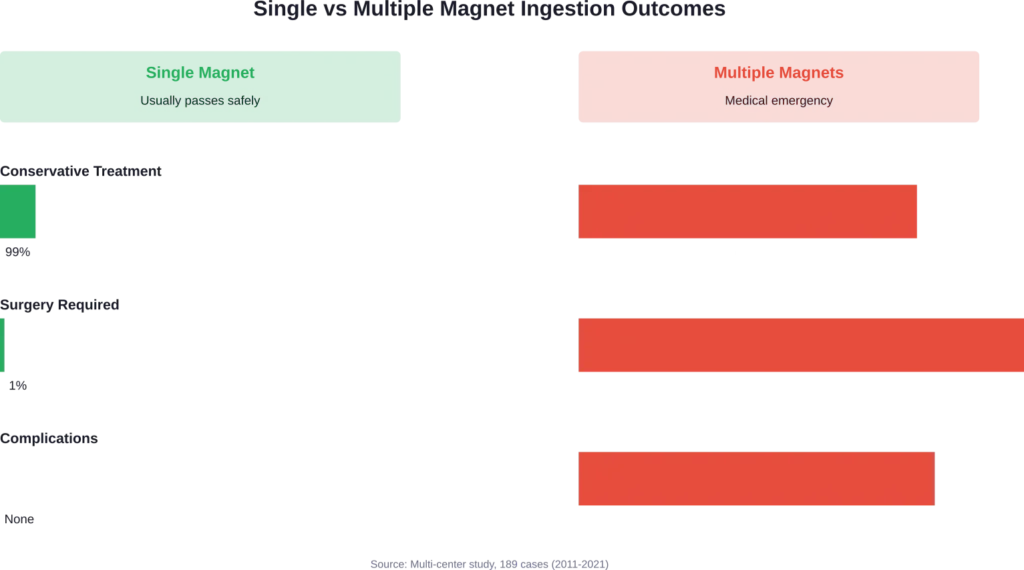
When someone swallows a single magnet, it usually passes through the digestive system without incident. The magnet travels from the stomach through the small intestine and eventually exits the body naturally within a few days.
But swallowing two or more magnets changes everything.
According to a multi-center observational study covering hospitals in Qatar, UAE, Saudi Arabia, Tunisia, and Turkey, 189 magnet ingestions were documented between 2011 and 2021. Of these cases, 88 (46.6%) involved multiple magnets.
Here’s the critical difference: multiple magnets attract each other with tremendous force, even through layers of intestinal tissue. As they move through different parts of the digestive tract, they can pull toward each other across bowel walls, trapping tissue between them.
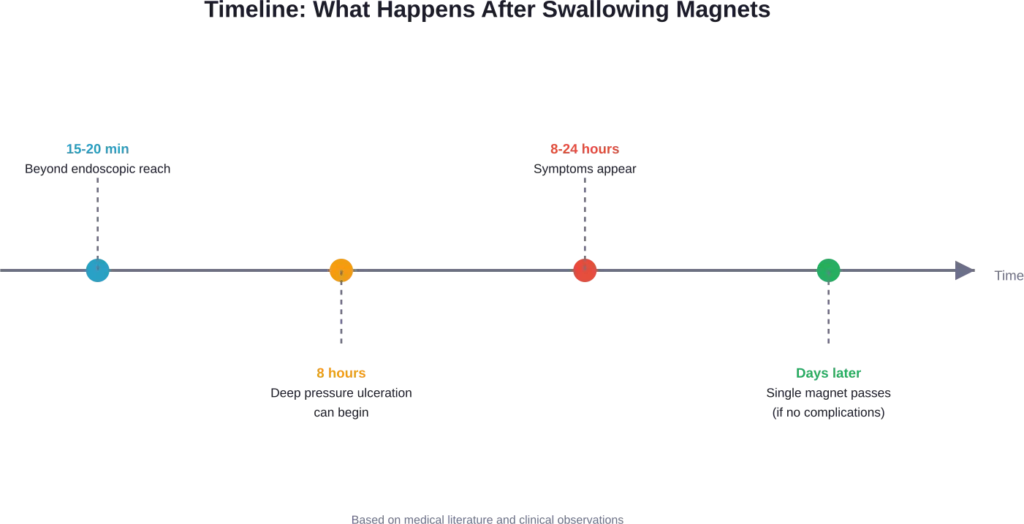
Real talk: this crushing pressure cuts off blood supply to the intestinal tissue, causing necrosis (tissue death) in as little as 8 hours.
What Makes Rare Earth Magnets So Dangerous
UC Davis health experts describe neodymium magnets as “capable of punching holes in your intestines if swallowed.” These aren’t your typical refrigerator magnets.
Rare earth magnets are the strongest commercially available magnets. They’re powerful enough to attract each other from significant distances—even when separated by stomach and intestinal walls.
The Consumer Product Safety Commission (CPSC) has issued multiple warnings about magnetic toy sets. About 145,830 LRIGYEH Magnetic Travel Toys were sold online at Amazon.com from February 2024 through October 2025 for about $7. About 7,723 TOP MAGNETS Magnetic Men stick figure toy sets were sold online at Amazon.com from June 2024 through October 2025 for about $9.
These products violate mandatory toy safety standards because each stick figure contains four small magnets that can easily detach and be swallowed.
How Multiple Magnets Cause Internal Injury
The mechanics of magnet-induced injury are straightforward but devastating.
When multiple magnets enter the digestive system, they don’t necessarily stay together. One magnet might reach the stomach while another remains in the esophagus. Or they might separate as they travel through different loops of the small intestine.
The powerful magnetic attraction pulls these separated magnets toward each other through the intestinal walls. This creates pressure necrosis—the trapped tissue between the magnets loses blood supply and begins to die.
According to Thomas Attard, MD, pediatric gastroenterologist at Children’s Mercy Hospital, there’s a very small window to retrieve swallowed magnets without surgery. It may take as little as 15 to 20 minutes for objects to move beyond reach of endoscopic removal.
Deep pressure ulceration can occur within eight hours of ingestion.
Common Complications From Multiple Magnet Ingestion
The multi-center study examined complications in patients who swallowed multiple magnets, finding that those affected experienced significant morbidity.
Single magnet ingestions showed significantly better outcomes with minimal complications.
According to the multi-center study, 53 (28%) of 189 total magnet ingestion cases required surgical intervention. 17 (8.9%) of total cases underwent gastroscopy.
Symptoms and Warning Signs
Here’s where it gets tricky: symptoms aren’t always obvious immediately.
Many magnet ingestions aren’t witnessed. Parents don’t realize their child swallowed magnets until symptoms develop or the child mentions it later.
According to the National Capital Poison Center, healthcare providers should consider battery ingestion in patients presenting with:
- Acute airway obstruction
- Wheezing or noisy breathing
- Drooling
- Vomiting
- Chest pain
- Abdominal pain
The challenge? These symptoms are non-specific. They can resemble common conditions like acute gastroenteritis (stomach flu). It may take 8-24 hours for symptoms to appear after ingestion.
One documented case involved a three-year-old who initially seemed fine but later developed persistent vomiting and abdominal pain. X-rays revealed multiple magnets creating a cluster in the intestines.
Age Groups Most Affected
A survey of more than 1,700 doctors reported at least 480 toy magnet ingestions over a decade, with 204 occurring in a single recent year. The age breakdown showed:
- 50.4% of patients between ages 1 and 6
- 33.6% between ages 6 and 12
- Median age: 4 years, 9 months
But don’t assume this only affects toddlers. The University of Rochester Medical Center notes that older children and even adolescents intentionally swallow magnets, sometimes using them as fake tongue or lip piercings.
What To Do If Someone Swallows Magnets
Time matters enormously.
If someone swallows magnets—or if there’s any suspicion of ingestion—seek immediate medical attention. Call the National Poison Center at 1-800-222-1222 or go directly to an emergency department.
Do not induce vomiting. This can cause additional trauma and doesn’t effectively remove the magnets.
Healthcare providers will order an X-ray to determine:
- How many magnets were swallowed
- Where they’re located in the digestive tract
- Whether they’re attracting to each other
- If a battery was also ingested (which creates additional risks)
The National Capital Poison Center’s treatment guidelines specify that patients over 12 years old who swallowed a battery ≤12 mm may not require an X-ray if asymptomatic since ingestion, only one battery was ingested, and no magnet was also ingested.
But wait—this guideline highlights an important point: batteries and magnets together create even more dangerous scenarios.
Treatment Options
Treatment depends entirely on the number of magnets, their location, and symptom severity.
Conservative management: If a single magnet was swallowed and the patient remains asymptomatic, doctors may monitor the situation with repeat X-rays to confirm the magnet is progressing through the digestive tract. Parents watch for the magnet to pass in stool.
Endoscopic removal: If caught early enough—within that critical 15-20 minute window—magnets still in the stomach or upper digestive tract can sometimes be retrieved using endoscopy. This involves inserting a flexible tube with a camera and tools through the mouth.
Surgical intervention: When multiple magnets have attracted to each other and caused injury, surgery becomes necessary. According to the multi-center study, 53 (28%) of 189 total magnet ingestion cases required surgical intervention to remove the magnets and repair damaged tissue.
Surgery may involve removing sections of dead bowel, repairing perforations, or addressing fistulas (abnormal connections between organs).
The Rise in Magnet Ingestion Incidents
This isn’t a stable problem—it’s getting worse.
Research on magnet ingestions in children presenting to US emergency departments from 2002 to 2011 found the incidence increased 8.5-fold, from 0.45 per 100,000 to 3.75 per 100,000, with a 75% average annual increase per year.
The US Centers for Disease Control and Prevention issued its first warning about this new generation of magnets in 2006.
From 2009 to 2011, there was a notable increase in older children ingesting these magnets, likely because magnetic desk toys and building sets became trendy among teenagers and adults.
Regulatory Response
The CPSC has taken action, but enforcement remains challenging.
Multiple manufacturers have been cited for violating mandatory toy safety standards. LRIGYEH’s parent company MAZHA hasn’t agreed to recall products or offer remedies. TOP MAGNETS hasn’t responded to violation notices.
Stoney Games did recall their Kluster magnet chess games, offering replacement magnets that aren’t small parts. Huaker recalled magnetic balls and rods sets, requesting consumers throw them away and email disposal photos for refunds.
But thousands of dangerous products remain in homes, having been purchased before recalls.
| Product Type | Risk Level | Why Dangerous | Action Needed |
|---|---|---|---|
| Single refrigerator magnet | Low | Weak attraction, typically passes | Monitor if swallowed |
| Rare earth desk toys | Extreme | Strong attraction, multiple pieces | Remove from home |
| Magnetic building sets | High | Small detachable magnets | Keep from children under 14 |
| Magnetic stick figures | Extreme | Four magnets per figure, easily separated | Dispose immediately |
Prevention Strategies
The most effective strategy is simple: keep high-powered magnets away from children.
According to health experts at UC Davis, parents should steer clear of neodymium magnets entirely. These products are marketed as toys but pose life-threatening risks.
Practical prevention steps include:
- Inspect toys before purchase—check for small detachable magnets
- Read warning labels carefully (though research shows labels prove ineffective at preventing ingestions)
- Keep desk toys and tool kits with magnets in secure locations
- Educate older children about the specific dangers of swallowing multiple magnets
- Regularly check existing toys for broken or loose magnet components
- Dispose of recalled products properly
If rare earth magnets are already in the home, consider replacing them with safer alternatives or securing them in locked storage away from all children.
Long-Term Outcomes and Recovery
Recovery depends on how quickly treatment begins and the extent of internal damage.
Children who undergo surgery face recovery periods involving hospitalization, pain management, and dietary restrictions. Some experience long-term complications from bowel resection or repair.
The documented cases in the multi-center study reported no deaths among the 189 patients, which is encouraging. However, the study noted significant morbidity—many children suffered serious complications requiring intensive medical intervention.
Cases caught early with endoscopic removal typically have excellent outcomes. The child recovers quickly without lasting effects.
Cases requiring surgery often involve hospitalization, recovery periods, pain management, and dietary restrictions.
Frequently Asked Questions
A single magnet typically passes through the digestive system within several days, similar to other small objects. However, multiple magnets may not pass at all—they can become stuck as they attract each other through intestinal walls, requiring medical intervention.
Yes, magnets are visible on X-rays because they’re metal objects. Medical imaging helps doctors determine how many magnets were swallowed, where they’re located, and whether they’ve attracted to each other across bowel loops.
Rare earth magnets (neodymium magnets) are significantly more powerful than traditional refrigerator magnets. They can attract each other from greater distances and with much stronger force, making them far more dangerous when swallowed because they can pull together through multiple layers of tissue.
A single magnet usually passes through the digestive system without causing harm. According to the multi-center study, patients who swallowed single magnets experienced no serious complications. The danger arises when multiple magnets are ingested.
If caught within 15-20 minutes, magnets may be retrieved endoscopically using a flexible tube inserted through the mouth. If magnets have progressed further or caused damage, surgical removal becomes necessary. According to the multi-center study, 53 (28%) of 189 total magnet ingestion cases required surgical intervention.
Warning signs include persistent vomiting, abdominal pain, difficulty breathing, drooling, or chest pain. However, symptoms may not appear for 8-24 hours after ingestion, and they can resemble common stomach flu. Any suspected magnet ingestion requires immediate medical evaluation regardless of symptoms.
High-powered magnetic toys that violate safety standards are subject to recalls, but enforcement is inconsistent. The CPSC has issued numerous warnings and recall notices, but thousands of dangerous products were sold before regulatory action. Many remain in homes despite not being legally sold as children’s toys.
Conclusion
Swallowing magnets represents a serious and growing health hazard, particularly for children.
While a single magnet typically passes without incident, multiple magnets create a true medical emergency. The powerful attraction between rare earth magnets can cause tissue death, bowel perforations, and life-threatening infections within hours.
Parents and caregivers should recognize that warning labels haven’t prevented ingestions—the most effective protection is removing high-powered magnets from environments where children live and play.
If magnet ingestion occurs or is suspected, seek immediate medical attention. Time is critical. The difference between endoscopic removal and emergency surgery can be measured in minutes.
Check your home today for magnetic toys, desk gadgets, and building sets. If they contain small, powerful magnets, consider disposal or secure storage. This simple action could prevent a preventable tragedy.