
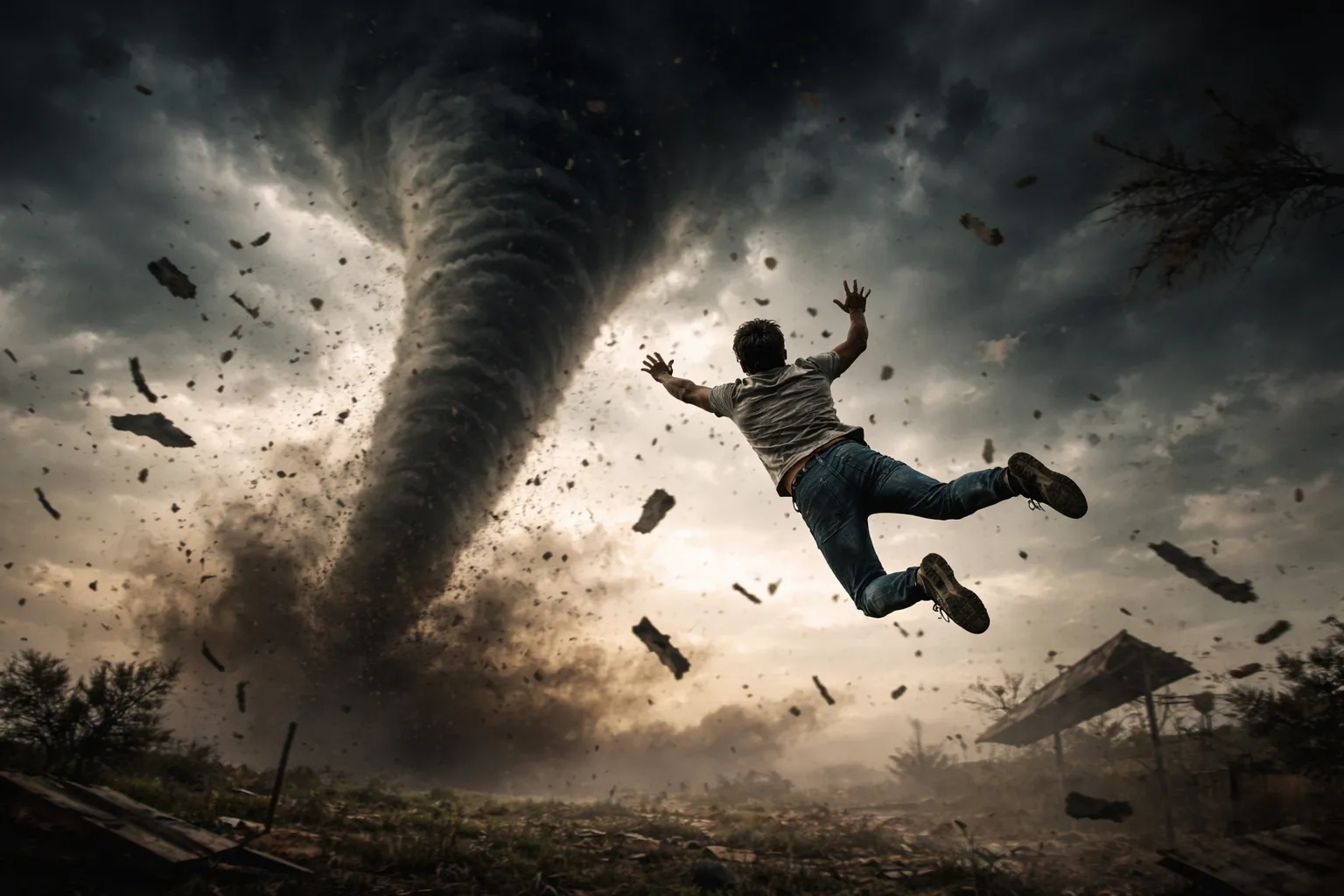
Quick Summary: Being sucked into a tornado means enduring violent winds exceeding 200 mph in strong tornadoes, with the most violent exceeding 300 mph, being struck by debris traveling at lethal speeds, and experiencing extreme disorientation before being thrown to the ground. According to NOAA, even the worst tornadoes have approximately a 99% survival rate overall, though those caught directly in the vortex face severe trauma from impacts and falls. Survival depends on protective shelter, awareness of warnings, and the tornado’s intensity.
The question sounds like something from a disaster movie. But for a handful of people who’ve lived through it, being caught in a tornado’s vortex is terrifyingly real.
Tornadoes remain one of nature’s most violent and unpredictable phenomena. According to the National Severe Storms Laboratory (NSSL), tornadoes are narrow, violently rotating columns of air extending from thunderstorms to the ground. The U.S. experiences more tornadoes than anywhere else globally, making understanding these storms critical for safety.
So what actually happens if you’re caught in one? Here’s what the science, survivor accounts, and meteorological data tell us.
Understanding the Anatomy of a Tornado
Before diving into what happens inside a tornado, it helps to understand what you’re dealing with.
Most tornadoes emerge from rotating thunderstorms called supercells. However, nearly 20% originate from quasi-linear convective systems (QLCS), according to NSSL research. These QLCS tornadoes frequently strike during late night and early morning hours when visibility is poor.
The visible funnel you see is actually a condensation funnel made of water droplets, dust, and debris. Wind itself is invisible. That spinning column can generate wind speeds exceeding 200 mph in strong tornadoes, with the most violent exceeding 300 mph.
NSSL data indicates that wall clouds may rotate persistently for 10-20 minutes before a tornado forms, though not always. Strong surface winds flow into these formations, creating the characteristic violent rotation.
The Power Behind the Winds
Tornado wind speeds vary dramatically based on intensity. The weakest tornadoes might produce winds around 65-85 mph. The strongest? Over 300 mph.
At those speeds, ordinary objects become missiles. Wood planks, metal sheets, glass shards—all transform into lethal projectiles.

What Happens When You’re Sucked Into a Tornado
The experience of being caught in a tornado is beyond what most can imagine.
One Gulf War veteran described being sucked into a tornado as “hands down one of the most traumatic and terrifying moments” of his life. That’s saying something for someone who served in combat.
Here’s what happens in sequence:
The Initial Lift
First, the extreme winds lift you off the ground. This isn’t gradual. It’s sudden and violent.
The upward velocity depends on the tornado’s intensity. Weaker tornadoes might lift objects only a few feet. Violent tornadoes can carry debris thousands of feet into the air.
You lose all control. There’s no way to orient yourself or resist the force.
Inside the Vortex
Once airborne, you’re surrounded by a maelstrom of debris. Everything from tree branches to car parts to building materials swirls around you.
Community discussions from survivors describe complete disorientation. There’s no sense of up or down. The roar is deafening—described as sounding like a freight train or jet engine.
Debris strikes come from all directions. According to CDC data on tornado-related fatalities, traumatic injuries are the leading cause of death. Among 338 tornado decedents studied, 21.9% suffered fatal head injuries specifically.
The wind speed means even small objects carry devastating impact force. A piece of wood traveling at 150 mph can penetrate concrete.
The Descent
Eventually, the tornado either dissipates or ejects you from the vortex.
This isn’t a gentle landing. You’re thrown to the ground with tremendous force. One survivor recalled thinking: “I thought, oh great, I survived being sucked up into the air in a tornado, now I’m gonna’ be crushed to death!”
The fall distance varies. Some people are dropped after being lifted only 20-30 feet. Others fall from much higher. Landing on debris, pavement, or other hard surfaces causes additional trauma.
Survival Odds and Statistics
Here’s something that might surprise you.
The National Weather Service reports that even during the worst tornadoes, the overall survival rate is approximately 99%. But this statistic requires context.
That 99% includes everyone in the tornado’s path—most of whom take shelter. Those who remain in sturdy buildings, basements, or designated safe rooms account for the vast majority of survivors.
The survival rate for people actually caught in the open or sucked into the vortex itself is dramatically lower.
| Location During Tornado | Relative Safety Level | Key Risk Factors |
|---|---|---|
| Underground shelter/basement | Highest survival rate | Minimal debris exposure |
| Interior room, lowest floor | High survival rate | Some structural collapse risk |
| Single-family home (no shelter) | Moderate survival rate | 46.7% of fatalities occur here |
| Mobile home | Low survival rate | 26.6% of fatalities occur here |
| Outdoors/caught in vortex | Very low survival rate | Direct debris impacts, falls |
CDC data shows that among tornado fatalities, 46.7% of decedents were in single-family homes, while 26.6% were in mobile homes. The median age of victims was 55 years, with approximately one-third being older adults.
Factors That Influence Survival
Several elements determine whether someone survives being caught in a tornado:
Tornado intensity: An EF0 or EF1 tornado offers dramatically better survival odds than an EF4 or EF5. The wind speed difference is literally life or death.
Warning time: Those aware of tornado warnings who take immediate shelter action drastically improve their survival chances. Preparedness matters enormously.
Landing surface: Being thrown onto grass or soft earth is far preferable to concrete or debris piles.
Debris density: Tornadoes in urban areas or through developed communities generate more dangerous projectiles than those crossing open fields.
Physical condition: Younger, healthier individuals better withstand the physical trauma of impacts and falls.
Real Survivor Accounts
Few people have been sucked into tornadoes and lived to describe it.
One survivor stated: “Words cannot describe what it felt like. Beyond horrifying. I am lucky to be alive for sure. I don’t think you will meet many people in your life who have survived something like this.”
The experience combines several terrifying elements simultaneously: loss of control, extreme physical violence, deafening noise, complete disorientation, and the certainty that death is imminent.
Survivors describe the sensation as surreal—almost dreamlike in its intensity. The human brain struggles to process the experience in real-time.
Physical injuries vary but commonly include:
- Traumatic head injuries from debris impacts
- Broken bones from the initial lift, impacts while airborne, and landing
- Lacerations from glass, metal, and sharp debris
- Internal injuries from blunt force trauma
- Crush injuries if buried under debris after landing
CDC analysis of tornado injuries found that among 955 individuals injured by tornado storms who sought medical assistance, 67% had minor injuries (treated and released), 27% were hospitalized, and 6% were killed.

Essential Safety Measures and Preparedness
The best way to survive a tornado is simple: don’t get caught in one.
That might sound obvious, but preparedness genuinely saves lives. According to available data, those aware of tornado warnings who take immediate protective action have dramatically better outcomes.
Before Tornado Season
Preparation happens long before storms develop. Identify your safe space now—ideally a basement or storm cellar. Interior bathrooms or closets on the lowest floor work if underground options aren’t available.
Stay away from windows. Flying glass is a major cause of lacerations during tornadoes.
Mobile homes offer virtually no protection. If that’s where you live, identify a nearby sturdy building or community shelter you can reach quickly.
When Warnings Are Issued
Tornado watches mean conditions are favorable for tornado formation. Tornado warnings mean a tornado has been spotted or indicated on radar.
When a warning is issued for your area, act immediately. Don’t wait to see the funnel. By the time it’s visible, you may not have time to reach safety.
Get to your predetermined safe location. Bring a battery-powered weather radio if possible. Cover yourself with mattresses, heavy blankets, or sleeping bags to protect against debris.
If Caught Outside
Sometimes people are caught outside with no shelter available. This is the worst-case scenario.
Do not try to outrun a tornado in a vehicle. Tornadoes can change direction unpredictably and move faster than they appear. Vehicles offer no protection and can be thrown hundreds of feet.
If no shelter exists, lie flat in the nearest ditch or depression. Cover your head and neck with your hands. It’s not ideal, but it’s better than being fully exposed.
Never seek shelter under highway overpasses. This is a dangerous myth. Overpasses can create wind tunnel effects that actually increase wind speed.
What Science Still Doesn’t Know
Despite decades of research, much about tornadoes remains mysterious.
NSSL researchers acknowledge that tornadoes are rare, deadly, and difficult to predict. They can deal out millions or even billions of dollars in property damage annually, yet scientists still struggle to understand exactly how they form.
Current tornado research targets ways to better understand formation mechanisms and use that knowledge to improve forecasts and warnings.
One challenge is that every tornado is unique. Two tornadoes can develop from similar atmospheric conditions yet behave completely differently. Predicting which thunderstorms will produce tornadoes—and how strong those tornadoes will be—remains imperfect.
Frequently Asked Questions
Breathing would be extremely difficult inside a tornado’s vortex. The violent winds, debris-filled air, and extreme atmospheric pressure changes would make normal respiration nearly impossible. Most survivors report being unable to breathe properly during the experience.
The distance depends on tornado intensity. Weaker tornadoes might lift someone only 20-30 feet before dropping them nearby. Violent EF4 or EF5 tornadoes have carried debris—including people—over a mile from the original location. Generally speaking, stronger tornadoes with higher wind speeds can transport objects much farther.
Survivors consistently describe the sound as similar to a freight train or jet engine at close range. The noise is deafening and disorienting, making it impossible to hear anything else. Some report their ears popping from rapid pressure changes.
Most survivors report remaining conscious throughout the ordeal, though severely disoriented. Some lose consciousness from debris impacts or lack of oxygen. The experience is so overwhelming that the brain struggles to process it, leading to fragmented memories for some survivors.
Underground shelters, basements, or storm cellars provide the best protection. If those aren’t available, interior rooms on the lowest floor away from windows offer the next-best option. Bathrooms and closets with sturdy walls work well. Avoid mobile homes entirely—seek substantial shelter elsewhere.
The National Weather Service indicates approximately 99% survival rates even in severe tornadoes, but this includes everyone in the affected area. Those in proper shelter account for most survivors. People caught in the open or in mobile homes face much lower survival rates, particularly in violent tornadoes.
Yes. Strong tornadoes regularly lift vehicles, livestock, and even train cars. An EF4 or EF5 tornado can pick up objects weighing several tons and carry them considerable distances. Cows, cars, and trucks become airborne projectiles in violent tornadoes, which is why seeking shelter in vehicles is so dangerous.
The Reality of Tornado Survival
Being sucked into a tornado represents one of the most violent experiences a person can endure.
The combination of extreme winds, debris impacts traveling at lethal speeds, complete disorientation, and the inevitable violent landing creates multiple points of potential fatal injury. According to CDC research, traumatic injuries—particularly head trauma—represent the leading cause of tornado deaths.
But here’s the thing: most tornado deaths are preventable.
The difference between life and death usually comes down to preparation and immediate action when warnings are issued. Those who have predetermined safe locations, stay informed about weather conditions, and act decisively when threats emerge overwhelmingly survive.
The U.S. experiences more tornadoes than anywhere else globally. If you live in tornado-prone regions, preparedness isn’t optional—it’s essential. Identify your shelter location now. Know the difference between watches and warnings. Have a weather radio and emergency kit ready.
Don’t wait until you hear the freight-train roar or see the funnel cloud. By then, your options have narrowed dramatically.
Take tornado safety seriously. Make your plan today. Because while the overall survival statistics sound reassuring, those caught unprepared face odds no one should accept.