
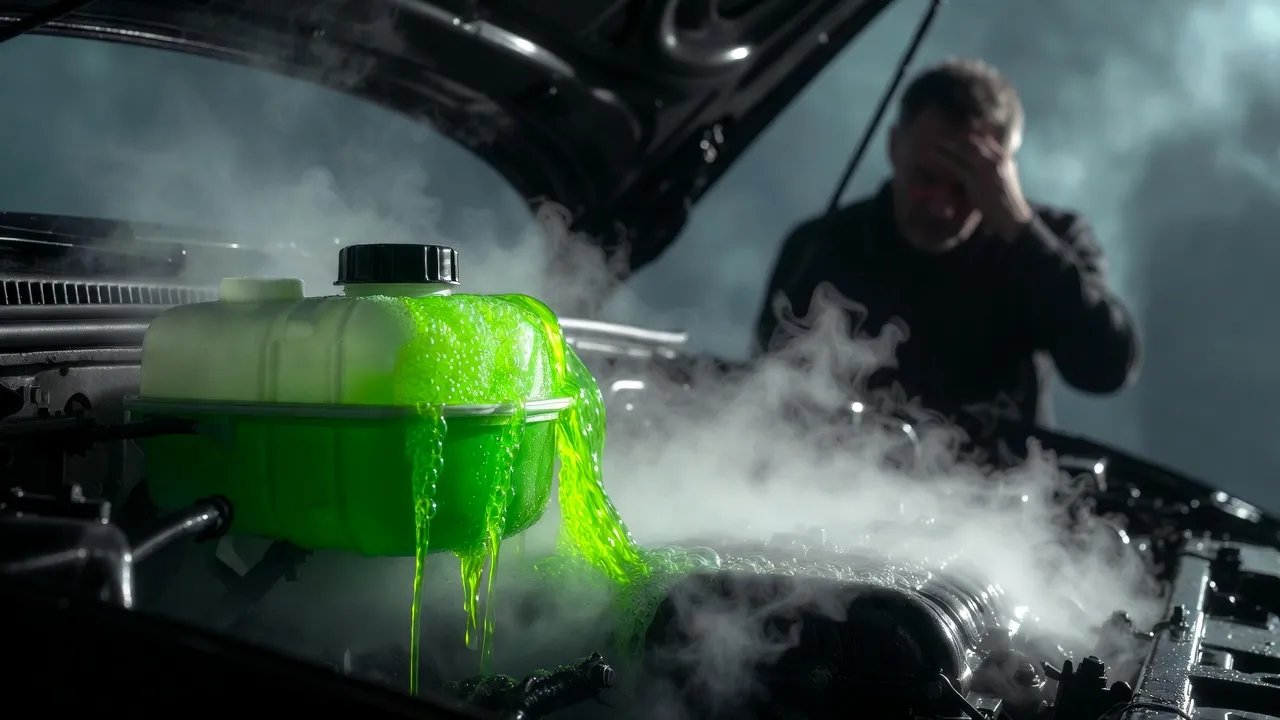
Quick Summary: Overfilling coolant can cause excess pressure in the cooling system, leading to coolant overflow, damage to hoses and seals, potential engine overheating, and fluid leaks. While a slight overfill above the maximum line typically expels itself harmlessly, significant overfilling creates unnecessary stress on system components and should be corrected by draining to the proper level.
When topping off engine fluids, it’s tempting to add a little extra—especially when it comes to coolant. After all, more protection should mean better engine performance, right?
Not exactly.
Overfilling the coolant reservoir can trigger a cascade of problems that range from minor annoyances to potentially costly repairs. Understanding how the cooling system works and what happens when that delicate balance gets disrupted is essential for preventing damage.
How the Cooling System Works
Before diving into what goes wrong with too much coolant, it’s worth understanding how the system is designed to function.
The coolant tank, also known as the coolant overflow bottle or expansion tank, plays a critical role in managing fluid levels as temperatures fluctuate. When the engine heats up during operation, coolant expands. The system is designed to accommodate this expansion by allowing excess fluid to flow into the reservoir.
As the engine cools down, that fluid gets drawn back into the main cooling system. This constant expansion and contraction is why reservoirs have clearly marked minimum and maximum lines—the level should sit between these markers when the engine is cold.
The cooling system operates under pressure, which raises the boiling point of coolant and allows it to absorb more heat without turning to steam. According to federal safety data, over 100,000 radiator cap scald incidents occur annually in the U.S., with over 20,000 victims requiring treatment at hospital emergency rooms and burn care facilities—a reminder that these systems hold serious pressure and heat.
What Happens When You Overfill the Reservoir
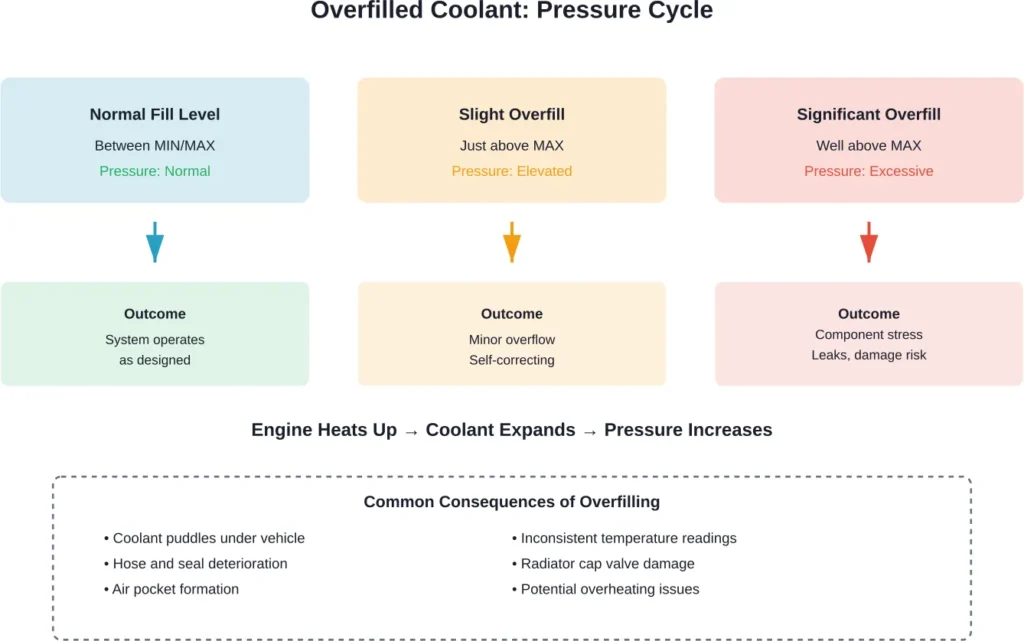
Here’s the thing though—when coolant is added well above the maximum line, the system has nowhere for expanding fluid to go.
The immediate consequence is overflow. As the engine heats up and coolant expands, excess fluid gets pushed out through the reservoir cap or overflow valve. This creates visible puddles under the vehicle and wastes coolant that needs replacement.
But overflow is just the start.
Excess Pressure on System Components
Overfilling creates additional pressure throughout the cooling system. Hoses, seals, gaskets, and connections that are designed to handle normal operating pressure suddenly face stress beyond their design parameters.
This excess pressure can cause:
- Hose ruptures or bulging at weak points
- Seal degradation and premature failure
- Gasket leaks around the radiator or water pump
- Damage to the radiator cap pressure valve
- Stress on the expansion tank itself, potentially causing cracks
While modern cooling systems are built with safety margins, consistently overfilling removes that buffer and accelerates wear on every component.
Potential for Air Pockets and Overheating
Counterintuitively, too much coolant can actually contribute to overheating issues.
When the system is overfilled, the constant overflow and refilling cycle can introduce air pockets into the cooling system. These air bubbles disrupt proper coolant circulation and create hot spots where fluid can’t reach to absorb heat effectively.
Air trapped in the system prevents the thermostat from opening at the correct temperature, throws off temperature sensor readings, and reduces the overall heat transfer efficiency. In worst-case scenarios, this can cause an engine to seize—requiring complete replacement.
Fluid Contamination Risks
When coolant overflows from the reservoir, it often spills onto engine components, belts, and other parts under the hood. This creates multiple problems beyond just the mess.
Coolant is slippery and can cause belt slippage if it contacts serpentine or accessory belts. It’s also corrosive to certain materials and can degrade rubber components over time.
More seriously, if coolant leaks into areas where it shouldn’t be—like through a compromised head gasket stressed by excess pressure—it can contaminate the engine oil. This creates the characteristic milky oil appearance, which according to automotive training sources such as Universal Technical Institute, indicates serious engine problems requiring immediate attention.
How Much Overfill Actually Causes Problems?
Real talk: not all overfills are created equal.
A slight overfill—maybe a quarter inch above the maximum line—typically isn’t catastrophic. The system will usually expel the excess through normal overflow mechanisms during the first heat cycle, and levels will self-correct.
But here’s where it gets tricky. User experiences shared in automotive forums reveal that significant overfills, where the reservoir is filled to the brim or even into the overflow tube, create immediate problems. Some users report dealers overfilling by several inches, which causes persistent overflow and requires correction.
The key factor is how much expansion room remains. Coolant can expand by roughly 5-10% when heated. If the reservoir is already at or above maximum when cold, that expansion has nowhere to go except out.
How to Check and Correct an Overfill
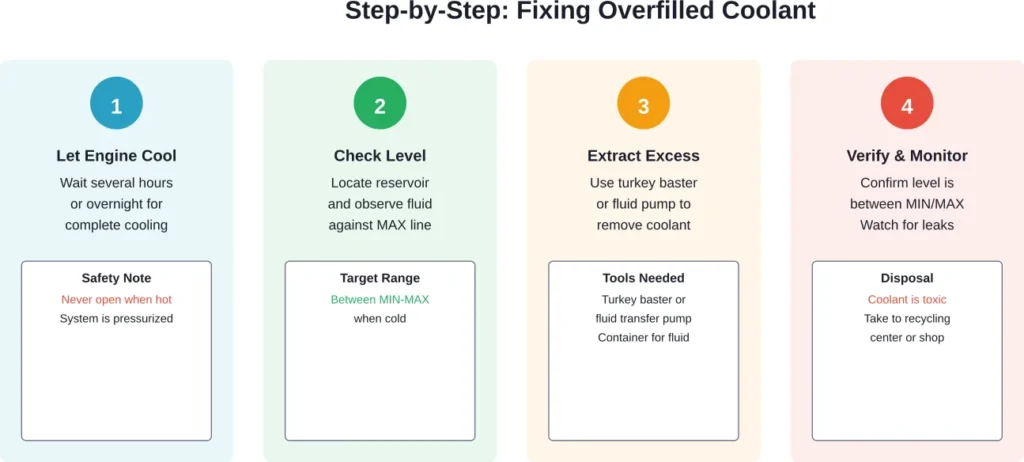
Checking coolant levels properly is straightforward but requires attention to a critical detail: the engine must be cold.
Checking coolant when the engine is hot gives a false reading because the fluid has already expanded. It’s also dangerous—opening a hot cooling system can result in pressurized coolant spray that causes severe burns.
Proper Checking Procedure
Allow the engine to cool completely, preferably after sitting overnight. Locate the coolant reservoir—typically a translucent plastic tank near the radiator with MIN and MAX markings.
Observe where the fluid level sits relative to these markers. On a cold engine, the level should be at or slightly above the MIN line, never above the MAX line.
Correcting Excess Coolant
If the reservoir is overfilled, correction involves removing excess fluid to bring levels into the proper range.
The simplest method for minor overfills is using a turkey baster, fluid transfer pump, or even a clean syringe to extract coolant from the reservoir. Remove fluid gradually until the level sits between the MIN and MAX markers.
For significant overfills where coolant has already circulated through the entire system, it may be necessary to drain from a lower point—either the radiator drain valve or a cooling system hose. This requires more mechanical knowledge and proper disposal of extracted coolant, as it’s toxic and must be recycled appropriately.
After correcting levels, monitor for several days to ensure the system stabilizes and no leaks have developed from the previous overfill pressure.
Common Causes of Coolant Overfilling
Understanding how overfilling happens in the first place helps prevent repeat occurrences.
The most common cause is simply topping off when the engine is hot. When coolant is already expanded from heat, adding fluid to bring it up to the MAX line means it’ll be well over that mark once everything cools down.
Another frequent culprit is misunderstanding the fill location. Some vehicles have both a radiator cap and a separate overflow reservoir. Filling the wrong location or filling both when only the reservoir needs topping creates excess fluid in the system.
Service centers and dealerships occasionally overfill during routine maintenance, either from inattention or misunderstanding the specific vehicle’s requirements. User experiences shared in automotive forums describe finding reservoirs filled to capacity after dealer service—well beyond the maximum marker.
Too Much Coolant vs. Too Little: Finding the Balance
While overfilling gets less attention than running low on coolant, both extremes cause problems.
Insufficient coolant is more immediately dangerous. When coolant levels drop too low, there isn’t enough fluid to absorb and transfer heat away from the engine. This leads directly to overheating, which can warp cylinder heads, blow head gaskets, or cause complete engine seizure.
But excess coolant creates its own set of complications through the pressure and overflow issues already discussed. The sweet spot is maintaining levels in that designated range between minimum and maximum markers.
| Condition | Primary Risk | Symptoms | Urgency |
|---|---|---|---|
| Too Low | Engine overheating | Temperature gauge rises, steam from hood, loss of power | Critical – stop driving immediately |
| Proper Level | None | Normal operation, stable temps | Maintain through regular checks |
| Slight Overfill | Minor overflow | Small puddles under vehicle after driving | Low – self-corrects or easy fix |
| Significant Overfill | System pressure damage | Persistent leaks, hose bulging, coolant spraying | Moderate – correct soon to prevent damage |
Preventing Coolant System Issues
Maintenance beats repair every time. A few simple habits keep the cooling system operating within design parameters and catch problems before they escalate.
Check coolant levels monthly when the engine is cold. This takes less than a minute and provides early warning of leaks or consumption issues. The level shouldn’t drop noticeably between checks—if it does, there’s a leak somewhere that needs diagnosis.
Use the correct coolant type specified in the owner’s manual. Different formulations aren’t always compatible, and mixing types can cause corrosion or reduced effectiveness. Modern vehicles often use extended-life coolants that last 150,000 miles, but traditional green coolant typically requires replacement every 30,000 miles or two years.
Inspect hoses and connections during routine service. Bulging hoses, soft spots, cracks, or visible corrosion indicate components nearing failure. Replacing a worn hose costs relatively little compared to the damage from a catastrophic cooling system failure.
Pay attention to temperature gauge behavior. If the gauge starts running hotter than normal, fluctuates erratically, or climbs toward the red zone, investigate immediately. These symptoms often precede major failures.
When Professional Service Is Needed
While correcting a simple overfill is straightforward, certain symptoms indicate deeper problems requiring professional diagnosis.
Persistent coolant loss with no visible leaks suggests internal consumption—possibly through a head gasket breach or cracked cylinder head. This requires pressure testing and potentially engine disassembly to diagnose properly.
If the engine overheats despite proper coolant levels, the problem might be a failed thermostat, clogged radiator, malfunctioning water pump, or air pockets in the system. These issues need systematic diagnosis with proper equipment.
Milky oil appearance, white exhaust smoke, or coolant that smells like exhaust gases all point to serious head gasket or engine block problems. These require immediate professional attention before catastrophic damage occurs.
Recent industry data shows collision repair costs nationwide averaged $4,667 in 2024, with complexity increasing due to advanced vehicle technology. While cooling system repairs typically cost less than collision work, catching problems early prevents expenses from escalating into that range.
Frequently Asked Questions
For minor overfills just above the maximum line, the system will typically expel excess fluid during the first heat cycle and self-correct. However, significant overfills should be corrected to prevent unnecessary pressure on seals, hoses, and other components. The few minutes needed to extract excess fluid prevents potential damage and persistent overflow issues.
Check the reservoir when the engine is completely cold. If fluid sits above the MAX marker, it’s overfilled. Other indicators include coolant puddles under the vehicle after driving, visible overflow from the reservoir cap, or coolant spraying onto engine components. Always check levels cold—hot coolant gives a false high reading due to thermal expansion.
Moderate overfilling won’t immediately damage the engine itself, but creates conditions that can lead to problems. Excess pressure can rupture hoses, damage seals, and stress gaskets. If these failures allow coolant to leak into the oil or create air pockets in the cooling system, overheating can result, which does cause engine damage. The risk escalates with the severity and duration of the overfill.
Coolant typically expands 5-10% when heated from ambient temperature to normal operating temperature. This is why reservoirs have a range between MIN and MAX markers rather than a single fill line. When cold, coolant should sit at or slightly above MIN. As it heats, it rises toward MAX, with the system designed to accommodate this expansion without overflow.
Overfilling alone doesn’t directly cause white exhaust smoke. However, if excess coolant creates pressure that damages a head gasket or other seal, coolant can leak into the combustion chamber. When coolant burns in the cylinders, it produces characteristic white smoke with a sweet smell. White smoke indicates a serious problem requiring immediate professional diagnosis.
Never pour coolant down drains or onto the ground—it’s toxic to humans, animals, and the environment. Collect extracted coolant in a sealed container and take it to an automotive shop, recycling center, or hazardous waste facility that accepts antifreeze. Many auto parts stores and quick-lube shops accept used coolant for recycling at no charge.
In a healthy cooling system, the level should remain stable between monthly checks. Minor fluctuation within the MIN-MAX range as ambient temperatures change is normal. However, consistent dropping levels indicate a leak—either external (visible puddles) or internal (consumption through a head gasket breach). Any noticeable loss between checks warrants investigation to identify and repair the source.
Conclusion: Maintaining the Balance
The cooling system operates on precise engineering that balances fluid volume, pressure, and temperature management. Overfilling disrupts this balance, creating excess pressure that stresses components and can lead to leaks, damage, and even overheating.
While a slight overfill above the maximum line typically self-corrects through normal overflow, significant overfilling requires prompt correction to prevent unnecessary wear on the system. The fix is straightforward—extract excess fluid until levels return to the proper range between MIN and MAX markers when the engine is cold.
Regular monitoring, using the correct coolant type, and checking levels when cold prevents both overfilling and underfilling. These simple maintenance habits keep the cooling system operating as designed and catch developing problems before they escalate into costly repairs.
If coolant levels drop consistently, leaks persist after correction, or overheating symptoms develop, professional diagnosis becomes necessary. The cooling system is too critical to engine survival to ignore warning signs.
Take a moment this week to check your coolant reservoir when the engine is cold. That quick visual check might prevent problems down the road.