

Quick Summary: Stopping creatine supplementation leads to a gradual decline in muscle creatine stores over 4-6 weeks, potentially resulting in modest reductions in strength, power output, and water weight. However, research shows muscle mass gains achieved through training are largely retained, and the body returns to producing creatine naturally without adverse health effects.
Creatine has become one of the most widely used supplements in fitness circles, backed by decades of research showing its effectiveness for strength and performance. But what actually happens when someone stops taking it?
The concern makes sense. After experiencing noticeable gains in the gym, there’s a natural worry that stopping supplementation might erase that progress. The reality, according to medical research, is more nuanced than many expect.
Understanding Creatine’s Role in the Body
Creatine is an amino acid compound that the body produces naturally in the liver, kidneys, and pancreas from the amino acids methionine, glycine, and arginine. According to the National Institutes of Health, approximately 95% of the body’s creatine is stored in skeletal muscle, with the remaining amount found in the brain, heart, and other tissues.
The primary dietary sources include red meat, fish, and poultry. A typical diet provides about 1 to 2 grams of creatine daily, according to Mayo Clinic data.
Creatine’s role in energy metabolism involves the transfer of phosphoryl groups from phosphorylcreatine to adenosine diphosphate (ADP) to regenerate adenosine triphosphate (ATP). This reversible reaction, catalyzed by creatine kinase, is fundamental for rapid energy production during high-intensity activities.
Supplementation increases intramuscular creatine concentrations beyond what diet alone can achieve, which explains the performance improvements athletes experience.
The Timeline: What Happens After Stopping Creatine
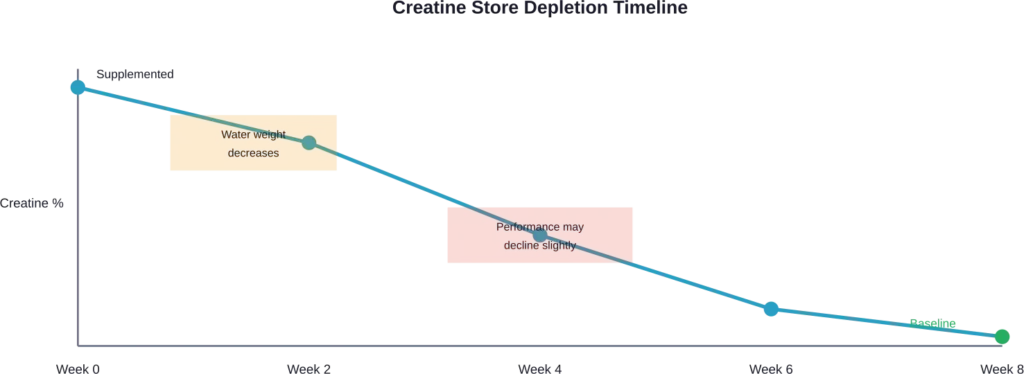
When creatine supplementation stops, the body doesn’t immediately lose all stored creatine. The decline follows a predictable timeline.
Week 1-2: Initial Water Weight Changes
The most immediate effect involves water retention. Creatine pulls water into muscle cells, contributing to increased cell volume. When supplementation ceases, this intracellular water gradually decreases.
Many people notice a modest drop in body weight during this period, typically ranging from 2-4 pounds. This isn’t muscle loss—it’s simply water redistribution.
Performance in the gym might remain relatively unchanged during this initial phase since muscle creatine stores don’t deplete instantly.
Week 3-6: Creatine Stores Decline
Research published in PubMed examining the effects of ceasing creatine supplementation found that muscle creatine levels gradually return to baseline over approximately 4-6 weeks. This timeline varies based on individual factors like muscle mass, diet, and training intensity.
During this phase, some athletes notice subtle changes in their ability to perform maximal effort activities, particularly those requiring explosive power or repeated high-intensity efforts.
Strength levels may experience a modest decline, but research indicates this decrease is typically smaller than many expect.
Effects on Muscle Mass and Strength
Here’s where common misconceptions need clarification. Research examining the cessation of creatine supplementation while maintaining resistance training provides reassuring data.
Research examining the effect of ceasing creatine supplementation while maintaining reduced training found that older men who combined creatine with 12 weeks of resistance training enhanced muscle strength and endurance and lean tissue mass, with these variables assessed during cessation of creatine combined with reduced training. The key factor? Continued training stimulus.
Muscle mass built during a training program doesn’t simply disappear when creatine supplementation stops. The actual muscle tissue gained through progressive overload and adequate protein intake remains, assuming training continues.
What may decrease:
- Maximal power output during explosive movements
- Performance in repeated high-intensity efforts with short rest periods
- Total training volume capacity in some individuals
- Muscle cell water content (which contributes to the “fuller” muscle appearance)
What typically doesn’t decrease significantly:
- Actual muscle tissue mass from hypertrophy
- Base strength levels (though peak performance might drop slightly)
- Endurance performance in moderate-intensity activities
Performance Changes to Expect
The International Society of Sports Nutrition notes that creatine supplementation consistently shows improvements in high-intensity exercise performance. When supplementation stops, these performance enhancements gradually diminish.
Athletes engaged in sports requiring repeated sprints, explosive movements, or maximal strength efforts may notice the most significant changes. Endurance athletes, on the other hand, typically experience minimal performance differences.
| Performance Aspect | Expected Change | Timeline |
|---|---|---|
| Water Weight | 2-4 pound decrease | 1-2 weeks |
| Maximal Power | 5-10% reduction | 3-4 weeks |
| Muscle Mass | Minimal change with training | Maintained |
| Endurance | Little to no change | N/A |
| Recovery | Slightly slower between sets | 2-4 weeks |
Natural Creatine Production Resumes
An important consideration: the body doesn’t “forget” how to produce creatine. Research indicates that endogenous creatine synthesis by the liver, kidneys, and pancreas continues, with the body producing approximately 1 to 3 grams of creatine daily to maintain usual creatine stores.
When supplementation stops, natural production returns to normal levels. The liver, kidneys, and pancreas resume synthesizing the body’s baseline creatine needs without issue.
This means there’s no physiological dependence or withdrawal syndrome associated with stopping creatine. The body simply returns to its natural state of creatine metabolism.
Should You Cycle Creatine?
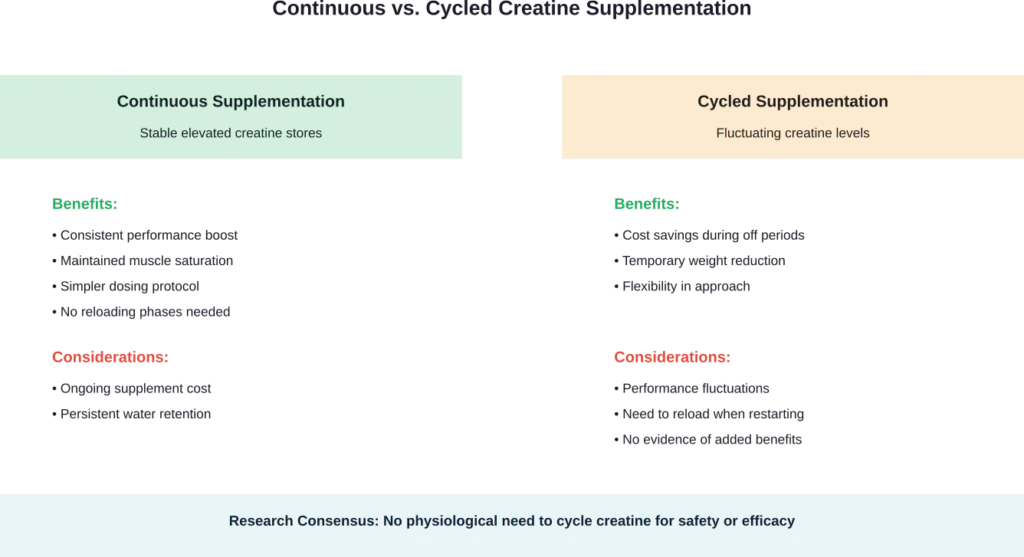
Community discussions often debate whether cycling creatine (taking breaks from supplementation) provides benefits. The scientific evidence doesn’t strongly support cycling for health or effectiveness reasons.
The International Society of Sports Nutrition position stand notes that long-term supplementation appears safe in healthy populations and research shows creatine supplementation maintains elevated muscle creatine stores. Cycling creatine is not supported by current evidence as a necessity for healthy individuals.
Reasons someone might stop taking creatine:
- Financial considerations
- Transitioning to different training goals that don’t emphasize maximal power
- Personal preference for achieving results without supplementation
- Preparing for weight-class competitions where water weight matters
None of these reasons involve medical necessity for cycling in healthy individuals.
Safety Considerations When Stopping
According to Cleveland Clinic and Mayo Clinic data, creatine supplementation has an excellent safety profile when used appropriately. Stopping supplementation doesn’t create adverse health effects.
There’s no evidence of:
- Withdrawal symptoms
- Rebound effects
- Hormonal disruptions
- Kidney or liver damage from cessation
The transition back to baseline creatine levels occurs naturally without medical intervention or specific protocols.
For individuals with pre-existing kidney conditions, consultation with healthcare providers about creatine supplementation—both starting and stopping—remains advisable, though current research shows creatine doesn’t harm healthy kidneys.
Making the Decision: Continue or Stop?
The choice to continue or stop creatine supplementation depends on individual goals, budget, and training priorities.
Strong reasons to continue:
- Training emphasizes maximal strength or power output
- Participating in sports requiring explosive efforts
- Wanting to maintain every possible performance advantage
- Research published in peer-reviewed sources indicates potential cognitive and neuroprotective applications of creatine, though these benefits remain areas of ongoing investigation
Valid reasons to stop:
- Shifting to endurance-focused training where creatine provides minimal benefit
- Wanting to reduce supplement expenses
- Preferring a minimalist supplement approach
- Competing in weight-class sports where water weight matters
Neither choice is inherently superior—both can support training goals depending on context.
Frequently Asked Questions
No, actual muscle tissue gained through training and proper nutrition will be retained. What decreases is primarily water weight and muscle cell volumization. Research shows that with continued training, lean tissue mass remains largely unchanged after stopping creatine supplementation.
Muscle creatine stores gradually return to baseline levels over approximately 4-6 weeks after stopping supplementation. The exact timeline varies based on individual factors including muscle mass, dietary creatine intake from food, and training intensity.
There’s no need to taper creatine. Stopping immediately causes no adverse effects. The body naturally transitions back to baseline creatine production and muscle stores decline gradually on their own.
Most people experience modest decreases in maximal power output and performance in repeated high-intensity efforts, typically in the range of 5-10%. Base strength levels often remain relatively stable, especially with consistent training. The decline is generally less dramatic than many athletes expect.
Absolutely. Creatine can be stopped and restarted at any time without safety concerns. When restarting, muscle creatine stores will re-saturate over several weeks with consistent supplementation, either through a loading phase or daily maintenance dosing.
No. Natural creatine synthesis by the liver, kidneys, and pancreas returns to normal levels after supplementation stops. There’s no evidence of long-term suppression of endogenous creatine production.
The initial weight loss after stopping creatine is primarily water, not fat or muscle. Creatine increases intracellular water retention in muscles. When supplementation stops, this water is released, typically resulting in a 2-4 pound decrease in body weight within the first couple of weeks.
Conclusion
Stopping creatine supplementation triggers a gradual return to baseline physiological states without adverse health consequences. Muscle creatine stores decline over 4-6 weeks, potentially leading to modest performance reductions in maximal power activities and some water weight loss.
But the muscle mass built through consistent training? That stays. The strength developed through progressive overload? Largely maintained.
The decision to continue or stop creatine ultimately comes down to individual training goals, performance priorities, and personal preferences. Research from authoritative sources like the National Institutes of Health and International Society of Sports Nutrition confirms that both approaches—continuous supplementation and periodic cessation—are safe and viable.
Ready to make an informed decision about supplementation strategy? Evaluate current training goals, consider the modest performance trade-offs, and choose the approach that best aligns with fitness objectives.