

Quick Summary: Structural engineering is a specialized branch of civil engineering focused on designing, analyzing, and ensuring the safety of structures like buildings, bridges, and stadiums. Structural engineers apply principles of physics, mathematics, and materials science to create infrastructure that can withstand loads, environmental forces, and time. Their work spans from initial concept through construction, ensuring every beam, column, and foundation meets rigorous safety standards.
Imagine walking across a bridge suspended hundreds of feet above a river, confident it won’t collapse beneath you. Or entering a skyscraper that sways gently in hurricane-force winds but remains perfectly safe. That confidence exists because of structural engineering—the discipline that transforms architectural visions into safe, enduring realities.
Structural engineering is more than calculations, codes, and concrete. It’s the art and science of turning ideas into infrastructure that serves communities for generations. But what exactly do structural engineers do, and how does their work differ from other engineering disciplines?
Let’s break down everything you need to know about this critical field.
Understanding Structural Engineering: The Foundation
Structural engineering is a branch of civil engineering that focuses specifically on the design and analysis of structures that enclose or span across space. These structures include buildings, bridges, offshore platforms, amusement park rides, stadiums, and even space stations.
The core responsibility is ensuring that structures can safely support and resist the loads they’ll encounter throughout their lifetime. That means accounting for gravity, wind, earthquakes, snow, traffic, and countless other forces.
According to the American Society of Civil Engineers, civil engineers—including structural specialists—have a leading role in planning, designing, building, and ensuring a sustainable future by providing the bridge between science and society. Structural engineers take that mission and apply it to the physical frameworks that hold our world together.
The Science Behind the Structure
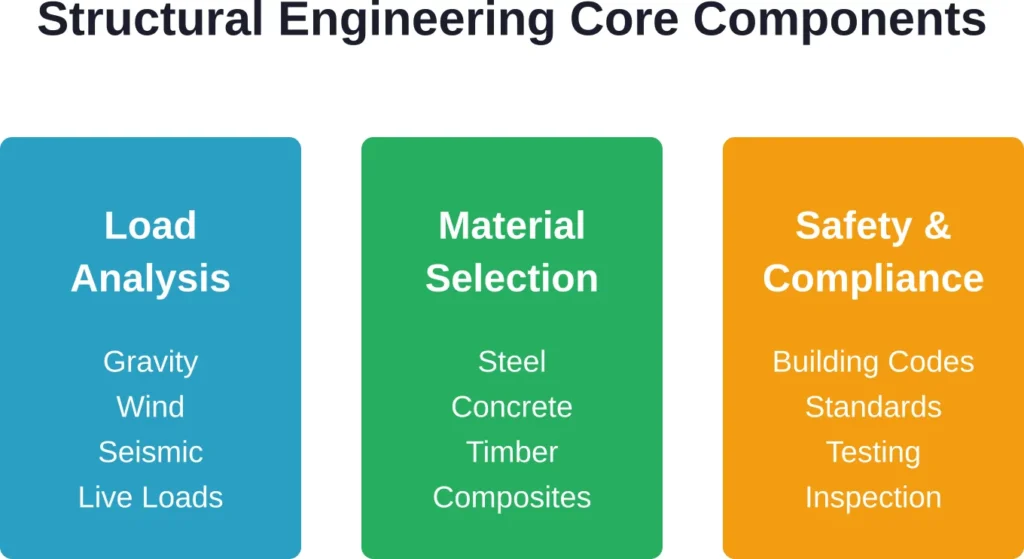
Every structural engineering project starts with fundamental principles from physics and mathematics. Engineers calculate loads, analyze stress distributions, and determine how materials will behave under various conditions.
They work with diverse materials—steel, concrete, timber, masonry, and increasingly, advanced composites. Each material has unique properties: strength, flexibility, durability, and cost. Choosing the right combination for a specific application requires deep technical knowledge.
The work goes beyond selecting materials, though. Structural engineers must understand how these materials interact within a complete system. A beam doesn’t exist in isolation—it connects to columns, which rest on foundations, which transfer loads into the earth.
What Do Structural Engineers Actually Do?
The day-to-day work of structural engineers varies dramatically depending on their specialization and project phase. But some core responsibilities remain consistent across the profession.
Design and Analysis
Structural engineers create detailed plans for how structures will be built. They determine the size and placement of every structural element—beams, columns, walls, foundations, and connections.
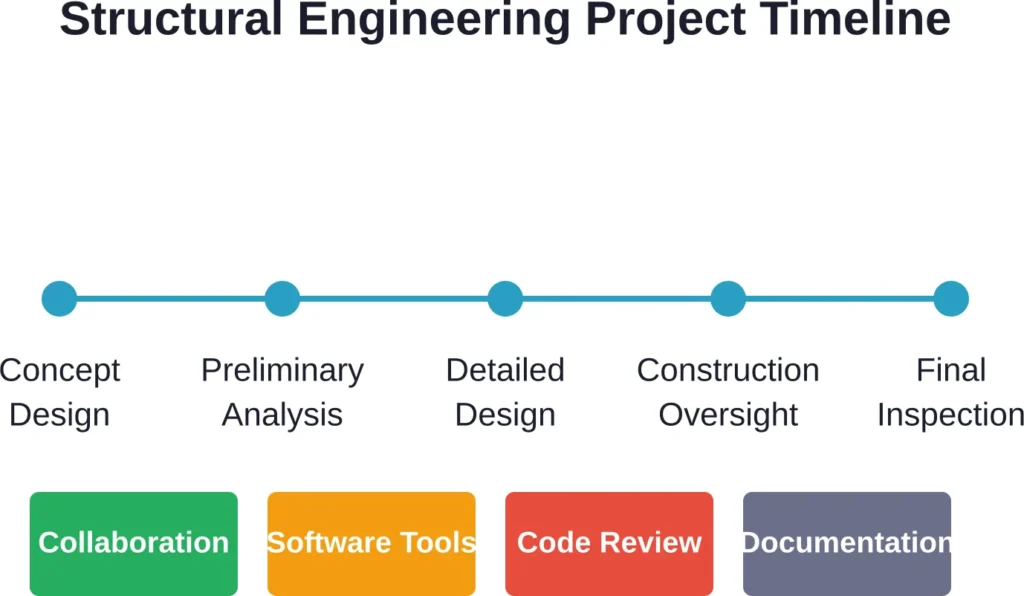
Modern structural engineers rely heavily on specialized software. Industry-specific tools like AutoCAD, Revit, and SAP2000 have become essential skills for professionals in the field. These programs allow engineers to model complex structures, run simulations, and optimize designs before construction begins.
The analysis phase involves calculating how structures will respond to various scenarios. What happens during an earthquake? How does the building handle strong winds? Will the foundation settle unevenly over time?
Collaboration and Coordination
Structural engineers don’t work in isolation. They collaborate constantly with architects, construction managers, contractors, and other engineering specialists.
Architects create the vision—the aesthetics, functionality, and user experience. Structural engineers make that vision structurally sound. This partnership requires compromise, creativity, and clear communication.
During construction, structural engineers review plans, visit job sites, and verify that work matches specifications. They catch problems early, before they become expensive or dangerous.
Inspection and Assessment
Not all structural engineering involves new construction. Many engineers specialize in evaluating existing structures—assessing damage, planning renovations, or determining if old buildings meet current safety standards.
After natural disasters, structural engineers perform reconnaissance, documenting damage patterns and gathering data that improves future designs. This work directly contributes to making communities safer and more resilient.
Where Structural Engineers Work
The career paths for structural engineers are remarkably diverse. Some work in consulting firms, designing projects for various clients. Others join construction companies, focusing on implementation and project delivery.
Government agencies employ structural engineers to develop building codes, inspect public infrastructure, and manage transportation systems. Academic institutions need engineers for research and education—structural engineering programs at major universities enroll hundreds of undergraduate and graduate students annually.
Structural engineering programs award bachelor’s, master’s, and doctoral degrees annually, demonstrating the field’s robust pipeline of new professionals.
Some engineers focus on niche areas: offshore oil platforms, amusement park rides, stadium design, or even space structures. Each specialization requires unique expertise and presents distinct challenges.
| Work Environment | Typical Activities | Project Types |
|---|---|---|
| Consulting Firms | Design, analysis, client meetings | Commercial buildings, residential, industrial |
| Construction Companies | Site visits, coordination, problem-solving | Implementation of large projects |
| Government Agencies | Code development, inspection, infrastructure | Bridges, highways, public buildings |
| Research & Academia | Teaching, experimentation, publication | Advanced materials, innovative methods |
Structural Engineering vs. Architecture: Clearing Up the Confusion
People often confuse structural engineers with architects. Both work on buildings, both review blueprints, and both visit construction sites. But their roles are fundamentally different.
Architects focus on the overall design concept—appearance, functionality, space planning, and user experience. They consider how people will move through and use a building. They select finishes, plan layouts, and create the aesthetic vision.
Structural engineers focus on making that vision stand up safely. They’re not primarily concerned with aesthetics, though good structural solutions can certainly be elegant. Their priority is ensuring the structure won’t collapse, excessive deflection won’t crack finishes, and occupants remain safe during emergencies.
Think of it this way: architects design what you see; structural engineers design what holds up what you see.
The relationship works best when both professionals respect each other’s expertise and collaborate from the earliest design stages. Late-stage structural changes can compromise architectural intent or blow budgets—early coordination prevents those conflicts.
Structural Engineering and Civil Engineering: Understanding the Relationship
Structural engineering is a specialized branch within the broader field of civil engineering. Civil engineers work on infrastructure projects of all types—transportation systems, water treatment facilities, environmental remediation, and yes, structures.
All structural engineers have civil engineering education as their foundation. But not all civil engineers specialize in structures. Other civil engineering specializations include geotechnical engineering (soil and foundations), transportation engineering (roads and transit systems), environmental engineering (water and waste), and construction management.
The distinction matters when hiring professionals. A general civil engineer might not have the specialized knowledge needed for complex structural analysis. For projects requiring detailed structural design—especially in seismic zones or for unusual building types—a licensed structural engineer is essential.

Essential Skills for Structural Engineers
Becoming an effective structural engineer requires a specific skill set that combines technical expertise with practical problem-solving abilities.
Technical Knowledge
Strong foundations in mathematics and physics are non-negotiable. Structural engineers apply calculus, differential equations, and statistics daily. They must understand mechanics, material science, and structural theory at an advanced level.
Knowledge of building codes and standards is equally critical. These regulations codify lessons learned from decades of research and real-world performance. Engineers must stay current as codes evolve to address new materials, construction methods, and environmental concerns.
Software Proficiency
Modern structural engineering is software-intensive. Proficiency in AutoCAD for drafting, Revit for building information modeling, and SAP2000 for structural analysis has become standard across the industry.
But software is a tool, not a substitute for engineering judgment. Engineers must understand the assumptions behind their models and recognize when results don’t make physical sense. Computers can calculate quickly—they can’t think critically.
Communication and Collaboration
Technical skills alone don’t make a successful structural engineer. The ability to explain complex concepts to non-engineers matters tremendously.
Engineers must write clear reports, present findings persuasively, and negotiate solutions when constraints conflict. They work with diverse teams where not everyone speaks the language of statics and dynamics.
Project success often hinges on how well the structural engineer communicates limitations, alternatives, and risks to stakeholders who need to make informed decisions.
The Path to Becoming a Structural Engineer
The typical path starts with a bachelor’s degree in civil engineering or structural engineering. Many engineers pursue master’s degrees to specialize further and deepen their expertise.
Licensure is essential for independent practice. In the United States, that means passing the Fundamentals of Engineering exam, gaining several years of supervised experience, and then passing the Professional Engineering exam.
Some states offer a separate Structural Engineering license with additional requirements. California, for example, requires passing two more rigorous exams focused specifically on structural design and analysis.
Continuing education doesn’t stop after licensure. Building codes update regularly, new materials enter the market, and research reveals better design approaches. Successful engineers commit to lifelong learning.
Structural Engineering’s Impact on Sustainability
The American Society of Civil Engineers defines sustainability as a set of environmental, social, and economic conditions in which all of society has the capacity and opportunity to maintain and improve quality of life indefinitely.
Structural engineers play a direct role in achieving that vision. The buildings and infrastructure they design consume enormous resources and energy over their lifetimes.
Sustainable structural engineering means optimizing material use, designing for long service life, considering life-cycle environmental impacts, and enabling future adaptability. It means choosing materials with lower carbon footprints, designing for deconstruction and reuse, and incorporating renewable energy systems.
Structures must also withstand increasingly severe climate impacts—more intense storms, rising sea levels, and extreme temperature swings. Resilient design protects both people and the environmental investments in our built infrastructure.
Emerging Trends in Structural Engineering
The field continues evolving as technology advances and societal needs change.
Advanced Materials
Engineers are working with ultra-high-performance concrete, fiber-reinforced polymers, and engineered timber products that offer strength-to-weight ratios impossible with traditional materials. These innovations enable longer spans, lighter structures, and more sustainable designs.
Digital Integration
Building Information Modeling connects structural engineers with entire project teams in shared digital environments. Cloud computing enables real-time collaboration across continents. Artificial intelligence assists with optimization and pattern recognition in complex systems.
The cloud is bringing particular benefits to structural engineering: enhanced collaboration across distributed teams, powerful computational capacity for complex analyses, centralized data management that reduces errors, and improved version control for construction documents.
Performance-Based Design
Rather than simply meeting prescriptive code requirements, engineers increasingly use performance-based approaches that define acceptable outcomes and then design systems to achieve them. This method enables innovation while maintaining or improving safety.
Get Structural Engineering Support for Design and Construction

Structural engineering helps ensure building stability, constructability, and coordination throughout project delivery. Powerkh supports structural teams with BIM modelling, technical coordination, detailing, and constructability review services.
Need Structural Engineering Support?
Talk with Powerkh to:
- support structural BIM coordination
- prepare technical drawings and documentation
- review constructability and coordination risks
- improve continuity between design and construction
Talk with Powerkh about structural BIM and coordination support.
Why Structural Engineers Matter
Here’s the thing: most people don’t think about structural engineering until something goes wrong. We take for granted that buildings will stand, bridges won’t fall, and stadiums won’t collapse during crowded events.
That unnoticed reliability represents countless hours of careful analysis, rigorous calculation, and thoughtful design. Structural engineers work largely in the background, ensuring safety that society depends on but rarely acknowledges.
After earthquakes, hurricanes, or structural failures, engineers study what happened and why. They document damage patterns, analyze failure modes, and publish findings that inform better codes and practices. This feedback loop continuously improves structural safety worldwide.
The work matters profoundly. Inadequate structural design costs lives—in building collapses, bridge failures, and infrastructure disasters. Proper structural engineering prevents those tragedies.
Frequently Asked Questions
Structural engineering is a specialized branch within civil engineering. All structural engineers are civil engineers, but not all civil engineers specialize in structures. Civil engineering covers transportation, water resources, environmental systems, and construction management, while structural engineering focuses specifically on designing and analyzing buildings, bridges, and other structures.
That depends on the renovation scope. If it involves removing or modifying load-bearing walls, adding significant weight, or altering the foundation, a structural engineer should evaluate the changes. Many jurisdictions require stamped structural drawings for permits when work affects the structural system. Consulting an engineer early prevents costly mistakes and ensures safety.
Industry-standard software includes AutoCAD for drafting, Revit for building information modeling, and SAP2000 for structural analysis and design. Other common programs include ETABS for building analysis, SAFE for foundation design, and STAAD.Pro for general structural engineering. Most engineers use multiple programs depending on project type and complexity.
The typical path includes a four-year bachelor’s degree in civil or structural engineering, then several years of supervised work experience before taking the Professional Engineering exam. Many engineers complete a master’s degree during this period. From starting undergraduate study to obtaining licensure typically takes 8-10 years. Some states offer additional Structural Engineering licenses requiring further examinations.
In seismic regions, structural engineers design buildings and infrastructure to withstand earthquake forces through ductile detailing, energy dissipation systems, base isolation, and performance-based design. They conduct detailed analyses modeling how structures will respond during ground shaking. After earthquakes, they assess damage and help communities rebuild more resilient infrastructure.
Absolutely. Structural engineers specializing in historic preservation assess existing conditions, design repairs that maintain historical integrity, and develop seismic retrofits for older buildings. This work requires understanding both modern engineering principles and historical construction methods. It demands creativity in strengthening structures while preserving their character and meeting current safety standards.
Career options include design engineering at consulting firms, construction engineering with contractors, government work developing codes and inspecting infrastructure, research and teaching at universities, forensic engineering investigating failures, and specialty areas like offshore structures, bridge engineering, stadium design, or tall building design. Many engineers move between these areas throughout their careers.
Conclusion: Building a Safer World
Structural engineering stands at the intersection of science, creativity, and social responsibility. It requires technical mastery, collaborative skills, and a commitment to protecting public safety.
The field offers intellectually challenging work with tangible real-world impact. Every project presents unique constraints and opportunities. Every design represents a solution to a complex puzzle with multiple competing requirements.
And the demand continues growing. Aging infrastructure needs replacement, climate change demands more resilient designs, and populations need safe housing and transportation. Structural engineers will remain essential to building sustainable, safe communities.
Whether designing a soaring skyscraper, analyzing a historic bridge, or developing next-generation materials, structural engineers shape the physical world we inhabit. Their work, though often invisible, provides the literal foundation for modern society.
Interested in learning more about structural engineering or considering it as a career? Explore accredited engineering programs, connect with professional organizations like the American Society of Civil Engineers, and consider shadowing practicing engineers to see the profession firsthand. The built environment needs skilled, dedicated professionals ready to take on tomorrow’s challenges.